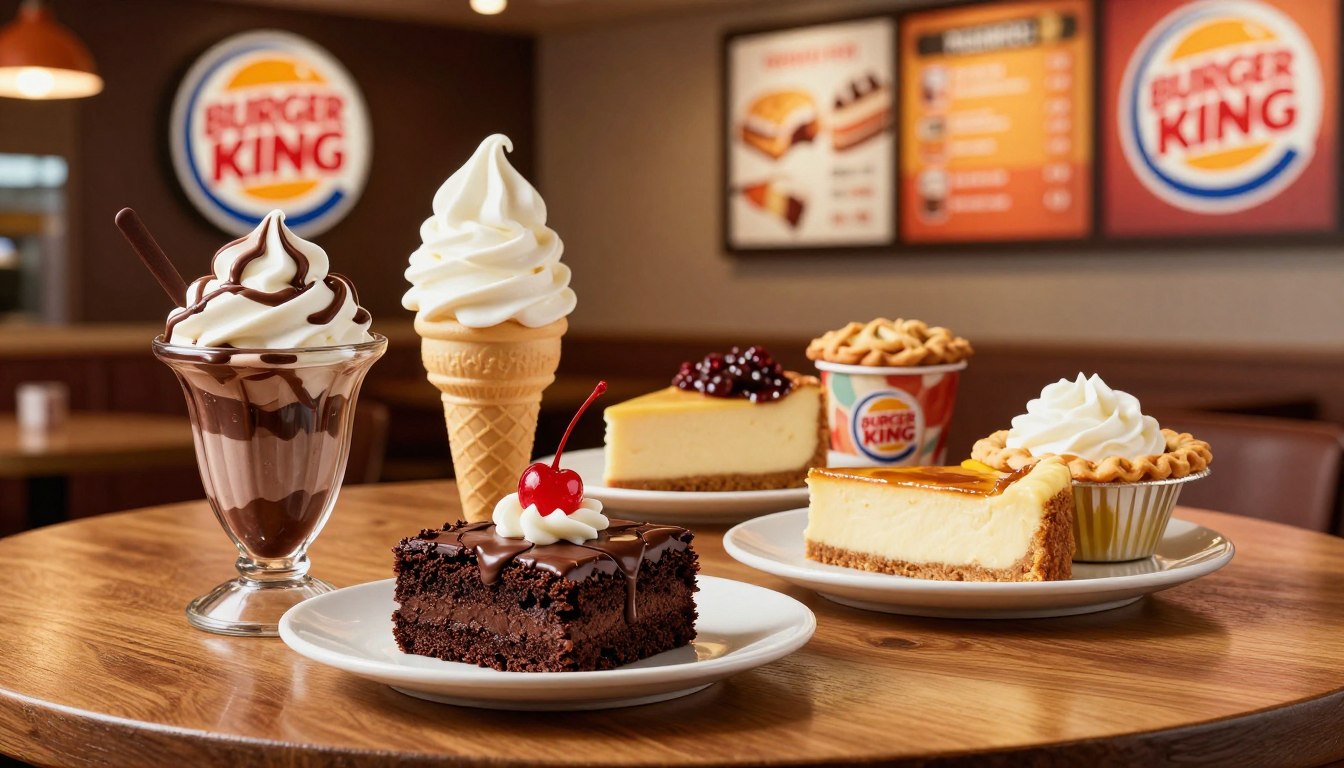
Burger King Dessert Menu
You’re about to get a quick tour of what’s on the U.S. dessert menu at Burger King today. Expect classics: vanilla soft serve, HERSHEY’S® Sundae Pie, sundaes like OREO® and M&M’s®, hand-spun shakes, Cinnabon® Minibon® bites, cookies, and occasional frozen drinks.
Most locations are franchise-run. That means availability and prices can change by store. The BK app is the fastest way to check live, location-specific pricing and promos.
This piece will list typical U.S. price ranges, describe how each item tastes and feels, and note who each treat suits best—kids, sharing, a small pick-me-up, or full indulgence. Nutrition and common allergens like milk, wheat/gluten, soy, and egg will appear later for families who need them.
Think creamy, crunchy, chocolatey, or cinnamon-sweet. Keep it simple and comforting as you decide what to grab after a meal or on the road.
Burger King Dessert Menu items and typical prices in the United States
Here’s a compact price guide to the core treats you’ll find at most U.S. locations. The table below gives quick ranges and a short description so you can spot value fast.
| Item | Typical U.S. price range | Quick description | Best value under $2? |
|---|---|---|---|
| HERSHEY’S® Sundae Pie | $1.49 – $3.69 | Chocolate crust, crème filling, whipped top. | Sometimes |
| Soft Serve (cone/cup) | $1.00 – $2.29 | Simple vanilla cone or cup; light and cheap. | Often |
| Sundaes (OREO®, M&M’s®, Brownie) | $2.49 – $3.49 | Candy or brownie topping over soft serve. | Rarely |
| Hand‑Spun Shakes | $1.99 – $6.49 (size/region) | Thick shakes in small to large; price varies by market. | Sometimes (small) |
| Cinnabon® Minibon® / Cookies | $1.00 – $5.99 | Single to multi-piece cinnamon bites and chunky cookies. | Often |
You may see different numbers online. Some sources list “value” pricing, while other markets show higher regional ranges. Shakes and pies are the most variable.
Why prices vary: many locations are franchises. Local labor, rent, city rules, and store type (highway vs neighborhood) affect cost. Promotions and regional pricing also change the final total.
Best way to confirm your real total: open the app, pick your exact location, tap Order and check the desserts section for live pricing and availability. Delivery apps can add markups and fees, so totals may be higher than drive‑thru or in‑app pickup. One more note: soft serve and shake availability depends on equipment. Double‑check in the app or at the speaker before you order.
HERSHEY’S® Sundae Pie and other pie-style treats
The HERSHEY’S® Sundae Pie is a slice-style treat that leans into classic chocolate comforts.
What it is
Think of a chilled pie slice with a crisp chocolate crust, a chocolate crème-like filling, and a whipped topping made with real HERSHEY’S®. The texture is soft but holds a slice shape. It’s an easy, low-mess finish when you’re on the go.
Price and portion
| Item | Typical U.S. price | What you get |
|---|---|---|
| HERSHEY’S® Sundae Pie | $1.49 – $3.69 | Single slice, filling and whipped top |
| Other pie-style treats | $1.99 – $4.00 | Limited-time slices or themed pies |
Calories and quick tips
A single slice is about 300 calories, 18g fat, 23g sugars, and 3g protein. Numbers can vary by location and supplier.
- Eating note: rich chocolate flavor, soft mouthfeel, dessert-case classic that’s car-friendly.
- Value tip: one slice is more filling than a cone; two slices split easily if you want variety.
- Availability note: pie-style offerings and special pies appear as limited-time items by market.
Soft serve basics: cone vs cup

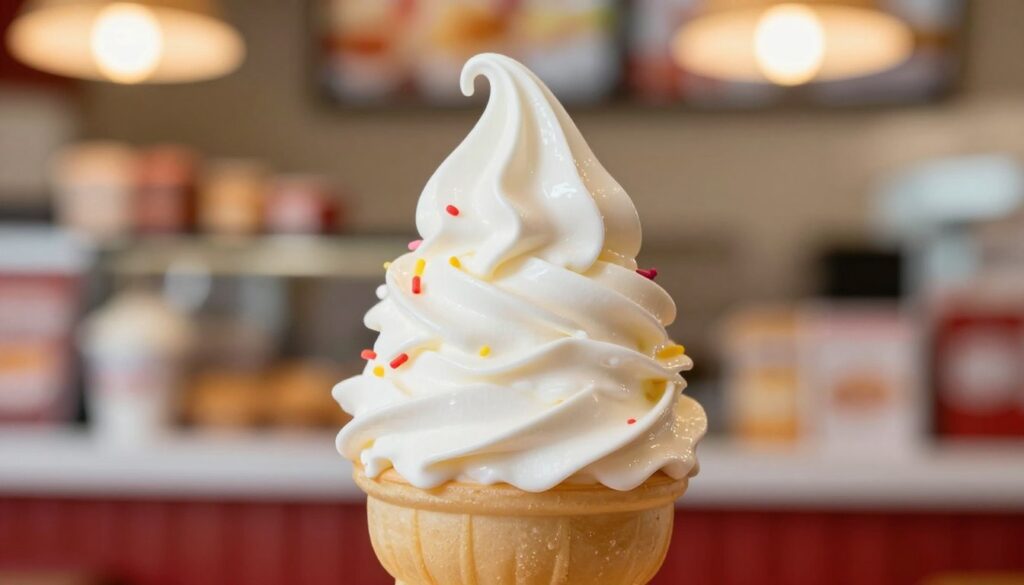
Soft serve is a simple treat, and choosing cone or cup changes how you eat it. The choice affects portion, price, and drip risk. Below are quick facts to help you decide.
Vanilla soft serve cone or cup: prices and portions
A typical cone often lands in the value range. Expect about $1.19–$1.29 for a cone at many locations.
Cups run a bit higher, usually around $1.85–$2.29 depending on store and portion. Cups can feel slightly more generous and are easier to top when available.
Calories and sugar comparison for lighter choices
| Option | Typical price | Calories | Sugar (approx) |
|---|---|---|---|
| Vanilla cone | $1.19–$1.29 | ~170 kcal | ~18 g |
| Vanilla cup | $1.85–$2.29 | ~230 kcal | ~23 g |
| Why pick it | Value vs portion | Lighter finish | Less added sugar |
- Choose a cone for the classic crunch and easy handheld bite.
- Pick a cup if you want a spoon, less drip, or room for toppings.
- Soft serve cone is often one of the lowest-calorie ice cream choices on the list.
- If the soft serve machine is down, pivot to a cookie, pie slice, or baked bite.
Comfort meets practical: the cone is a reliable under-$2 add-on at many spots. That makes it an easy option when you want a quick, familiar ice cream finish.
Sundaes lineup: OREO®, M&M’s®, brownie, and classic flavors
Sundaes turn plain soft serve into a small celebration with cookie bits, candy, or warm sauce. You get a quick read on which topping and texture will match your mood.
OREO® option: cookie contrast and price
The OREO® sundae pairs crushed cookie crumbles with cold vanilla. Expect a sharper chocolate-cookie contrast than a plain cone. Typical price: about $3.11–$3.49. Nutrition: ~280 calories, 10g fat, 30g sugar, 5g protein.
M&M’s® option: candy crunch and sweetness
M&M’s® adds candy pieces for extra crunch. It tastes sweeter and has a bit more sugar. Typical calorie count: ~290 kcal, 12g fat, 32g sugar, 4g protein. Price sits near the standard sundae range around $2.49–$3.49 depending on location.
Brownie option: the richest pick
The brownie sundae brings chewy brownie chunks into cold vanilla. This is the richest of the three. Expect about 310 calories, 14g fat, and 34g sugars. Price usually aligns with other sundaes, often near $2.49.
Classic sauce styles and store variations
Some stores list HERSHEY’S® sundaes or offer hot fudge or caramel as alternatives. Prices vary: caramel can be lower ($1.99–$2.49) while hot fudge often matches midrange sundaes ($2.49–$2.89).
| Item | Typical price | Calories | Notable topping |
|---|---|---|---|
| OREO® Sundae | $3.11–$3.49 | ~280 kcal | Cookie crumbles |
| M&M’s® Sundae | $2.49–$3.49 | ~290 kcal | Candy pieces |
| Brownie Sundae | $2.49–$3.49 | ~310 kcal | Brownie chunks |
| HERSHEY’S® / Hot fudge / Caramel | $1.99–$3.00 | Varies | Syrup-style |
Quick tip: if you want less sugar, pick a smaller soft serve instead of a sundae. You keep the flavor but cut added sugars fast.
Hand-spun shakes and frozen drinks
A hand-spun shake gives you a thicker, creamier finish than a cone and travels well.
Hand-spun means the shake is blended until dense and smooth. It feels richer than soft serve and is easier to sip in the car. That makes it a filling after-meal treat or a shareable snack for kids.
Classic flavors and quick taste notes
Chocolate: deep cocoa, heavy and sweet. Vanilla: classic, milky, pairs well with fries. Strawberry: bright, slightly tart, feels fresher after a salty meal.
Sizes and price ranges
| Size | Typical low estimate | Higher market estimate |
|---|---|---|
| Small | $1.99 | $3.79 |
| Medium | $2.49 | $4.99 |
| Large | $2.99 | $6.49 |
Nutrition note for medium shakes
Medium chocolate: about 600 calories, 20g fat, 70g sugars, 9g protein. Medium vanilla: roughly 590 calories, 18g fat, 68g sugars, 8g protein.
“Thick” usually means more calories and sugar. Splitting a medium is a practical way to cut a meal’s added sugar without losing the experience.
Frozen Strawberry & NERDS® limited-time drink
This frozen item mixes a strawberry base with candy topping. Expect around 340 calories and ~65g sugar. It appears for short runs and can sell out fast.
Practical tip: equipment or supply issues can remove shakes or frozen drinks that day. Check the app before you order. For a broader view, see the full U.S. dessert guide here.
Baked desserts: Cinnabon® Minibon® bites and cookies
If you prefer a warm, bakery-style finish, the Minibon® bites and cookies are a dependable pick.
Cinnabon® Minibon® options come in single, two-piece, and four-piece packs. Typical prices run about $1.99 for one, $3.69 for two, and $5.99 for four. A single Minibon® is roughly 350 calories, with about 15g fat and 24g sugars. These are hand-rolled style bites with a soft, cinnamon center and a sweet glaze.
The Chunky cookie with OREO® pieces is soft-baked and dense. It lists near $1.00 and clocks about 310 calories, 14g fat, and 28g sugars. It travels well and needs no spoon. Two Chocolate Chip Cookies (where available) often come as a $1.50 add-on. They are simple, familiar, and a good fallback when machines are down.
| Item | Pack size | Typical price | Nutrition (approx) |
|---|---|---|---|
| Cinnabon® Minibon® | 1 / 2 / 4 pcs | $1.99 / $3.69 / $5.99 | 1 pc: 350 kcal, 15g fat, 24g sugars |
| Chunky OREO® Cookie | Single | ~$1.00 | ~310 kcal, 14g fat, 28g sugars |
| Chocolate Chip Cookies | 2-pack | ~$1.50 | Varies by location; soft-baked |
- When baked beats frozen: pick Minibon® for warm, cinnamony comfort instead of a cold sundae.
- Choose a multi-piece pack to share in the car or to stretch value.
- Baked items are often the most reliable choice late at night when soft-serve machines are inconsistent.
Limited-time and seasonal Burger King desserts to watch for
Short-run offerings pop up around promotions, and the app is the fastest way to spot them.
These items often tie to a film, holiday, or a special promo. They arrive for weeks, not months, and can sell out when supplies run low. That means availability varies by location and by store.
Open the app and look for featured tiles, banners, or a temporary dessert category. Those visuals usually list participating locations and show how long the item is offered.
Real examples include Patrick’s Star-Berry Pie (SpongeBob tie-in), the Franken-Candy Sundae for Halloween, and test-market Kit Kat shake flavors in Houston, TX. Test items often remain local, so national availability is rare.
| Item | Typical window | Where to check |
|---|---|---|
| Patrick’s Star-Berry Pie | Limited run (weeks) | App featured tile / participating locations |
| Franken-Candy Sundae | Halloween period | App banner / select stores |
| Kit Kat shake (test) | Test-market only | Local app listings (example: Houston) |
- Note: change your app location to see what’s sold near a hotel or highway exit.
- Expect LTO pricing to vary more than standard items because franchises set local prices and promo deals.
Calories and nutrition guide for popular BK desserts
This snapshot shows where common treats land on calories, sugar, and fat so you can choose wisely.
Calorie highlights: pie vs soft serve vs sundaes vs shakes
Soft serve cones are usually the lightest option. A cone runs about 170 calories.
Pies and sundaes sit in the middle. Examples: HERSHEY’S® Sundae Pie ~300 cal, OREO® Sundae ~280–310 cal.
Medium shakes make the biggest jump. A chocolate medium is about 600 calories.
Sugar and fat considerations for lighter ordering
| Item | Calories | Fat (g) | Sugar (g) |
|---|---|---|---|
| Soft Serve Cone | 170 | 4.5 | 18 |
| HERSHEY’S® Sundae Pie | 300 | 18 | 23 |
| OREO® / M&M’s® / Brownie Sundaes | 280–310 | 10–14 | 30–34 |
| Medium Chocolate Shake | ~600 | 20 | 70 |
Serving sizes and customization that can change nutrition
Shakes and candy-topped frozen drinks carry high sugar. That matters if you order for kids or want to avoid a sugar crash.
- Size reality: a medium shake can serve two.
- Customization: extra sauce or toppings raises calories, sugar, and fat.
- Lighter options: pick a cone, split a sundae, or skip add-ons for a smaller sweet finish.
Ingredients and allergen notes for Burger King dessert items
Allergens hide in plain sight in many fast-food sweets, so a quick read helps you order with confidence.
Common allergens you should watch
Many dessert items contain milk in soft serve, shakes, pie filling, and frosting.
Wheat or gluten shows up in pie crusts, cookies, and Minibon dough.
Soy appears in chocolate coatings and some flavorings. Egg can be present in baked goods and certain fillings.
| Ingredient | Where it appears | Typical risk |
|---|---|---|
| Milk | Soft serve, shakes, cream fillings | High |
| Wheat/Gluten | Crusts, cookies, dough | High |
| Soy | Chocolate coatings, stabilizers | Moderate |
| Egg | Baked pies, some doughs | Moderate |
Cross-contact risk and practical steps
Shared equipment can move trace allergens between items. Even a plain cone can contact chocolate or cookie bits during prep.
- Check the official burger king allergen PDF and nutrition docs online before ordering.
- If unsure at the counter, pick a packaged cookie or skip toppings to simplify ingredients.
- Ask staff about equipment use when allergies are serious—better safe than sorry.
Ordering tips to get the best dessert value and availability
What you choose—counter, drive-thru, app, or delivery—affects price and what’s actually in stock. Use a quick checklist to save money and avoid disappointment.
In-store, drive-thru, app, and delivery: what changes
| Channel | Typical price | Selection note |
|---|---|---|
| In-store counter | Standard | Full visibility; ask about toppings |
| Drive-thru | Often same as counter | Quicker; staff may limit customization |
| Official app | Often lower; app deals | Best real-time pricing and promos |
| Delivery apps | Higher (fees/markups) | May not show full item list |
Find desserts near you fast
Open the app → pick the nearest location → tap Order → go to the desserts section. That way you see current menu items and any local promos.
Add-ons and simple adjustments
Stores vary on extra sauce, cookie crumbles, or larger portions. Custom requests may cost more and are sometimes limited in the app.
- If soft-serve is down, pivot to pie or baked items.
- Want to share? Look for multi-piece packs first.
- Use Royal Perks points to redeem free treats when available.
Picking the right sweet finish for your next BK meal
Choose your after-meal dessert by mood: light, chocolate-forward, or sippable and filling.
If you want simple comfort, pick a vanilla soft serve cone. For texture and toppings, grab a sundae or brownie-style option. If you want rich and chilled, a HERSHEY’S® Sundae Pie fits the bill. For warm sharing, go with multi-piece Cinnabon® Minibon® packs.
Feeding a crew? Share a shake or buy a multi-piece pack to stretch the budget. Check live pricing in the Burger King app before you order so your choice matches today’s local cost.
Remember nutrition and allergens. Use official Burger King documents for certainty, especially for kids or sensitive diners. Keep it classic, save a few bucks, or go all-in on chocolate—the choice is yours.
FAQ
What items are typically found on the fast-food dessert list and how much do they cost?
FAQ
What items are typically found on the fast-food dessert list and how much do they cost?
You’ll usually see soft serve cones and cups, branded sundae flavors, pie-style treats like the HERSHEY’S® Sundae Pie, hand-spun shakes, and small baked items such as Cinnabon® Minibon® bites or cookies. Prices vary by region, but expect small soft serve cones around
FAQ
What items are typically found on the fast-food dessert list and how much do they cost?
You’ll usually see soft serve cones and cups, branded sundae flavors, pie-style treats like the HERSHEY’S® Sundae Pie, hand-spun shakes, and small baked items such as Cinnabon® Minibon® bites or cookies. Prices vary by region, but expect small soft serve cones around $1–$2, sundaes $2–$4, pies $2.50–$4.50, and shakes $3–5 depending on size. Local taxes and franchise pricing will change final totals.
Why do dessert prices vary between stores, cities, or franchises?
Franchisees set local prices within corporate guidelines. Rent, labor costs, regional promotions, and whether you order in-store, via the app, or through delivery all affect price. Test-market items and seasonal offerings may only appear in certain regions, too.
How can I confirm live pricing for dessert items before I go?
The brand’s official mobile app shows current prices by location when you enable location services. You can also check the store’s in-app menu, call the local restaurant, or use delivery partners to compare fees and menu availability in real time.
What’s in the HERSHEY’S® Sundae Pie and how is it built?
The pie has a chocolate cookie crust, a smooth crème or vanilla filling, and a whipped topping finished with HERSHEY’S® chocolate drizzle. It’s a hand-assembled, portioned pie meant for one or to share as a small treat.
What price range should I expect for the HERSHEY’S® Sundae Pie and what size is it?
Typical retail pricing falls between $2.50 and $4.50. The packaged portion is a single-serving pie slice in a small heat-safe dish. Exact weight and price depend on location and whether it’s part of a value promotion or combo.
How many calories and macros are in pie-style treats like the HERSHEY’S® Sundae Pie?
Pies tend to be higher in calories, sugar, and fat than a plain soft serve. A single pie serving commonly ranges from 300–500 kcal, with significant sugar and saturated fat. For exact values, check the official nutrition guide in the app or on the company website for that specific product.
What are the differences between a soft serve cone and a cup?
A cone gives a crunchy, handheld experience and usually comes in a standard portion. A cup may offer a slightly larger portion and is easier to top or share. Prices can be the same or the cup may cost a little more depending on portion size at your local store.
How do calories and sugar compare between cone and cup soft serve?
Calories scale with portion size and added toppings. A plain small cone often ranges 150–220 kcal; a similar cup may be 200–300 kcal. Adding syrups, candies, or whipped cream increases sugar and calories rapidly.
What sundaes are offered and what should I expect from each?
Common sundaes include OREO® and M&M’s® toppings, brownie sundaes, and classic hot fudge or caramel. OREO® sundaes add cookie crunch and chocolate notes. M&M’s® offer a candy crunch and sweeter profile. Brownie sundaes are the richest with dense chocolate and often higher calories.
How is an OREO® Sundae typically topped and priced?
The OREO® Sundae pairs soft serve with crushed OREO® pieces and a chocolate drizzle or syrup. Pricing is commonly in the $2–$4 range depending on size and location.
What should I know about the M&M’s® Sundae in terms of sweetness and calories?
M&M’s® add both texture and extra sugar; expect a sweeter taste and a noticeable calorie bump compared with plain sundaes. A medium-sized candy-topped sundae can be 300–450 kcal depending on serving size and syrup used.
What makes the brownie sundae the richest option?
The brownie provides dense chocolate, often warmed, combined with soft serve and syrup. It adds saturated fat and calories beyond a plain sundae. It’s best as an occasional treat or shared dessert.
Are there differences between HERSHEY’S® sundae toppings and standard hot fudge or caramel?
HERSHEY’S® branded sauces use a specific chocolate profile and may be offered in some locations as part of branded pies or sundaes. Hot fudge and caramel are more common and can vary slightly by store based on supplier and recipe.
What classic shake flavors are available and how do they differ?
Classic shakes are usually chocolate, vanilla, and strawberry. Chocolate is richest, vanilla is the cleanest base, and strawberry has a fruit-forward sweetness. Availability can vary by location and season.
How are shake sizes priced and what should I expect for each size?
Shakes typically come in small, medium, and large where offered. Small starts around $2.50–$3, medium $3–4, and large $4–5. Prices vary by region and promotions. Size affects calorie and sugar content proportionally.
What does “thick” mean nutritionally for a medium shake?
“Thick” usually indicates more mix or soft-serve base per ounce. A medium thick shake can contain 400–700 kcal and substantial sugar. Thicker textures often mean higher calorie density.
Is the Frozen Strawberry & NERDS® drink widely available?
That drink is typically a limited-time or test-market item. Availability varies by location and season. Check the app or local store for current offerings and regional rollouts.
What are the options and prices for Cinnabon® Minibon® bites and cookies?
Cinnabon® Minibon® bites are offered in single or multi-piece packs and usually cost between $1.50 and $3. Cookies with OREO® pieces or chocolate chip cookies are often $1–$2 as add-ons. Prices differ by restaurant and promotions.
How does a chunky cookie with OREO® pieces compare in texture and value?
Chunky cookies deliver a chewy, dense bite with crunchy OREO® bits. They’re an inexpensive way to add texture and sweetness to a meal and often represent good value as a shareable item.
What limited-time or seasonal treats should I watch for?
Look for movie tie-ins, holiday sundaes, and test flavors like Kit Kat or other branded shakes. These show up in the app first and are commonly region-limited or time-limited.
How can I spot test-market items and seasonal sundaes in the app?
Enable push notifications and location services in the app. Promotional banners and a “limited time” or “featured” section highlight seasonal and test-market items. Local stores may also post signs in-store or at the drive-thru.
How do calorie counts compare across pies, soft serve, sundaes, and shakes?
Generally, pies and brownie sundaes are highest in calories, followed by large shakes, then candy-topped sundaes, and finally plain soft serve. Exact counts vary by serving size and added toppings.
What should I consider about sugar and fat when choosing a lighter option?
Choose plain soft serve in a small portion or a fruit-flavored option if available. Skip candy toppings, syrups, and whipped cream. Custom requests like half-sauce or no whipped topping reduce sugar and calories.
How do serving size and customization change nutrition facts?
Increasing size or adding toppings directly raises calories, sugar, and fat. Substituting syrups, removing whipped cream, or sharing portions are effective ways to lower totals.
Which common allergens appear in these sweet items?
Many treats contain milk, wheat/gluten, soy, and sometimes egg or tree nuts depending on the topping or cookie. Branded candies like M&M’s® also carry allergen information on their packaging.
Is there a cross-contact risk for allergens in the store kitchen?
Yes. Shared equipment and preparation areas increase cross-contact risk. If you have a severe allergy, inform staff and review official allergen guidance before ordering.
Where can I find official allergen and nutrition documents for each dessert?
Visit the company’s website or the mobile app’s nutrition/allergen section. Many locations also have printed guides at the counter. Those documents list ingredient details, calories, and common allergens.
How do ordering channels affect price, promos, and selection?
In-store and drive-thru orders often match menu pricing. The app may offer exclusive deals, combos, or loyalty discounts. Delivery adds fees and sometimes limits menu items due to packaging or partner availability.
What’s the fastest way to find dessert availability near me?
Turn on location in the brand’s app and check the menu for your nearest store. The app filters items by location; you can also call the restaurant directly for immediate confirmation.
What simple add-ons or topping requests might vary by store?
Requests like extra drizzle, no whipped topping, or additional candy pieces can often be accommodated but vary by staff and equipment. Some locations charge for extra toppings; ask at order time.
How do I pick the right sweet finish for my meal?
Consider who you’re feeding and whether you want to share. Choose lighter soft serve for a low-calorie treat, a sundae for variety and toppings, a pie or brownie for a richer experience, or a shake when you want a filling dessert. Use the app to compare prices and nutrition before you order.
–, sundaes –, pies .50–.50, and shakes –5 depending on size. Local taxes and franchise pricing will change final totals.
Why do dessert prices vary between stores, cities, or franchises?
Franchisees set local prices within corporate guidelines. Rent, labor costs, regional promotions, and whether you order in-store, via the app, or through delivery all affect price. Test-market items and seasonal offerings may only appear in certain regions, too.
How can I confirm live pricing for dessert items before I go?
The brand’s official mobile app shows current prices by location when you enable location services. You can also check the store’s in-app menu, call the local restaurant, or use delivery partners to compare fees and menu availability in real time.
What’s in the HERSHEY’S® Sundae Pie and how is it built?
The pie has a chocolate cookie crust, a smooth crème or vanilla filling, and a whipped topping finished with HERSHEY’S® chocolate drizzle. It’s a hand-assembled, portioned pie meant for one or to share as a small treat.
What price range should I expect for the HERSHEY’S® Sundae Pie and what size is it?
Typical retail pricing falls between .50 and .50. The packaged portion is a single-serving pie slice in a small heat-safe dish. Exact weight and price depend on location and whether it’s part of a value promotion or combo.
How many calories and macros are in pie-style treats like the HERSHEY’S® Sundae Pie?
Pies tend to be higher in calories, sugar, and fat than a plain soft serve. A single pie serving commonly ranges from 300–500 kcal, with significant sugar and saturated fat. For exact values, check the official nutrition guide in the app or on the company website for that specific product.
What are the differences between a soft serve cone and a cup?
A cone gives a crunchy, handheld experience and usually comes in a standard portion. A cup may offer a slightly larger portion and is easier to top or share. Prices can be the same or the cup may cost a little more depending on portion size at your local store.
How do calories and sugar compare between cone and cup soft serve?
Calories scale with portion size and added toppings. A plain small cone often ranges 150–220 kcal; a similar cup may be 200–300 kcal. Adding syrups, candies, or whipped cream increases sugar and calories rapidly.
What sundaes are offered and what should I expect from each?
Common sundaes include OREO® and M&M’s® toppings, brownie sundaes, and classic hot fudge or caramel. OREO® sundaes add cookie crunch and chocolate notes. M&M’s® offer a candy crunch and sweeter profile. Brownie sundaes are the richest with dense chocolate and often higher calories.
How is an OREO® Sundae typically topped and priced?
The OREO® Sundae pairs soft serve with crushed OREO® pieces and a chocolate drizzle or syrup. Pricing is commonly in the – range depending on size and location.
What should I know about the M&M’s® Sundae in terms of sweetness and calories?
M&M’s® add both texture and extra sugar; expect a sweeter taste and a noticeable calorie bump compared with plain sundaes. A medium-sized candy-topped sundae can be 300–450 kcal depending on serving size and syrup used.
What makes the brownie sundae the richest option?
The brownie provides dense chocolate, often warmed, combined with soft serve and syrup. It adds saturated fat and calories beyond a plain sundae. It’s best as an occasional treat or shared dessert.
Are there differences between HERSHEY’S® sundae toppings and standard hot fudge or caramel?
HERSHEY’S® branded sauces use a specific chocolate profile and may be offered in some locations as part of branded pies or sundaes. Hot fudge and caramel are more common and can vary slightly by store based on supplier and recipe.
What classic shake flavors are available and how do they differ?
Classic shakes are usually chocolate, vanilla, and strawberry. Chocolate is richest, vanilla is the cleanest base, and strawberry has a fruit-forward sweetness. Availability can vary by location and season.
How are shake sizes priced and what should I expect for each size?
Shakes typically come in small, medium, and large where offered. Small starts around .50–, medium –4, and large –5. Prices vary by region and promotions. Size affects calorie and sugar content proportionally.
What does “thick” mean nutritionally for a medium shake?
“Thick” usually indicates more mix or soft-serve base per ounce. A medium thick shake can contain 400–700 kcal and substantial sugar. Thicker textures often mean higher calorie density.
Is the Frozen Strawberry & NERDS® drink widely available?
That drink is typically a limited-time or test-market item. Availability varies by location and season. Check the app or local store for current offerings and regional rollouts.
What are the options and prices for Cinnabon® Minibon® bites and cookies?
Cinnabon® Minibon® bites are offered in single or multi-piece packs and usually cost between
FAQ
What items are typically found on the fast-food dessert list and how much do they cost?
You’ll usually see soft serve cones and cups, branded sundae flavors, pie-style treats like the HERSHEY’S® Sundae Pie, hand-spun shakes, and small baked items such as Cinnabon® Minibon® bites or cookies. Prices vary by region, but expect small soft serve cones around $1–$2, sundaes $2–$4, pies $2.50–$4.50, and shakes $3–5 depending on size. Local taxes and franchise pricing will change final totals.
Why do dessert prices vary between stores, cities, or franchises?
Franchisees set local prices within corporate guidelines. Rent, labor costs, regional promotions, and whether you order in-store, via the app, or through delivery all affect price. Test-market items and seasonal offerings may only appear in certain regions, too.
How can I confirm live pricing for dessert items before I go?
The brand’s official mobile app shows current prices by location when you enable location services. You can also check the store’s in-app menu, call the local restaurant, or use delivery partners to compare fees and menu availability in real time.
What’s in the HERSHEY’S® Sundae Pie and how is it built?
The pie has a chocolate cookie crust, a smooth crème or vanilla filling, and a whipped topping finished with HERSHEY’S® chocolate drizzle. It’s a hand-assembled, portioned pie meant for one or to share as a small treat.
What price range should I expect for the HERSHEY’S® Sundae Pie and what size is it?
Typical retail pricing falls between $2.50 and $4.50. The packaged portion is a single-serving pie slice in a small heat-safe dish. Exact weight and price depend on location and whether it’s part of a value promotion or combo.
How many calories and macros are in pie-style treats like the HERSHEY’S® Sundae Pie?
Pies tend to be higher in calories, sugar, and fat than a plain soft serve. A single pie serving commonly ranges from 300–500 kcal, with significant sugar and saturated fat. For exact values, check the official nutrition guide in the app or on the company website for that specific product.
What are the differences between a soft serve cone and a cup?
A cone gives a crunchy, handheld experience and usually comes in a standard portion. A cup may offer a slightly larger portion and is easier to top or share. Prices can be the same or the cup may cost a little more depending on portion size at your local store.
How do calories and sugar compare between cone and cup soft serve?
Calories scale with portion size and added toppings. A plain small cone often ranges 150–220 kcal; a similar cup may be 200–300 kcal. Adding syrups, candies, or whipped cream increases sugar and calories rapidly.
What sundaes are offered and what should I expect from each?
Common sundaes include OREO® and M&M’s® toppings, brownie sundaes, and classic hot fudge or caramel. OREO® sundaes add cookie crunch and chocolate notes. M&M’s® offer a candy crunch and sweeter profile. Brownie sundaes are the richest with dense chocolate and often higher calories.
How is an OREO® Sundae typically topped and priced?
The OREO® Sundae pairs soft serve with crushed OREO® pieces and a chocolate drizzle or syrup. Pricing is commonly in the $2–$4 range depending on size and location.
What should I know about the M&M’s® Sundae in terms of sweetness and calories?
M&M’s® add both texture and extra sugar; expect a sweeter taste and a noticeable calorie bump compared with plain sundaes. A medium-sized candy-topped sundae can be 300–450 kcal depending on serving size and syrup used.
What makes the brownie sundae the richest option?
The brownie provides dense chocolate, often warmed, combined with soft serve and syrup. It adds saturated fat and calories beyond a plain sundae. It’s best as an occasional treat or shared dessert.
Are there differences between HERSHEY’S® sundae toppings and standard hot fudge or caramel?
HERSHEY’S® branded sauces use a specific chocolate profile and may be offered in some locations as part of branded pies or sundaes. Hot fudge and caramel are more common and can vary slightly by store based on supplier and recipe.
What classic shake flavors are available and how do they differ?
Classic shakes are usually chocolate, vanilla, and strawberry. Chocolate is richest, vanilla is the cleanest base, and strawberry has a fruit-forward sweetness. Availability can vary by location and season.
How are shake sizes priced and what should I expect for each size?
Shakes typically come in small, medium, and large where offered. Small starts around $2.50–$3, medium $3–4, and large $4–5. Prices vary by region and promotions. Size affects calorie and sugar content proportionally.
What does “thick” mean nutritionally for a medium shake?
“Thick” usually indicates more mix or soft-serve base per ounce. A medium thick shake can contain 400–700 kcal and substantial sugar. Thicker textures often mean higher calorie density.
Is the Frozen Strawberry & NERDS® drink widely available?
That drink is typically a limited-time or test-market item. Availability varies by location and season. Check the app or local store for current offerings and regional rollouts.
What are the options and prices for Cinnabon® Minibon® bites and cookies?
Cinnabon® Minibon® bites are offered in single or multi-piece packs and usually cost between $1.50 and $3. Cookies with OREO® pieces or chocolate chip cookies are often $1–$2 as add-ons. Prices differ by restaurant and promotions.
How does a chunky cookie with OREO® pieces compare in texture and value?
Chunky cookies deliver a chewy, dense bite with crunchy OREO® bits. They’re an inexpensive way to add texture and sweetness to a meal and often represent good value as a shareable item.
What limited-time or seasonal treats should I watch for?
Look for movie tie-ins, holiday sundaes, and test flavors like Kit Kat or other branded shakes. These show up in the app first and are commonly region-limited or time-limited.
How can I spot test-market items and seasonal sundaes in the app?
Enable push notifications and location services in the app. Promotional banners and a “limited time” or “featured” section highlight seasonal and test-market items. Local stores may also post signs in-store or at the drive-thru.
How do calorie counts compare across pies, soft serve, sundaes, and shakes?
Generally, pies and brownie sundaes are highest in calories, followed by large shakes, then candy-topped sundaes, and finally plain soft serve. Exact counts vary by serving size and added toppings.
What should I consider about sugar and fat when choosing a lighter option?
Choose plain soft serve in a small portion or a fruit-flavored option if available. Skip candy toppings, syrups, and whipped cream. Custom requests like half-sauce or no whipped topping reduce sugar and calories.
How do serving size and customization change nutrition facts?
Increasing size or adding toppings directly raises calories, sugar, and fat. Substituting syrups, removing whipped cream, or sharing portions are effective ways to lower totals.
Which common allergens appear in these sweet items?
Many treats contain milk, wheat/gluten, soy, and sometimes egg or tree nuts depending on the topping or cookie. Branded candies like M&M’s® also carry allergen information on their packaging.
Is there a cross-contact risk for allergens in the store kitchen?
Yes. Shared equipment and preparation areas increase cross-contact risk. If you have a severe allergy, inform staff and review official allergen guidance before ordering.
Where can I find official allergen and nutrition documents for each dessert?
Visit the company’s website or the mobile app’s nutrition/allergen section. Many locations also have printed guides at the counter. Those documents list ingredient details, calories, and common allergens.
How do ordering channels affect price, promos, and selection?
In-store and drive-thru orders often match menu pricing. The app may offer exclusive deals, combos, or loyalty discounts. Delivery adds fees and sometimes limits menu items due to packaging or partner availability.
What’s the fastest way to find dessert availability near me?
Turn on location in the brand’s app and check the menu for your nearest store. The app filters items by location; you can also call the restaurant directly for immediate confirmation.
What simple add-ons or topping requests might vary by store?
Requests like extra drizzle, no whipped topping, or additional candy pieces can often be accommodated but vary by staff and equipment. Some locations charge for extra toppings; ask at order time.
How do I pick the right sweet finish for my meal?
Consider who you’re feeding and whether you want to share. Choose lighter soft serve for a low-calorie treat, a sundae for variety and toppings, a pie or brownie for a richer experience, or a shake when you want a filling dessert. Use the app to compare prices and nutrition before you order.
.50 and . Cookies with OREO® pieces or chocolate chip cookies are often
FAQ
What items are typically found on the fast-food dessert list and how much do they cost?
You’ll usually see soft serve cones and cups, branded sundae flavors, pie-style treats like the HERSHEY’S® Sundae Pie, hand-spun shakes, and small baked items such as Cinnabon® Minibon® bites or cookies. Prices vary by region, but expect small soft serve cones around $1–$2, sundaes $2–$4, pies $2.50–$4.50, and shakes $3–5 depending on size. Local taxes and franchise pricing will change final totals.
Why do dessert prices vary between stores, cities, or franchises?
Franchisees set local prices within corporate guidelines. Rent, labor costs, regional promotions, and whether you order in-store, via the app, or through delivery all affect price. Test-market items and seasonal offerings may only appear in certain regions, too.
How can I confirm live pricing for dessert items before I go?
The brand’s official mobile app shows current prices by location when you enable location services. You can also check the store’s in-app menu, call the local restaurant, or use delivery partners to compare fees and menu availability in real time.
What’s in the HERSHEY’S® Sundae Pie and how is it built?
The pie has a chocolate cookie crust, a smooth crème or vanilla filling, and a whipped topping finished with HERSHEY’S® chocolate drizzle. It’s a hand-assembled, portioned pie meant for one or to share as a small treat.
What price range should I expect for the HERSHEY’S® Sundae Pie and what size is it?
Typical retail pricing falls between $2.50 and $4.50. The packaged portion is a single-serving pie slice in a small heat-safe dish. Exact weight and price depend on location and whether it’s part of a value promotion or combo.
How many calories and macros are in pie-style treats like the HERSHEY’S® Sundae Pie?
Pies tend to be higher in calories, sugar, and fat than a plain soft serve. A single pie serving commonly ranges from 300–500 kcal, with significant sugar and saturated fat. For exact values, check the official nutrition guide in the app or on the company website for that specific product.
What are the differences between a soft serve cone and a cup?
A cone gives a crunchy, handheld experience and usually comes in a standard portion. A cup may offer a slightly larger portion and is easier to top or share. Prices can be the same or the cup may cost a little more depending on portion size at your local store.
How do calories and sugar compare between cone and cup soft serve?
Calories scale with portion size and added toppings. A plain small cone often ranges 150–220 kcal; a similar cup may be 200–300 kcal. Adding syrups, candies, or whipped cream increases sugar and calories rapidly.
What sundaes are offered and what should I expect from each?
Common sundaes include OREO® and M&M’s® toppings, brownie sundaes, and classic hot fudge or caramel. OREO® sundaes add cookie crunch and chocolate notes. M&M’s® offer a candy crunch and sweeter profile. Brownie sundaes are the richest with dense chocolate and often higher calories.
How is an OREO® Sundae typically topped and priced?
The OREO® Sundae pairs soft serve with crushed OREO® pieces and a chocolate drizzle or syrup. Pricing is commonly in the $2–$4 range depending on size and location.
What should I know about the M&M’s® Sundae in terms of sweetness and calories?
M&M’s® add both texture and extra sugar; expect a sweeter taste and a noticeable calorie bump compared with plain sundaes. A medium-sized candy-topped sundae can be 300–450 kcal depending on serving size and syrup used.
What makes the brownie sundae the richest option?
The brownie provides dense chocolate, often warmed, combined with soft serve and syrup. It adds saturated fat and calories beyond a plain sundae. It’s best as an occasional treat or shared dessert.
Are there differences between HERSHEY’S® sundae toppings and standard hot fudge or caramel?
HERSHEY’S® branded sauces use a specific chocolate profile and may be offered in some locations as part of branded pies or sundaes. Hot fudge and caramel are more common and can vary slightly by store based on supplier and recipe.
What classic shake flavors are available and how do they differ?
Classic shakes are usually chocolate, vanilla, and strawberry. Chocolate is richest, vanilla is the cleanest base, and strawberry has a fruit-forward sweetness. Availability can vary by location and season.
How are shake sizes priced and what should I expect for each size?
Shakes typically come in small, medium, and large where offered. Small starts around $2.50–$3, medium $3–4, and large $4–5. Prices vary by region and promotions. Size affects calorie and sugar content proportionally.
What does “thick” mean nutritionally for a medium shake?
“Thick” usually indicates more mix or soft-serve base per ounce. A medium thick shake can contain 400–700 kcal and substantial sugar. Thicker textures often mean higher calorie density.
Is the Frozen Strawberry & NERDS® drink widely available?
That drink is typically a limited-time or test-market item. Availability varies by location and season. Check the app or local store for current offerings and regional rollouts.
What are the options and prices for Cinnabon® Minibon® bites and cookies?
Cinnabon® Minibon® bites are offered in single or multi-piece packs and usually cost between $1.50 and $3. Cookies with OREO® pieces or chocolate chip cookies are often $1–$2 as add-ons. Prices differ by restaurant and promotions.
How does a chunky cookie with OREO® pieces compare in texture and value?
Chunky cookies deliver a chewy, dense bite with crunchy OREO® bits. They’re an inexpensive way to add texture and sweetness to a meal and often represent good value as a shareable item.
What limited-time or seasonal treats should I watch for?
Look for movie tie-ins, holiday sundaes, and test flavors like Kit Kat or other branded shakes. These show up in the app first and are commonly region-limited or time-limited.
How can I spot test-market items and seasonal sundaes in the app?
Enable push notifications and location services in the app. Promotional banners and a “limited time” or “featured” section highlight seasonal and test-market items. Local stores may also post signs in-store or at the drive-thru.
How do calorie counts compare across pies, soft serve, sundaes, and shakes?
Generally, pies and brownie sundaes are highest in calories, followed by large shakes, then candy-topped sundaes, and finally plain soft serve. Exact counts vary by serving size and added toppings.
What should I consider about sugar and fat when choosing a lighter option?
Choose plain soft serve in a small portion or a fruit-flavored option if available. Skip candy toppings, syrups, and whipped cream. Custom requests like half-sauce or no whipped topping reduce sugar and calories.
How do serving size and customization change nutrition facts?
Increasing size or adding toppings directly raises calories, sugar, and fat. Substituting syrups, removing whipped cream, or sharing portions are effective ways to lower totals.
Which common allergens appear in these sweet items?
Many treats contain milk, wheat/gluten, soy, and sometimes egg or tree nuts depending on the topping or cookie. Branded candies like M&M’s® also carry allergen information on their packaging.
Is there a cross-contact risk for allergens in the store kitchen?
Yes. Shared equipment and preparation areas increase cross-contact risk. If you have a severe allergy, inform staff and review official allergen guidance before ordering.
Where can I find official allergen and nutrition documents for each dessert?
Visit the company’s website or the mobile app’s nutrition/allergen section. Many locations also have printed guides at the counter. Those documents list ingredient details, calories, and common allergens.
How do ordering channels affect price, promos, and selection?
In-store and drive-thru orders often match menu pricing. The app may offer exclusive deals, combos, or loyalty discounts. Delivery adds fees and sometimes limits menu items due to packaging or partner availability.
What’s the fastest way to find dessert availability near me?
Turn on location in the brand’s app and check the menu for your nearest store. The app filters items by location; you can also call the restaurant directly for immediate confirmation.
What simple add-ons or topping requests might vary by store?
Requests like extra drizzle, no whipped topping, or additional candy pieces can often be accommodated but vary by staff and equipment. Some locations charge for extra toppings; ask at order time.
How do I pick the right sweet finish for my meal?
Consider who you’re feeding and whether you want to share. Choose lighter soft serve for a low-calorie treat, a sundae for variety and toppings, a pie or brownie for a richer experience, or a shake when you want a filling dessert. Use the app to compare prices and nutrition before you order.
– as add-ons. Prices differ by restaurant and promotions.
How does a chunky cookie with OREO® pieces compare in texture and value?
Chunky cookies deliver a chewy, dense bite with crunchy OREO® bits. They’re an inexpensive way to add texture and sweetness to a meal and often represent good value as a shareable item.
What limited-time or seasonal treats should I watch for?
Look for movie tie-ins, holiday sundaes, and test flavors like Kit Kat or other branded shakes. These show up in the app first and are commonly region-limited or time-limited.
How can I spot test-market items and seasonal sundaes in the app?
Enable push notifications and location services in the app. Promotional banners and a “limited time” or “featured” section highlight seasonal and test-market items. Local stores may also post signs in-store or at the drive-thru.
How do calorie counts compare across pies, soft serve, sundaes, and shakes?
Generally, pies and brownie sundaes are highest in calories, followed by large shakes, then candy-topped sundaes, and finally plain soft serve. Exact counts vary by serving size and added toppings.
What should I consider about sugar and fat when choosing a lighter option?
Choose plain soft serve in a small portion or a fruit-flavored option if available. Skip candy toppings, syrups, and whipped cream. Custom requests like half-sauce or no whipped topping reduce sugar and calories.
How do serving size and customization change nutrition facts?
Increasing size or adding toppings directly raises calories, sugar, and fat. Substituting syrups, removing whipped cream, or sharing portions are effective ways to lower totals.
Which common allergens appear in these sweet items?
Many treats contain milk, wheat/gluten, soy, and sometimes egg or tree nuts depending on the topping or cookie. Branded candies like M&M’s® also carry allergen information on their packaging.
Is there a cross-contact risk for allergens in the store kitchen?
Yes. Shared equipment and preparation areas increase cross-contact risk. If you have a severe allergy, inform staff and review official allergen guidance before ordering.
Where can I find official allergen and nutrition documents for each dessert?
Visit the company’s website or the mobile app’s nutrition/allergen section. Many locations also have printed guides at the counter. Those documents list ingredient details, calories, and common allergens.
How do ordering channels affect price, promos, and selection?
In-store and drive-thru orders often match menu pricing. The app may offer exclusive deals, combos, or loyalty discounts. Delivery adds fees and sometimes limits menu items due to packaging or partner availability.
What’s the fastest way to find dessert availability near me?
Turn on location in the brand’s app and check the menu for your nearest store. The app filters items by location; you can also call the restaurant directly for immediate confirmation.
What simple add-ons or topping requests might vary by store?
Requests like extra drizzle, no whipped topping, or additional candy pieces can often be accommodated but vary by staff and equipment. Some locations charge for extra toppings; ask at order time.
How do I pick the right sweet finish for my meal?
Consider who you’re feeding and whether you want to share. Choose lighter soft serve for a low-calorie treat, a sundae for variety and toppings, a pie or brownie for a richer experience, or a shake when you want a filling dessert. Use the app to compare prices and nutrition before you order.
FAQ
What items are typically found on the fast-food dessert list and how much do they cost?
You’ll usually see soft serve cones and cups, branded sundae flavors, pie-style treats like the HERSHEY’S® Sundae Pie, hand-spun shakes, and small baked items such as Cinnabon® Minibon® bites or cookies. Prices vary by region, but expect small soft serve cones around
FAQ
What items are typically found on the fast-food dessert list and how much do they cost?
You’ll usually see soft serve cones and cups, branded sundae flavors, pie-style treats like the HERSHEY’S® Sundae Pie, hand-spun shakes, and small baked items such as Cinnabon® Minibon® bites or cookies. Prices vary by region, but expect small soft serve cones around $1–$2, sundaes $2–$4, pies $2.50–$4.50, and shakes $3–5 depending on size. Local taxes and franchise pricing will change final totals.
Why do dessert prices vary between stores, cities, or franchises?
Franchisees set local prices within corporate guidelines. Rent, labor costs, regional promotions, and whether you order in-store, via the app, or through delivery all affect price. Test-market items and seasonal offerings may only appear in certain regions, too.
How can I confirm live pricing for dessert items before I go?
The brand’s official mobile app shows current prices by location when you enable location services. You can also check the store’s in-app menu, call the local restaurant, or use delivery partners to compare fees and menu availability in real time.
What’s in the HERSHEY’S® Sundae Pie and how is it built?
The pie has a chocolate cookie crust, a smooth crème or vanilla filling, and a whipped topping finished with HERSHEY’S® chocolate drizzle. It’s a hand-assembled, portioned pie meant for one or to share as a small treat.
What price range should I expect for the HERSHEY’S® Sundae Pie and what size is it?
Typical retail pricing falls between $2.50 and $4.50. The packaged portion is a single-serving pie slice in a small heat-safe dish. Exact weight and price depend on location and whether it’s part of a value promotion or combo.
How many calories and macros are in pie-style treats like the HERSHEY’S® Sundae Pie?
Pies tend to be higher in calories, sugar, and fat than a plain soft serve. A single pie serving commonly ranges from 300–500 kcal, with significant sugar and saturated fat. For exact values, check the official nutrition guide in the app or on the company website for that specific product.
What are the differences between a soft serve cone and a cup?
A cone gives a crunchy, handheld experience and usually comes in a standard portion. A cup may offer a slightly larger portion and is easier to top or share. Prices can be the same or the cup may cost a little more depending on portion size at your local store.
How do calories and sugar compare between cone and cup soft serve?
Calories scale with portion size and added toppings. A plain small cone often ranges 150–220 kcal; a similar cup may be 200–300 kcal. Adding syrups, candies, or whipped cream increases sugar and calories rapidly.
What sundaes are offered and what should I expect from each?
Common sundaes include OREO® and M&M’s® toppings, brownie sundaes, and classic hot fudge or caramel. OREO® sundaes add cookie crunch and chocolate notes. M&M’s® offer a candy crunch and sweeter profile. Brownie sundaes are the richest with dense chocolate and often higher calories.
How is an OREO® Sundae typically topped and priced?
The OREO® Sundae pairs soft serve with crushed OREO® pieces and a chocolate drizzle or syrup. Pricing is commonly in the $2–$4 range depending on size and location.
What should I know about the M&M’s® Sundae in terms of sweetness and calories?
M&M’s® add both texture and extra sugar; expect a sweeter taste and a noticeable calorie bump compared with plain sundaes. A medium-sized candy-topped sundae can be 300–450 kcal depending on serving size and syrup used.
What makes the brownie sundae the richest option?
The brownie provides dense chocolate, often warmed, combined with soft serve and syrup. It adds saturated fat and calories beyond a plain sundae. It’s best as an occasional treat or shared dessert.
Are there differences between HERSHEY’S® sundae toppings and standard hot fudge or caramel?
HERSHEY’S® branded sauces use a specific chocolate profile and may be offered in some locations as part of branded pies or sundaes. Hot fudge and caramel are more common and can vary slightly by store based on supplier and recipe.
What classic shake flavors are available and how do they differ?
Classic shakes are usually chocolate, vanilla, and strawberry. Chocolate is richest, vanilla is the cleanest base, and strawberry has a fruit-forward sweetness. Availability can vary by location and season.
How are shake sizes priced and what should I expect for each size?
Shakes typically come in small, medium, and large where offered. Small starts around $2.50–$3, medium $3–4, and large $4–5. Prices vary by region and promotions. Size affects calorie and sugar content proportionally.
What does “thick” mean nutritionally for a medium shake?
“Thick” usually indicates more mix or soft-serve base per ounce. A medium thick shake can contain 400–700 kcal and substantial sugar. Thicker textures often mean higher calorie density.
Is the Frozen Strawberry & NERDS® drink widely available?
That drink is typically a limited-time or test-market item. Availability varies by location and season. Check the app or local store for current offerings and regional rollouts.
What are the options and prices for Cinnabon® Minibon® bites and cookies?
Cinnabon® Minibon® bites are offered in single or multi-piece packs and usually cost between $1.50 and $3. Cookies with OREO® pieces or chocolate chip cookies are often $1–$2 as add-ons. Prices differ by restaurant and promotions.
How does a chunky cookie with OREO® pieces compare in texture and value?
Chunky cookies deliver a chewy, dense bite with crunchy OREO® bits. They’re an inexpensive way to add texture and sweetness to a meal and often represent good value as a shareable item.
What limited-time or seasonal treats should I watch for?
Look for movie tie-ins, holiday sundaes, and test flavors like Kit Kat or other branded shakes. These show up in the app first and are commonly region-limited or time-limited.
How can I spot test-market items and seasonal sundaes in the app?
Enable push notifications and location services in the app. Promotional banners and a “limited time” or “featured” section highlight seasonal and test-market items. Local stores may also post signs in-store or at the drive-thru.
How do calorie counts compare across pies, soft serve, sundaes, and shakes?
Generally, pies and brownie sundaes are highest in calories, followed by large shakes, then candy-topped sundaes, and finally plain soft serve. Exact counts vary by serving size and added toppings.
What should I consider about sugar and fat when choosing a lighter option?
Choose plain soft serve in a small portion or a fruit-flavored option if available. Skip candy toppings, syrups, and whipped cream. Custom requests like half-sauce or no whipped topping reduce sugar and calories.
How do serving size and customization change nutrition facts?
Increasing size or adding toppings directly raises calories, sugar, and fat. Substituting syrups, removing whipped cream, or sharing portions are effective ways to lower totals.
Which common allergens appear in these sweet items?
Many treats contain milk, wheat/gluten, soy, and sometimes egg or tree nuts depending on the topping or cookie. Branded candies like M&M’s® also carry allergen information on their packaging.
Is there a cross-contact risk for allergens in the store kitchen?
Yes. Shared equipment and preparation areas increase cross-contact risk. If you have a severe allergy, inform staff and review official allergen guidance before ordering.
Where can I find official allergen and nutrition documents for each dessert?
Visit the company’s website or the mobile app’s nutrition/allergen section. Many locations also have printed guides at the counter. Those documents list ingredient details, calories, and common allergens.
How do ordering channels affect price, promos, and selection?
In-store and drive-thru orders often match menu pricing. The app may offer exclusive deals, combos, or loyalty discounts. Delivery adds fees and sometimes limits menu items due to packaging or partner availability.
What’s the fastest way to find dessert availability near me?
Turn on location in the brand’s app and check the menu for your nearest store. The app filters items by location; you can also call the restaurant directly for immediate confirmation.
What simple add-ons or topping requests might vary by store?
Requests like extra drizzle, no whipped topping, or additional candy pieces can often be accommodated but vary by staff and equipment. Some locations charge for extra toppings; ask at order time.
How do I pick the right sweet finish for my meal?
Consider who you’re feeding and whether you want to share. Choose lighter soft serve for a low-calorie treat, a sundae for variety and toppings, a pie or brownie for a richer experience, or a shake when you want a filling dessert. Use the app to compare prices and nutrition before you order.
–, sundaes –, pies .50–.50, and shakes –5 depending on size. Local taxes and franchise pricing will change final totals.
Why do dessert prices vary between stores, cities, or franchises?
Franchisees set local prices within corporate guidelines. Rent, labor costs, regional promotions, and whether you order in-store, via the app, or through delivery all affect price. Test-market items and seasonal offerings may only appear in certain regions, too.
How can I confirm live pricing for dessert items before I go?
The brand’s official mobile app shows current prices by location when you enable location services. You can also check the store’s in-app menu, call the local restaurant, or use delivery partners to compare fees and menu availability in real time.
What’s in the HERSHEY’S® Sundae Pie and how is it built?
The pie has a chocolate cookie crust, a smooth crème or vanilla filling, and a whipped topping finished with HERSHEY’S® chocolate drizzle. It’s a hand-assembled, portioned pie meant for one or to share as a small treat.
What price range should I expect for the HERSHEY’S® Sundae Pie and what size is it?
Typical retail pricing falls between .50 and .50. The packaged portion is a single-serving pie slice in a small heat-safe dish. Exact weight and price depend on location and whether it’s part of a value promotion or combo.
How many calories and macros are in pie-style treats like the HERSHEY’S® Sundae Pie?
Pies tend to be higher in calories, sugar, and fat than a plain soft serve. A single pie serving commonly ranges from 300–500 kcal, with significant sugar and saturated fat. For exact values, check the official nutrition guide in the app or on the company website for that specific product.
What are the differences between a soft serve cone and a cup?
A cone gives a crunchy, handheld experience and usually comes in a standard portion. A cup may offer a slightly larger portion and is easier to top or share. Prices can be the same or the cup may cost a little more depending on portion size at your local store.
How do calories and sugar compare between cone and cup soft serve?
Calories scale with portion size and added toppings. A plain small cone often ranges 150–220 kcal; a similar cup may be 200–300 kcal. Adding syrups, candies, or whipped cream increases sugar and calories rapidly.
What sundaes are offered and what should I expect from each?
Common sundaes include OREO® and M&M’s® toppings, brownie sundaes, and classic hot fudge or caramel. OREO® sundaes add cookie crunch and chocolate notes. M&M’s® offer a candy crunch and sweeter profile. Brownie sundaes are the richest with dense chocolate and often higher calories.
How is an OREO® Sundae typically topped and priced?
The OREO® Sundae pairs soft serve with crushed OREO® pieces and a chocolate drizzle or syrup. Pricing is commonly in the – range depending on size and location.
What should I know about the M&M’s® Sundae in terms of sweetness and calories?
M&M’s® add both texture and extra sugar; expect a sweeter taste and a noticeable calorie bump compared with plain sundaes. A medium-sized candy-topped sundae can be 300–450 kcal depending on serving size and syrup used.
What makes the brownie sundae the richest option?
The brownie provides dense chocolate, often warmed, combined with soft serve and syrup. It adds saturated fat and calories beyond a plain sundae. It’s best as an occasional treat or shared dessert.
Are there differences between HERSHEY’S® sundae toppings and standard hot fudge or caramel?
HERSHEY’S® branded sauces use a specific chocolate profile and may be offered in some locations as part of branded pies or sundaes. Hot fudge and caramel are more common and can vary slightly by store based on supplier and recipe.
What classic shake flavors are available and how do they differ?
Classic shakes are usually chocolate, vanilla, and strawberry. Chocolate is richest, vanilla is the cleanest base, and strawberry has a fruit-forward sweetness. Availability can vary by location and season.
How are shake sizes priced and what should I expect for each size?
Shakes typically come in small, medium, and large where offered. Small starts around .50–, medium –4, and large –5. Prices vary by region and promotions. Size affects calorie and sugar content proportionally.
What does “thick” mean nutritionally for a medium shake?
“Thick” usually indicates more mix or soft-serve base per ounce. A medium thick shake can contain 400–700 kcal and substantial sugar. Thicker textures often mean higher calorie density.
Is the Frozen Strawberry & NERDS® drink widely available?
That drink is typically a limited-time or test-market item. Availability varies by location and season. Check the app or local store for current offerings and regional rollouts.
What are the options and prices for Cinnabon® Minibon® bites and cookies?
Cinnabon® Minibon® bites are offered in single or multi-piece packs and usually cost between
FAQ
What items are typically found on the fast-food dessert list and how much do they cost?
You’ll usually see soft serve cones and cups, branded sundae flavors, pie-style treats like the HERSHEY’S® Sundae Pie, hand-spun shakes, and small baked items such as Cinnabon® Minibon® bites or cookies. Prices vary by region, but expect small soft serve cones around $1–$2, sundaes $2–$4, pies $2.50–$4.50, and shakes $3–5 depending on size. Local taxes and franchise pricing will change final totals.
Why do dessert prices vary between stores, cities, or franchises?
Franchisees set local prices within corporate guidelines. Rent, labor costs, regional promotions, and whether you order in-store, via the app, or through delivery all affect price. Test-market items and seasonal offerings may only appear in certain regions, too.
How can I confirm live pricing for dessert items before I go?
The brand’s official mobile app shows current prices by location when you enable location services. You can also check the store’s in-app menu, call the local restaurant, or use delivery partners to compare fees and menu availability in real time.
What’s in the HERSHEY’S® Sundae Pie and how is it built?
The pie has a chocolate cookie crust, a smooth crème or vanilla filling, and a whipped topping finished with HERSHEY’S® chocolate drizzle. It’s a hand-assembled, portioned pie meant for one or to share as a small treat.
What price range should I expect for the HERSHEY’S® Sundae Pie and what size is it?
Typical retail pricing falls between $2.50 and $4.50. The packaged portion is a single-serving pie slice in a small heat-safe dish. Exact weight and price depend on location and whether it’s part of a value promotion or combo.
How many calories and macros are in pie-style treats like the HERSHEY’S® Sundae Pie?
Pies tend to be higher in calories, sugar, and fat than a plain soft serve. A single pie serving commonly ranges from 300–500 kcal, with significant sugar and saturated fat. For exact values, check the official nutrition guide in the app or on the company website for that specific product.
What are the differences between a soft serve cone and a cup?
A cone gives a crunchy, handheld experience and usually comes in a standard portion. A cup may offer a slightly larger portion and is easier to top or share. Prices can be the same or the cup may cost a little more depending on portion size at your local store.
How do calories and sugar compare between cone and cup soft serve?
Calories scale with portion size and added toppings. A plain small cone often ranges 150–220 kcal; a similar cup may be 200–300 kcal. Adding syrups, candies, or whipped cream increases sugar and calories rapidly.
What sundaes are offered and what should I expect from each?
Common sundaes include OREO® and M&M’s® toppings, brownie sundaes, and classic hot fudge or caramel. OREO® sundaes add cookie crunch and chocolate notes. M&M’s® offer a candy crunch and sweeter profile. Brownie sundaes are the richest with dense chocolate and often higher calories.
How is an OREO® Sundae typically topped and priced?
The OREO® Sundae pairs soft serve with crushed OREO® pieces and a chocolate drizzle or syrup. Pricing is commonly in the $2–$4 range depending on size and location.
What should I know about the M&M’s® Sundae in terms of sweetness and calories?
M&M’s® add both texture and extra sugar; expect a sweeter taste and a noticeable calorie bump compared with plain sundaes. A medium-sized candy-topped sundae can be 300–450 kcal depending on serving size and syrup used.
What makes the brownie sundae the richest option?
The brownie provides dense chocolate, often warmed, combined with soft serve and syrup. It adds saturated fat and calories beyond a plain sundae. It’s best as an occasional treat or shared dessert.
Are there differences between HERSHEY’S® sundae toppings and standard hot fudge or caramel?
HERSHEY’S® branded sauces use a specific chocolate profile and may be offered in some locations as part of branded pies or sundaes. Hot fudge and caramel are more common and can vary slightly by store based on supplier and recipe.
What classic shake flavors are available and how do they differ?
Classic shakes are usually chocolate, vanilla, and strawberry. Chocolate is richest, vanilla is the cleanest base, and strawberry has a fruit-forward sweetness. Availability can vary by location and season.
How are shake sizes priced and what should I expect for each size?
Shakes typically come in small, medium, and large where offered. Small starts around $2.50–$3, medium $3–4, and large $4–5. Prices vary by region and promotions. Size affects calorie and sugar content proportionally.
What does “thick” mean nutritionally for a medium shake?
“Thick” usually indicates more mix or soft-serve base per ounce. A medium thick shake can contain 400–700 kcal and substantial sugar. Thicker textures often mean higher calorie density.
Is the Frozen Strawberry & NERDS® drink widely available?
That drink is typically a limited-time or test-market item. Availability varies by location and season. Check the app or local store for current offerings and regional rollouts.
What are the options and prices for Cinnabon® Minibon® bites and cookies?
Cinnabon® Minibon® bites are offered in single or multi-piece packs and usually cost between $1.50 and $3. Cookies with OREO® pieces or chocolate chip cookies are often $1–$2 as add-ons. Prices differ by restaurant and promotions.
How does a chunky cookie with OREO® pieces compare in texture and value?
Chunky cookies deliver a chewy, dense bite with crunchy OREO® bits. They’re an inexpensive way to add texture and sweetness to a meal and often represent good value as a shareable item.
What limited-time or seasonal treats should I watch for?
Look for movie tie-ins, holiday sundaes, and test flavors like Kit Kat or other branded shakes. These show up in the app first and are commonly region-limited or time-limited.
How can I spot test-market items and seasonal sundaes in the app?
Enable push notifications and location services in the app. Promotional banners and a “limited time” or “featured” section highlight seasonal and test-market items. Local stores may also post signs in-store or at the drive-thru.
How do calorie counts compare across pies, soft serve, sundaes, and shakes?
Generally, pies and brownie sundaes are highest in calories, followed by large shakes, then candy-topped sundaes, and finally plain soft serve. Exact counts vary by serving size and added toppings.
What should I consider about sugar and fat when choosing a lighter option?
Choose plain soft serve in a small portion or a fruit-flavored option if available. Skip candy toppings, syrups, and whipped cream. Custom requests like half-sauce or no whipped topping reduce sugar and calories.
How do serving size and customization change nutrition facts?
Increasing size or adding toppings directly raises calories, sugar, and fat. Substituting syrups, removing whipped cream, or sharing portions are effective ways to lower totals.
Which common allergens appear in these sweet items?
Many treats contain milk, wheat/gluten, soy, and sometimes egg or tree nuts depending on the topping or cookie. Branded candies like M&M’s® also carry allergen information on their packaging.
Is there a cross-contact risk for allergens in the store kitchen?
Yes. Shared equipment and preparation areas increase cross-contact risk. If you have a severe allergy, inform staff and review official allergen guidance before ordering.
Where can I find official allergen and nutrition documents for each dessert?
Visit the company’s website or the mobile app’s nutrition/allergen section. Many locations also have printed guides at the counter. Those documents list ingredient details, calories, and common allergens.
How do ordering channels affect price, promos, and selection?
In-store and drive-thru orders often match menu pricing. The app may offer exclusive deals, combos, or loyalty discounts. Delivery adds fees and sometimes limits menu items due to packaging or partner availability.
What’s the fastest way to find dessert availability near me?
Turn on location in the brand’s app and check the menu for your nearest store. The app filters items by location; you can also call the restaurant directly for immediate confirmation.
What simple add-ons or topping requests might vary by store?
Requests like extra drizzle, no whipped topping, or additional candy pieces can often be accommodated but vary by staff and equipment. Some locations charge for extra toppings; ask at order time.
How do I pick the right sweet finish for my meal?
Consider who you’re feeding and whether you want to share. Choose lighter soft serve for a low-calorie treat, a sundae for variety and toppings, a pie or brownie for a richer experience, or a shake when you want a filling dessert. Use the app to compare prices and nutrition before you order.
.50 and . Cookies with OREO® pieces or chocolate chip cookies are often
FAQ
What items are typically found on the fast-food dessert list and how much do they cost?
You’ll usually see soft serve cones and cups, branded sundae flavors, pie-style treats like the HERSHEY’S® Sundae Pie, hand-spun shakes, and small baked items such as Cinnabon® Minibon® bites or cookies. Prices vary by region, but expect small soft serve cones around $1–$2, sundaes $2–$4, pies $2.50–$4.50, and shakes $3–5 depending on size. Local taxes and franchise pricing will change final totals.
Why do dessert prices vary between stores, cities, or franchises?
Franchisees set local prices within corporate guidelines. Rent, labor costs, regional promotions, and whether you order in-store, via the app, or through delivery all affect price. Test-market items and seasonal offerings may only appear in certain regions, too.
How can I confirm live pricing for dessert items before I go?
The brand’s official mobile app shows current prices by location when you enable location services. You can also check the store’s in-app menu, call the local restaurant, or use delivery partners to compare fees and menu availability in real time.
What’s in the HERSHEY’S® Sundae Pie and how is it built?
The pie has a chocolate cookie crust, a smooth crème or vanilla filling, and a whipped topping finished with HERSHEY’S® chocolate drizzle. It’s a hand-assembled, portioned pie meant for one or to share as a small treat.
What price range should I expect for the HERSHEY’S® Sundae Pie and what size is it?
Typical retail pricing falls between $2.50 and $4.50. The packaged portion is a single-serving pie slice in a small heat-safe dish. Exact weight and price depend on location and whether it’s part of a value promotion or combo.
How many calories and macros are in pie-style treats like the HERSHEY’S® Sundae Pie?
Pies tend to be higher in calories, sugar, and fat than a plain soft serve. A single pie serving commonly ranges from 300–500 kcal, with significant sugar and saturated fat. For exact values, check the official nutrition guide in the app or on the company website for that specific product.
What are the differences between a soft serve cone and a cup?
A cone gives a crunchy, handheld experience and usually comes in a standard portion. A cup may offer a slightly larger portion and is easier to top or share. Prices can be the same or the cup may cost a little more depending on portion size at your local store.
How do calories and sugar compare between cone and cup soft serve?
Calories scale with portion size and added toppings. A plain small cone often ranges 150–220 kcal; a similar cup may be 200–300 kcal. Adding syrups, candies, or whipped cream increases sugar and calories rapidly.
What sundaes are offered and what should I expect from each?
Common sundaes include OREO® and M&M’s® toppings, brownie sundaes, and classic hot fudge or caramel. OREO® sundaes add cookie crunch and chocolate notes. M&M’s® offer a candy crunch and sweeter profile. Brownie sundaes are the richest with dense chocolate and often higher calories.
How is an OREO® Sundae typically topped and priced?
The OREO® Sundae pairs soft serve with crushed OREO® pieces and a chocolate drizzle or syrup. Pricing is commonly in the $2–$4 range depending on size and location.
What should I know about the M&M’s® Sundae in terms of sweetness and calories?
M&M’s® add both texture and extra sugar; expect a sweeter taste and a noticeable calorie bump compared with plain sundaes. A medium-sized candy-topped sundae can be 300–450 kcal depending on serving size and syrup used.
What makes the brownie sundae the richest option?
The brownie provides dense chocolate, often warmed, combined with soft serve and syrup. It adds saturated fat and calories beyond a plain sundae. It’s best as an occasional treat or shared dessert.
Are there differences between HERSHEY’S® sundae toppings and standard hot fudge or caramel?
HERSHEY’S® branded sauces use a specific chocolate profile and may be offered in some locations as part of branded pies or sundaes. Hot fudge and caramel are more common and can vary slightly by store based on supplier and recipe.
What classic shake flavors are available and how do they differ?
Classic shakes are usually chocolate, vanilla, and strawberry. Chocolate is richest, vanilla is the cleanest base, and strawberry has a fruit-forward sweetness. Availability can vary by location and season.
How are shake sizes priced and what should I expect for each size?
Shakes typically come in small, medium, and large where offered. Small starts around $2.50–$3, medium $3–4, and large $4–5. Prices vary by region and promotions. Size affects calorie and sugar content proportionally.
What does “thick” mean nutritionally for a medium shake?
“Thick” usually indicates more mix or soft-serve base per ounce. A medium thick shake can contain 400–700 kcal and substantial sugar. Thicker textures often mean higher calorie density.
Is the Frozen Strawberry & NERDS® drink widely available?
That drink is typically a limited-time or test-market item. Availability varies by location and season. Check the app or local store for current offerings and regional rollouts.
What are the options and prices for Cinnabon® Minibon® bites and cookies?
Cinnabon® Minibon® bites are offered in single or multi-piece packs and usually cost between $1.50 and $3. Cookies with OREO® pieces or chocolate chip cookies are often $1–$2 as add-ons. Prices differ by restaurant and promotions.
How does a chunky cookie with OREO® pieces compare in texture and value?
Chunky cookies deliver a chewy, dense bite with crunchy OREO® bits. They’re an inexpensive way to add texture and sweetness to a meal and often represent good value as a shareable item.
What limited-time or seasonal treats should I watch for?
Look for movie tie-ins, holiday sundaes, and test flavors like Kit Kat or other branded shakes. These show up in the app first and are commonly region-limited or time-limited.
How can I spot test-market items and seasonal sundaes in the app?
Enable push notifications and location services in the app. Promotional banners and a “limited time” or “featured” section highlight seasonal and test-market items. Local stores may also post signs in-store or at the drive-thru.
How do calorie counts compare across pies, soft serve, sundaes, and shakes?
Generally, pies and brownie sundaes are highest in calories, followed by large shakes, then candy-topped sundaes, and finally plain soft serve. Exact counts vary by serving size and added toppings.
What should I consider about sugar and fat when choosing a lighter option?
Choose plain soft serve in a small portion or a fruit-flavored option if available. Skip candy toppings, syrups, and whipped cream. Custom requests like half-sauce or no whipped topping reduce sugar and calories.
How do serving size and customization change nutrition facts?
Increasing size or adding toppings directly raises calories, sugar, and fat. Substituting syrups, removing whipped cream, or sharing portions are effective ways to lower totals.
Which common allergens appear in these sweet items?
Many treats contain milk, wheat/gluten, soy, and sometimes egg or tree nuts depending on the topping or cookie. Branded candies like M&M’s® also carry allergen information on their packaging.
Is there a cross-contact risk for allergens in the store kitchen?
Yes. Shared equipment and preparation areas increase cross-contact risk. If you have a severe allergy, inform staff and review official allergen guidance before ordering.
Where can I find official allergen and nutrition documents for each dessert?
Visit the company’s website or the mobile app’s nutrition/allergen section. Many locations also have printed guides at the counter. Those documents list ingredient details, calories, and common allergens.
How do ordering channels affect price, promos, and selection?
In-store and drive-thru orders often match menu pricing. The app may offer exclusive deals, combos, or loyalty discounts. Delivery adds fees and sometimes limits menu items due to packaging or partner availability.
What’s the fastest way to find dessert availability near me?
Turn on location in the brand’s app and check the menu for your nearest store. The app filters items by location; you can also call the restaurant directly for immediate confirmation.
What simple add-ons or topping requests might vary by store?
Requests like extra drizzle, no whipped topping, or additional candy pieces can often be accommodated but vary by staff and equipment. Some locations charge for extra toppings; ask at order time.
How do I pick the right sweet finish for my meal?
Consider who you’re feeding and whether you want to share. Choose lighter soft serve for a low-calorie treat, a sundae for variety and toppings, a pie or brownie for a richer experience, or a shake when you want a filling dessert. Use the app to compare prices and nutrition before you order.
– as add-ons. Prices differ by restaurant and promotions.
How does a chunky cookie with OREO® pieces compare in texture and value?
Chunky cookies deliver a chewy, dense bite with crunchy OREO® bits. They’re an inexpensive way to add texture and sweetness to a meal and often represent good value as a shareable item.
What limited-time or seasonal treats should I watch for?
Look for movie tie-ins, holiday sundaes, and test flavors like Kit Kat or other branded shakes. These show up in the app first and are commonly region-limited or time-limited.
How can I spot test-market items and seasonal sundaes in the app?
Enable push notifications and location services in the app. Promotional banners and a “limited time” or “featured” section highlight seasonal and test-market items. Local stores may also post signs in-store or at the drive-thru.
How do calorie counts compare across pies, soft serve, sundaes, and shakes?
Generally, pies and brownie sundaes are highest in calories, followed by large shakes, then candy-topped sundaes, and finally plain soft serve. Exact counts vary by serving size and added toppings.
What should I consider about sugar and fat when choosing a lighter option?
Choose plain soft serve in a small portion or a fruit-flavored option if available. Skip candy toppings, syrups, and whipped cream. Custom requests like half-sauce or no whipped topping reduce sugar and calories.
How do serving size and customization change nutrition facts?
Increasing size or adding toppings directly raises calories, sugar, and fat. Substituting syrups, removing whipped cream, or sharing portions are effective ways to lower totals.
Which common allergens appear in these sweet items?
Many treats contain milk, wheat/gluten, soy, and sometimes egg or tree nuts depending on the topping or cookie. Branded candies like M&M’s® also carry allergen information on their packaging.
Is there a cross-contact risk for allergens in the store kitchen?
Yes. Shared equipment and preparation areas increase cross-contact risk. If you have a severe allergy, inform staff and review official allergen guidance before ordering.
Where can I find official allergen and nutrition documents for each dessert?
Visit the company’s website or the mobile app’s nutrition/allergen section. Many locations also have printed guides at the counter. Those documents list ingredient details, calories, and common allergens.
How do ordering channels affect price, promos, and selection?
In-store and drive-thru orders often match menu pricing. The app may offer exclusive deals, combos, or loyalty discounts. Delivery adds fees and sometimes limits menu items due to packaging or partner availability.
What’s the fastest way to find dessert availability near me?
Turn on location in the brand’s app and check the menu for your nearest store. The app filters items by location; you can also call the restaurant directly for immediate confirmation.
What simple add-ons or topping requests might vary by store?
Requests like extra drizzle, no whipped topping, or additional candy pieces can often be accommodated but vary by staff and equipment. Some locations charge for extra toppings; ask at order time.
How do I pick the right sweet finish for my meal?
Consider who you’re feeding and whether you want to share. Choose lighter soft serve for a low-calorie treat, a sundae for variety and toppings, a pie or brownie for a richer experience, or a shake when you want a filling dessert. Use the app to compare prices and nutrition before you order.
FAQ
What items are typically found on the fast-food dessert list and how much do they cost?
You’ll usually see soft serve cones and cups, branded sundae flavors, pie-style treats like the HERSHEY’S® Sundae Pie, hand-spun shakes, and small baked items such as Cinnabon® Minibon® bites or cookies. Prices vary by region, but expect small soft serve cones around
FAQ
What items are typically found on the fast-food dessert list and how much do they cost?
You’ll usually see soft serve cones and cups, branded sundae flavors, pie-style treats like the HERSHEY’S® Sundae Pie, hand-spun shakes, and small baked items such as Cinnabon® Minibon® bites or cookies. Prices vary by region, but expect small soft serve cones around $1–$2, sundaes $2–$4, pies $2.50–$4.50, and shakes $3–5 depending on size. Local taxes and franchise pricing will change final totals.
Why do dessert prices vary between stores, cities, or franchises?
Franchisees set local prices within corporate guidelines. Rent, labor costs, regional promotions, and whether you order in-store, via the app, or through delivery all affect price. Test-market items and seasonal offerings may only appear in certain regions, too.
How can I confirm live pricing for dessert items before I go?
The brand’s official mobile app shows current prices by location when you enable location services. You can also check the store’s in-app menu, call the local restaurant, or use delivery partners to compare fees and menu availability in real time.
What’s in the HERSHEY’S® Sundae Pie and how is it built?
The pie has a chocolate cookie crust, a smooth crème or vanilla filling, and a whipped topping finished with HERSHEY’S® chocolate drizzle. It’s a hand-assembled, portioned pie meant for one or to share as a small treat.
What price range should I expect for the HERSHEY’S® Sundae Pie and what size is it?
Typical retail pricing falls between $2.50 and $4.50. The packaged portion is a single-serving pie slice in a small heat-safe dish. Exact weight and price depend on location and whether it’s part of a value promotion or combo.
How many calories and macros are in pie-style treats like the HERSHEY’S® Sundae Pie?
Pies tend to be higher in calories, sugar, and fat than a plain soft serve. A single pie serving commonly ranges from 300–500 kcal, with significant sugar and saturated fat. For exact values, check the official nutrition guide in the app or on the company website for that specific product.
What are the differences between a soft serve cone and a cup?
A cone gives a crunchy, handheld experience and usually comes in a standard portion. A cup may offer a slightly larger portion and is easier to top or share. Prices can be the same or the cup may cost a little more depending on portion size at your local store.
How do calories and sugar compare between cone and cup soft serve?
Calories scale with portion size and added toppings. A plain small cone often ranges 150–220 kcal; a similar cup may be 200–300 kcal. Adding syrups, candies, or whipped cream increases sugar and calories rapidly.
What sundaes are offered and what should I expect from each?
Common sundaes include OREO® and M&M’s® toppings, brownie sundaes, and classic hot fudge or caramel. OREO® sundaes add cookie crunch and chocolate notes. M&M’s® offer a candy crunch and sweeter profile. Brownie sundaes are the richest with dense chocolate and often higher calories.
How is an OREO® Sundae typically topped and priced?
The OREO® Sundae pairs soft serve with crushed OREO® pieces and a chocolate drizzle or syrup. Pricing is commonly in the $2–$4 range depending on size and location.
What should I know about the M&M’s® Sundae in terms of sweetness and calories?
M&M’s® add both texture and extra sugar; expect a sweeter taste and a noticeable calorie bump compared with plain sundaes. A medium-sized candy-topped sundae can be 300–450 kcal depending on serving size and syrup used.
What makes the brownie sundae the richest option?
The brownie provides dense chocolate, often warmed, combined with soft serve and syrup. It adds saturated fat and calories beyond a plain sundae. It’s best as an occasional treat or shared dessert.
Are there differences between HERSHEY’S® sundae toppings and standard hot fudge or caramel?
HERSHEY’S® branded sauces use a specific chocolate profile and may be offered in some locations as part of branded pies or sundaes. Hot fudge and caramel are more common and can vary slightly by store based on supplier and recipe.
What classic shake flavors are available and how do they differ?
Classic shakes are usually chocolate, vanilla, and strawberry. Chocolate is richest, vanilla is the cleanest base, and strawberry has a fruit-forward sweetness. Availability can vary by location and season.
How are shake sizes priced and what should I expect for each size?
Shakes typically come in small, medium, and large where offered. Small starts around $2.50–$3, medium $3–4, and large $4–5. Prices vary by region and promotions. Size affects calorie and sugar content proportionally.
What does “thick” mean nutritionally for a medium shake?
“Thick” usually indicates more mix or soft-serve base per ounce. A medium thick shake can contain 400–700 kcal and substantial sugar. Thicker textures often mean higher calorie density.
Is the Frozen Strawberry & NERDS® drink widely available?
That drink is typically a limited-time or test-market item. Availability varies by location and season. Check the app or local store for current offerings and regional rollouts.
What are the options and prices for Cinnabon® Minibon® bites and cookies?
Cinnabon® Minibon® bites are offered in single or multi-piece packs and usually cost between $1.50 and $3. Cookies with OREO® pieces or chocolate chip cookies are often $1–$2 as add-ons. Prices differ by restaurant and promotions.
How does a chunky cookie with OREO® pieces compare in texture and value?
Chunky cookies deliver a chewy, dense bite with crunchy OREO® bits. They’re an inexpensive way to add texture and sweetness to a meal and often represent good value as a shareable item.
What limited-time or seasonal treats should I watch for?
Look for movie tie-ins, holiday sundaes, and test flavors like Kit Kat or other branded shakes. These show up in the app first and are commonly region-limited or time-limited.
How can I spot test-market items and seasonal sundaes in the app?
Enable push notifications and location services in the app. Promotional banners and a “limited time” or “featured” section highlight seasonal and test-market items. Local stores may also post signs in-store or at the drive-thru.
How do calorie counts compare across pies, soft serve, sundaes, and shakes?
Generally, pies and brownie sundaes are highest in calories, followed by large shakes, then candy-topped sundaes, and finally plain soft serve. Exact counts vary by serving size and added toppings.
What should I consider about sugar and fat when choosing a lighter option?
Choose plain soft serve in a small portion or a fruit-flavored option if available. Skip candy toppings, syrups, and whipped cream. Custom requests like half-sauce or no whipped topping reduce sugar and calories.
How do serving size and customization change nutrition facts?
Increasing size or adding toppings directly raises calories, sugar, and fat. Substituting syrups, removing whipped cream, or sharing portions are effective ways to lower totals.
Which common allergens appear in these sweet items?
Many treats contain milk, wheat/gluten, soy, and sometimes egg or tree nuts depending on the topping or cookie. Branded candies like M&M’s® also carry allergen information on their packaging.
Is there a cross-contact risk for allergens in the store kitchen?
Yes. Shared equipment and preparation areas increase cross-contact risk. If you have a severe allergy, inform staff and review official allergen guidance before ordering.
Where can I find official allergen and nutrition documents for each dessert?
Visit the company’s website or the mobile app’s nutrition/allergen section. Many locations also have printed guides at the counter. Those documents list ingredient details, calories, and common allergens.
How do ordering channels affect price, promos, and selection?
In-store and drive-thru orders often match menu pricing. The app may offer exclusive deals, combos, or loyalty discounts. Delivery adds fees and sometimes limits menu items due to packaging or partner availability.
What’s the fastest way to find dessert availability near me?
Turn on location in the brand’s app and check the menu for your nearest store. The app filters items by location; you can also call the restaurant directly for immediate confirmation.
What simple add-ons or topping requests might vary by store?
Requests like extra drizzle, no whipped topping, or additional candy pieces can often be accommodated but vary by staff and equipment. Some locations charge for extra toppings; ask at order time.
How do I pick the right sweet finish for my meal?
Consider who you’re feeding and whether you want to share. Choose lighter soft serve for a low-calorie treat, a sundae for variety and toppings, a pie or brownie for a richer experience, or a shake when you want a filling dessert. Use the app to compare prices and nutrition before you order.
–, sundaes –, pies .50–.50, and shakes –5 depending on size. Local taxes and franchise pricing will change final totals.
Why do dessert prices vary between stores, cities, or franchises?
Franchisees set local prices within corporate guidelines. Rent, labor costs, regional promotions, and whether you order in-store, via the app, or through delivery all affect price. Test-market items and seasonal offerings may only appear in certain regions, too.
How can I confirm live pricing for dessert items before I go?
The brand’s official mobile app shows current prices by location when you enable location services. You can also check the store’s in-app menu, call the local restaurant, or use delivery partners to compare fees and menu availability in real time.
What’s in the HERSHEY’S® Sundae Pie and how is it built?
The pie has a chocolate cookie crust, a smooth crème or vanilla filling, and a whipped topping finished with HERSHEY’S® chocolate drizzle. It’s a hand-assembled, portioned pie meant for one or to share as a small treat.
What price range should I expect for the HERSHEY’S® Sundae Pie and what size is it?
Typical retail pricing falls between .50 and .50. The packaged portion is a single-serving pie slice in a small heat-safe dish. Exact weight and price depend on location and whether it’s part of a value promotion or combo.
How many calories and macros are in pie-style treats like the HERSHEY’S® Sundae Pie?
Pies tend to be higher in calories, sugar, and fat than a plain soft serve. A single pie serving commonly ranges from 300–500 kcal, with significant sugar and saturated fat. For exact values, check the official nutrition guide in the app or on the company website for that specific product.
What are the differences between a soft serve cone and a cup?
A cone gives a crunchy, handheld experience and usually comes in a standard portion. A cup may offer a slightly larger portion and is easier to top or share. Prices can be the same or the cup may cost a little more depending on portion size at your local store.
How do calories and sugar compare between cone and cup soft serve?
Calories scale with portion size and added toppings. A plain small cone often ranges 150–220 kcal; a similar cup may be 200–300 kcal. Adding syrups, candies, or whipped cream increases sugar and calories rapidly.
What sundaes are offered and what should I expect from each?
Common sundaes include OREO® and M&M’s® toppings, brownie sundaes, and classic hot fudge or caramel. OREO® sundaes add cookie crunch and chocolate notes. M&M’s® offer a candy crunch and sweeter profile. Brownie sundaes are the richest with dense chocolate and often higher calories.
How is an OREO® Sundae typically topped and priced?
The OREO® Sundae pairs soft serve with crushed OREO® pieces and a chocolate drizzle or syrup. Pricing is commonly in the – range depending on size and location.
What should I know about the M&M’s® Sundae in terms of sweetness and calories?
M&M’s® add both texture and extra sugar; expect a sweeter taste and a noticeable calorie bump compared with plain sundaes. A medium-sized candy-topped sundae can be 300–450 kcal depending on serving size and syrup used.
What makes the brownie sundae the richest option?
The brownie provides dense chocolate, often warmed, combined with soft serve and syrup. It adds saturated fat and calories beyond a plain sundae. It’s best as an occasional treat or shared dessert.
Are there differences between HERSHEY’S® sundae toppings and standard hot fudge or caramel?
HERSHEY’S® branded sauces use a specific chocolate profile and may be offered in some locations as part of branded pies or sundaes. Hot fudge and caramel are more common and can vary slightly by store based on supplier and recipe.
What classic shake flavors are available and how do they differ?
Classic shakes are usually chocolate, vanilla, and strawberry. Chocolate is richest, vanilla is the cleanest base, and strawberry has a fruit-forward sweetness. Availability can vary by location and season.
How are shake sizes priced and what should I expect for each size?
Shakes typically come in small, medium, and large where offered. Small starts around .50–, medium –4, and large –5. Prices vary by region and promotions. Size affects calorie and sugar content proportionally.
What does “thick” mean nutritionally for a medium shake?
“Thick” usually indicates more mix or soft-serve base per ounce. A medium thick shake can contain 400–700 kcal and substantial sugar. Thicker textures often mean higher calorie density.
Is the Frozen Strawberry & NERDS® drink widely available?
That drink is typically a limited-time or test-market item. Availability varies by location and season. Check the app or local store for current offerings and regional rollouts.
What are the options and prices for Cinnabon® Minibon® bites and cookies?
Cinnabon® Minibon® bites are offered in single or multi-piece packs and usually cost between
FAQ
What items are typically found on the fast-food dessert list and how much do they cost?
You’ll usually see soft serve cones and cups, branded sundae flavors, pie-style treats like the HERSHEY’S® Sundae Pie, hand-spun shakes, and small baked items such as Cinnabon® Minibon® bites or cookies. Prices vary by region, but expect small soft serve cones around $1–$2, sundaes $2–$4, pies $2.50–$4.50, and shakes $3–5 depending on size. Local taxes and franchise pricing will change final totals.
Why do dessert prices vary between stores, cities, or franchises?
Franchisees set local prices within corporate guidelines. Rent, labor costs, regional promotions, and whether you order in-store, via the app, or through delivery all affect price. Test-market items and seasonal offerings may only appear in certain regions, too.
How can I confirm live pricing for dessert items before I go?
The brand’s official mobile app shows current prices by location when you enable location services. You can also check the store’s in-app menu, call the local restaurant, or use delivery partners to compare fees and menu availability in real time.
What’s in the HERSHEY’S® Sundae Pie and how is it built?
The pie has a chocolate cookie crust, a smooth crème or vanilla filling, and a whipped topping finished with HERSHEY’S® chocolate drizzle. It’s a hand-assembled, portioned pie meant for one or to share as a small treat.
What price range should I expect for the HERSHEY’S® Sundae Pie and what size is it?
Typical retail pricing falls between $2.50 and $4.50. The packaged portion is a single-serving pie slice in a small heat-safe dish. Exact weight and price depend on location and whether it’s part of a value promotion or combo.
How many calories and macros are in pie-style treats like the HERSHEY’S® Sundae Pie?
Pies tend to be higher in calories, sugar, and fat than a plain soft serve. A single pie serving commonly ranges from 300–500 kcal, with significant sugar and saturated fat. For exact values, check the official nutrition guide in the app or on the company website for that specific product.
What are the differences between a soft serve cone and a cup?
A cone gives a crunchy, handheld experience and usually comes in a standard portion. A cup may offer a slightly larger portion and is easier to top or share. Prices can be the same or the cup may cost a little more depending on portion size at your local store.
How do calories and sugar compare between cone and cup soft serve?
Calories scale with portion size and added toppings. A plain small cone often ranges 150–220 kcal; a similar cup may be 200–300 kcal. Adding syrups, candies, or whipped cream increases sugar and calories rapidly.
What sundaes are offered and what should I expect from each?
Common sundaes include OREO® and M&M’s® toppings, brownie sundaes, and classic hot fudge or caramel. OREO® sundaes add cookie crunch and chocolate notes. M&M’s® offer a candy crunch and sweeter profile. Brownie sundaes are the richest with dense chocolate and often higher calories.
How is an OREO® Sundae typically topped and priced?
The OREO® Sundae pairs soft serve with crushed OREO® pieces and a chocolate drizzle or syrup. Pricing is commonly in the $2–$4 range depending on size and location.
What should I know about the M&M’s® Sundae in terms of sweetness and calories?
M&M’s® add both texture and extra sugar; expect a sweeter taste and a noticeable calorie bump compared with plain sundaes. A medium-sized candy-topped sundae can be 300–450 kcal depending on serving size and syrup used.
What makes the brownie sundae the richest option?
The brownie provides dense chocolate, often warmed, combined with soft serve and syrup. It adds saturated fat and calories beyond a plain sundae. It’s best as an occasional treat or shared dessert.
Are there differences between HERSHEY’S® sundae toppings and standard hot fudge or caramel?
HERSHEY’S® branded sauces use a specific chocolate profile and may be offered in some locations as part of branded pies or sundaes. Hot fudge and caramel are more common and can vary slightly by store based on supplier and recipe.
What classic shake flavors are available and how do they differ?
Classic shakes are usually chocolate, vanilla, and strawberry. Chocolate is richest, vanilla is the cleanest base, and strawberry has a fruit-forward sweetness. Availability can vary by location and season.
How are shake sizes priced and what should I expect for each size?
Shakes typically come in small, medium, and large where offered. Small starts around $2.50–$3, medium $3–4, and large $4–5. Prices vary by region and promotions. Size affects calorie and sugar content proportionally.
What does “thick” mean nutritionally for a medium shake?
“Thick” usually indicates more mix or soft-serve base per ounce. A medium thick shake can contain 400–700 kcal and substantial sugar. Thicker textures often mean higher calorie density.
Is the Frozen Strawberry & NERDS® drink widely available?
That drink is typically a limited-time or test-market item. Availability varies by location and season. Check the app or local store for current offerings and regional rollouts.
What are the options and prices for Cinnabon® Minibon® bites and cookies?
Cinnabon® Minibon® bites are offered in single or multi-piece packs and usually cost between $1.50 and $3. Cookies with OREO® pieces or chocolate chip cookies are often $1–$2 as add-ons. Prices differ by restaurant and promotions.
How does a chunky cookie with OREO® pieces compare in texture and value?
Chunky cookies deliver a chewy, dense bite with crunchy OREO® bits. They’re an inexpensive way to add texture and sweetness to a meal and often represent good value as a shareable item.
What limited-time or seasonal treats should I watch for?
Look for movie tie-ins, holiday sundaes, and test flavors like Kit Kat or other branded shakes. These show up in the app first and are commonly region-limited or time-limited.
How can I spot test-market items and seasonal sundaes in the app?
Enable push notifications and location services in the app. Promotional banners and a “limited time” or “featured” section highlight seasonal and test-market items. Local stores may also post signs in-store or at the drive-thru.
How do calorie counts compare across pies, soft serve, sundaes, and shakes?
Generally, pies and brownie sundaes are highest in calories, followed by large shakes, then candy-topped sundaes, and finally plain soft serve. Exact counts vary by serving size and added toppings.
What should I consider about sugar and fat when choosing a lighter option?
Choose plain soft serve in a small portion or a fruit-flavored option if available. Skip candy toppings, syrups, and whipped cream. Custom requests like half-sauce or no whipped topping reduce sugar and calories.
How do serving size and customization change nutrition facts?
Increasing size or adding toppings directly raises calories, sugar, and fat. Substituting syrups, removing whipped cream, or sharing portions are effective ways to lower totals.
Which common allergens appear in these sweet items?
Many treats contain milk, wheat/gluten, soy, and sometimes egg or tree nuts depending on the topping or cookie. Branded candies like M&M’s® also carry allergen information on their packaging.
Is there a cross-contact risk for allergens in the store kitchen?
Yes. Shared equipment and preparation areas increase cross-contact risk. If you have a severe allergy, inform staff and review official allergen guidance before ordering.
Where can I find official allergen and nutrition documents for each dessert?
Visit the company’s website or the mobile app’s nutrition/allergen section. Many locations also have printed guides at the counter. Those documents list ingredient details, calories, and common allergens.
How do ordering channels affect price, promos, and selection?
In-store and drive-thru orders often match menu pricing. The app may offer exclusive deals, combos, or loyalty discounts. Delivery adds fees and sometimes limits menu items due to packaging or partner availability.
What’s the fastest way to find dessert availability near me?
Turn on location in the brand’s app and check the menu for your nearest store. The app filters items by location; you can also call the restaurant directly for immediate confirmation.
What simple add-ons or topping requests might vary by store?
Requests like extra drizzle, no whipped topping, or additional candy pieces can often be accommodated but vary by staff and equipment. Some locations charge for extra toppings; ask at order time.
How do I pick the right sweet finish for my meal?
Consider who you’re feeding and whether you want to share. Choose lighter soft serve for a low-calorie treat, a sundae for variety and toppings, a pie or brownie for a richer experience, or a shake when you want a filling dessert. Use the app to compare prices and nutrition before you order.
.50 and . Cookies with OREO® pieces or chocolate chip cookies are often
FAQ
What items are typically found on the fast-food dessert list and how much do they cost?
You’ll usually see soft serve cones and cups, branded sundae flavors, pie-style treats like the HERSHEY’S® Sundae Pie, hand-spun shakes, and small baked items such as Cinnabon® Minibon® bites or cookies. Prices vary by region, but expect small soft serve cones around $1–$2, sundaes $2–$4, pies $2.50–$4.50, and shakes $3–5 depending on size. Local taxes and franchise pricing will change final totals.
Why do dessert prices vary between stores, cities, or franchises?
Franchisees set local prices within corporate guidelines. Rent, labor costs, regional promotions, and whether you order in-store, via the app, or through delivery all affect price. Test-market items and seasonal offerings may only appear in certain regions, too.
How can I confirm live pricing for dessert items before I go?
The brand’s official mobile app shows current prices by location when you enable location services. You can also check the store’s in-app menu, call the local restaurant, or use delivery partners to compare fees and menu availability in real time.
What’s in the HERSHEY’S® Sundae Pie and how is it built?
The pie has a chocolate cookie crust, a smooth crème or vanilla filling, and a whipped topping finished with HERSHEY’S® chocolate drizzle. It’s a hand-assembled, portioned pie meant for one or to share as a small treat.
What price range should I expect for the HERSHEY’S® Sundae Pie and what size is it?
Typical retail pricing falls between $2.50 and $4.50. The packaged portion is a single-serving pie slice in a small heat-safe dish. Exact weight and price depend on location and whether it’s part of a value promotion or combo.
How many calories and macros are in pie-style treats like the HERSHEY’S® Sundae Pie?
Pies tend to be higher in calories, sugar, and fat than a plain soft serve. A single pie serving commonly ranges from 300–500 kcal, with significant sugar and saturated fat. For exact values, check the official nutrition guide in the app or on the company website for that specific product.
What are the differences between a soft serve cone and a cup?
A cone gives a crunchy, handheld experience and usually comes in a standard portion. A cup may offer a slightly larger portion and is easier to top or share. Prices can be the same or the cup may cost a little more depending on portion size at your local store.
How do calories and sugar compare between cone and cup soft serve?
Calories scale with portion size and added toppings. A plain small cone often ranges 150–220 kcal; a similar cup may be 200–300 kcal. Adding syrups, candies, or whipped cream increases sugar and calories rapidly.
What sundaes are offered and what should I expect from each?
Common sundaes include OREO® and M&M’s® toppings, brownie sundaes, and classic hot fudge or caramel. OREO® sundaes add cookie crunch and chocolate notes. M&M’s® offer a candy crunch and sweeter profile. Brownie sundaes are the richest with dense chocolate and often higher calories.
How is an OREO® Sundae typically topped and priced?
The OREO® Sundae pairs soft serve with crushed OREO® pieces and a chocolate drizzle or syrup. Pricing is commonly in the $2–$4 range depending on size and location.
What should I know about the M&M’s® Sundae in terms of sweetness and calories?
M&M’s® add both texture and extra sugar; expect a sweeter taste and a noticeable calorie bump compared with plain sundaes. A medium-sized candy-topped sundae can be 300–450 kcal depending on serving size and syrup used.
What makes the brownie sundae the richest option?
The brownie provides dense chocolate, often warmed, combined with soft serve and syrup. It adds saturated fat and calories beyond a plain sundae. It’s best as an occasional treat or shared dessert.
Are there differences between HERSHEY’S® sundae toppings and standard hot fudge or caramel?
HERSHEY’S® branded sauces use a specific chocolate profile and may be offered in some locations as part of branded pies or sundaes. Hot fudge and caramel are more common and can vary slightly by store based on supplier and recipe.
What classic shake flavors are available and how do they differ?
Classic shakes are usually chocolate, vanilla, and strawberry. Chocolate is richest, vanilla is the cleanest base, and strawberry has a fruit-forward sweetness. Availability can vary by location and season.
How are shake sizes priced and what should I expect for each size?
Shakes typically come in small, medium, and large where offered. Small starts around $2.50–$3, medium $3–4, and large $4–5. Prices vary by region and promotions. Size affects calorie and sugar content proportionally.
What does “thick” mean nutritionally for a medium shake?
“Thick” usually indicates more mix or soft-serve base per ounce. A medium thick shake can contain 400–700 kcal and substantial sugar. Thicker textures often mean higher calorie density.
Is the Frozen Strawberry & NERDS® drink widely available?
That drink is typically a limited-time or test-market item. Availability varies by location and season. Check the app or local store for current offerings and regional rollouts.
What are the options and prices for Cinnabon® Minibon® bites and cookies?
Cinnabon® Minibon® bites are offered in single or multi-piece packs and usually cost between $1.50 and $3. Cookies with OREO® pieces or chocolate chip cookies are often $1–$2 as add-ons. Prices differ by restaurant and promotions.
How does a chunky cookie with OREO® pieces compare in texture and value?
Chunky cookies deliver a chewy, dense bite with crunchy OREO® bits. They’re an inexpensive way to add texture and sweetness to a meal and often represent good value as a shareable item.
What limited-time or seasonal treats should I watch for?
Look for movie tie-ins, holiday sundaes, and test flavors like Kit Kat or other branded shakes. These show up in the app first and are commonly region-limited or time-limited.
How can I spot test-market items and seasonal sundaes in the app?
Enable push notifications and location services in the app. Promotional banners and a “limited time” or “featured” section highlight seasonal and test-market items. Local stores may also post signs in-store or at the drive-thru.
How do calorie counts compare across pies, soft serve, sundaes, and shakes?
Generally, pies and brownie sundaes are highest in calories, followed by large shakes, then candy-topped sundaes, and finally plain soft serve. Exact counts vary by serving size and added toppings.
What should I consider about sugar and fat when choosing a lighter option?
Choose plain soft serve in a small portion or a fruit-flavored option if available. Skip candy toppings, syrups, and whipped cream. Custom requests like half-sauce or no whipped topping reduce sugar and calories.
How do serving size and customization change nutrition facts?
Increasing size or adding toppings directly raises calories, sugar, and fat. Substituting syrups, removing whipped cream, or sharing portions are effective ways to lower totals.
Which common allergens appear in these sweet items?
Many treats contain milk, wheat/gluten, soy, and sometimes egg or tree nuts depending on the topping or cookie. Branded candies like M&M’s® also carry allergen information on their packaging.
Is there a cross-contact risk for allergens in the store kitchen?
Yes. Shared equipment and preparation areas increase cross-contact risk. If you have a severe allergy, inform staff and review official allergen guidance before ordering.
Where can I find official allergen and nutrition documents for each dessert?
Visit the company’s website or the mobile app’s nutrition/allergen section. Many locations also have printed guides at the counter. Those documents list ingredient details, calories, and common allergens.
How do ordering channels affect price, promos, and selection?
In-store and drive-thru orders often match menu pricing. The app may offer exclusive deals, combos, or loyalty discounts. Delivery adds fees and sometimes limits menu items due to packaging or partner availability.
What’s the fastest way to find dessert availability near me?
Turn on location in the brand’s app and check the menu for your nearest store. The app filters items by location; you can also call the restaurant directly for immediate confirmation.
What simple add-ons or topping requests might vary by store?
Requests like extra drizzle, no whipped topping, or additional candy pieces can often be accommodated but vary by staff and equipment. Some locations charge for extra toppings; ask at order time.
How do I pick the right sweet finish for my meal?
Consider who you’re feeding and whether you want to share. Choose lighter soft serve for a low-calorie treat, a sundae for variety and toppings, a pie or brownie for a richer experience, or a shake when you want a filling dessert. Use the app to compare prices and nutrition before you order.
– as add-ons. Prices differ by restaurant and promotions.
How does a chunky cookie with OREO® pieces compare in texture and value?
Chunky cookies deliver a chewy, dense bite with crunchy OREO® bits. They’re an inexpensive way to add texture and sweetness to a meal and often represent good value as a shareable item.
What limited-time or seasonal treats should I watch for?
Look for movie tie-ins, holiday sundaes, and test flavors like Kit Kat or other branded shakes. These show up in the app first and are commonly region-limited or time-limited.
How can I spot test-market items and seasonal sundaes in the app?
Enable push notifications and location services in the app. Promotional banners and a “limited time” or “featured” section highlight seasonal and test-market items. Local stores may also post signs in-store or at the drive-thru.
How do calorie counts compare across pies, soft serve, sundaes, and shakes?
Generally, pies and brownie sundaes are highest in calories, followed by large shakes, then candy-topped sundaes, and finally plain soft serve. Exact counts vary by serving size and added toppings.
What should I consider about sugar and fat when choosing a lighter option?
Choose plain soft serve in a small portion or a fruit-flavored option if available. Skip candy toppings, syrups, and whipped cream. Custom requests like half-sauce or no whipped topping reduce sugar and calories.
How do serving size and customization change nutrition facts?
Increasing size or adding toppings directly raises calories, sugar, and fat. Substituting syrups, removing whipped cream, or sharing portions are effective ways to lower totals.
Which common allergens appear in these sweet items?
Many treats contain milk, wheat/gluten, soy, and sometimes egg or tree nuts depending on the topping or cookie. Branded candies like M&M’s® also carry allergen information on their packaging.
Is there a cross-contact risk for allergens in the store kitchen?
Yes. Shared equipment and preparation areas increase cross-contact risk. If you have a severe allergy, inform staff and review official allergen guidance before ordering.
Where can I find official allergen and nutrition documents for each dessert?
Visit the company’s website or the mobile app’s nutrition/allergen section. Many locations also have printed guides at the counter. Those documents list ingredient details, calories, and common allergens.
How do ordering channels affect price, promos, and selection?
In-store and drive-thru orders often match menu pricing. The app may offer exclusive deals, combos, or loyalty discounts. Delivery adds fees and sometimes limits menu items due to packaging or partner availability.
What’s the fastest way to find dessert availability near me?
Turn on location in the brand’s app and check the menu for your nearest store. The app filters items by location; you can also call the restaurant directly for immediate confirmation.
What simple add-ons or topping requests might vary by store?
Requests like extra drizzle, no whipped topping, or additional candy pieces can often be accommodated but vary by staff and equipment. Some locations charge for extra toppings; ask at order time.
How do I pick the right sweet finish for my meal?
Consider who you’re feeding and whether you want to share. Choose lighter soft serve for a low-calorie treat, a sundae for variety and toppings, a pie or brownie for a richer experience, or a shake when you want a filling dessert. Use the app to compare prices and nutrition before you order.
Why do dessert prices vary between stores, cities, or franchises?
How can I confirm live pricing for dessert items before I go?
What’s in the HERSHEY’S® Sundae Pie and how is it built?
What price range should I expect for the HERSHEY’S® Sundae Pie and what size is it?
How many calories and macros are in pie-style treats like the HERSHEY’S® Sundae Pie?
What are the differences between a soft serve cone and a cup?
How do calories and sugar compare between cone and cup soft serve?
What sundaes are offered and what should I expect from each?
How is an OREO® Sundae typically topped and priced?
What should I know about the M&M’s® Sundae in terms of sweetness and calories?
What makes the brownie sundae the richest option?
Are there differences between HERSHEY’S® sundae toppings and standard hot fudge or caramel?
What classic shake flavors are available and how do they differ?
How are shake sizes priced and what should I expect for each size?
What does “thick” mean nutritionally for a medium shake?
Is the Frozen Strawberry & NERDS® drink widely available?
What are the options and prices for Cinnabon® Minibon® bites and cookies?
FAQ
What items are typically found on the fast-food dessert list and how much do they cost?
You’ll usually see soft serve cones and cups, branded sundae flavors, pie-style treats like the HERSHEY’S® Sundae Pie, hand-spun shakes, and small baked items such as Cinnabon® Minibon® bites or cookies. Prices vary by region, but expect small soft serve cones around
FAQ
What items are typically found on the fast-food dessert list and how much do they cost?
You’ll usually see soft serve cones and cups, branded sundae flavors, pie-style treats like the HERSHEY’S® Sundae Pie, hand-spun shakes, and small baked items such as Cinnabon® Minibon® bites or cookies. Prices vary by region, but expect small soft serve cones around $1–$2, sundaes $2–$4, pies $2.50–$4.50, and shakes $3–5 depending on size. Local taxes and franchise pricing will change final totals.
Why do dessert prices vary between stores, cities, or franchises?
Franchisees set local prices within corporate guidelines. Rent, labor costs, regional promotions, and whether you order in-store, via the app, or through delivery all affect price. Test-market items and seasonal offerings may only appear in certain regions, too.
How can I confirm live pricing for dessert items before I go?
The brand’s official mobile app shows current prices by location when you enable location services. You can also check the store’s in-app menu, call the local restaurant, or use delivery partners to compare fees and menu availability in real time.
What’s in the HERSHEY’S® Sundae Pie and how is it built?
The pie has a chocolate cookie crust, a smooth crème or vanilla filling, and a whipped topping finished with HERSHEY’S® chocolate drizzle. It’s a hand-assembled, portioned pie meant for one or to share as a small treat.
What price range should I expect for the HERSHEY’S® Sundae Pie and what size is it?
Typical retail pricing falls between $2.50 and $4.50. The packaged portion is a single-serving pie slice in a small heat-safe dish. Exact weight and price depend on location and whether it’s part of a value promotion or combo.
How many calories and macros are in pie-style treats like the HERSHEY’S® Sundae Pie?
Pies tend to be higher in calories, sugar, and fat than a plain soft serve. A single pie serving commonly ranges from 300–500 kcal, with significant sugar and saturated fat. For exact values, check the official nutrition guide in the app or on the company website for that specific product.
What are the differences between a soft serve cone and a cup?
A cone gives a crunchy, handheld experience and usually comes in a standard portion. A cup may offer a slightly larger portion and is easier to top or share. Prices can be the same or the cup may cost a little more depending on portion size at your local store.
How do calories and sugar compare between cone and cup soft serve?
Calories scale with portion size and added toppings. A plain small cone often ranges 150–220 kcal; a similar cup may be 200–300 kcal. Adding syrups, candies, or whipped cream increases sugar and calories rapidly.
What sundaes are offered and what should I expect from each?
Common sundaes include OREO® and M&M’s® toppings, brownie sundaes, and classic hot fudge or caramel. OREO® sundaes add cookie crunch and chocolate notes. M&M’s® offer a candy crunch and sweeter profile. Brownie sundaes are the richest with dense chocolate and often higher calories.
How is an OREO® Sundae typically topped and priced?
The OREO® Sundae pairs soft serve with crushed OREO® pieces and a chocolate drizzle or syrup. Pricing is commonly in the $2–$4 range depending on size and location.
What should I know about the M&M’s® Sundae in terms of sweetness and calories?
M&M’s® add both texture and extra sugar; expect a sweeter taste and a noticeable calorie bump compared with plain sundaes. A medium-sized candy-topped sundae can be 300–450 kcal depending on serving size and syrup used.
What makes the brownie sundae the richest option?
The brownie provides dense chocolate, often warmed, combined with soft serve and syrup. It adds saturated fat and calories beyond a plain sundae. It’s best as an occasional treat or shared dessert.
Are there differences between HERSHEY’S® sundae toppings and standard hot fudge or caramel?
HERSHEY’S® branded sauces use a specific chocolate profile and may be offered in some locations as part of branded pies or sundaes. Hot fudge and caramel are more common and can vary slightly by store based on supplier and recipe.
What classic shake flavors are available and how do they differ?
Classic shakes are usually chocolate, vanilla, and strawberry. Chocolate is richest, vanilla is the cleanest base, and strawberry has a fruit-forward sweetness. Availability can vary by location and season.
How are shake sizes priced and what should I expect for each size?
Shakes typically come in small, medium, and large where offered. Small starts around $2.50–$3, medium $3–4, and large $4–5. Prices vary by region and promotions. Size affects calorie and sugar content proportionally.
What does “thick” mean nutritionally for a medium shake?
“Thick” usually indicates more mix or soft-serve base per ounce. A medium thick shake can contain 400–700 kcal and substantial sugar. Thicker textures often mean higher calorie density.
Is the Frozen Strawberry & NERDS® drink widely available?
That drink is typically a limited-time or test-market item. Availability varies by location and season. Check the app or local store for current offerings and regional rollouts.
What are the options and prices for Cinnabon® Minibon® bites and cookies?
Cinnabon® Minibon® bites are offered in single or multi-piece packs and usually cost between $1.50 and $3. Cookies with OREO® pieces or chocolate chip cookies are often $1–$2 as add-ons. Prices differ by restaurant and promotions.
How does a chunky cookie with OREO® pieces compare in texture and value?
Chunky cookies deliver a chewy, dense bite with crunchy OREO® bits. They’re an inexpensive way to add texture and sweetness to a meal and often represent good value as a shareable item.
What limited-time or seasonal treats should I watch for?
Look for movie tie-ins, holiday sundaes, and test flavors like Kit Kat or other branded shakes. These show up in the app first and are commonly region-limited or time-limited.
How can I spot test-market items and seasonal sundaes in the app?
Enable push notifications and location services in the app. Promotional banners and a “limited time” or “featured” section highlight seasonal and test-market items. Local stores may also post signs in-store or at the drive-thru.
How do calorie counts compare across pies, soft serve, sundaes, and shakes?
Generally, pies and brownie sundaes are highest in calories, followed by large shakes, then candy-topped sundaes, and finally plain soft serve. Exact counts vary by serving size and added toppings.
What should I consider about sugar and fat when choosing a lighter option?
Choose plain soft serve in a small portion or a fruit-flavored option if available. Skip candy toppings, syrups, and whipped cream. Custom requests like half-sauce or no whipped topping reduce sugar and calories.
How do serving size and customization change nutrition facts?
Increasing size or adding toppings directly raises calories, sugar, and fat. Substituting syrups, removing whipped cream, or sharing portions are effective ways to lower totals.
Which common allergens appear in these sweet items?
Many treats contain milk, wheat/gluten, soy, and sometimes egg or tree nuts depending on the topping or cookie. Branded candies like M&M’s® also carry allergen information on their packaging.
Is there a cross-contact risk for allergens in the store kitchen?
Yes. Shared equipment and preparation areas increase cross-contact risk. If you have a severe allergy, inform staff and review official allergen guidance before ordering.
Where can I find official allergen and nutrition documents for each dessert?
Visit the company’s website or the mobile app’s nutrition/allergen section. Many locations also have printed guides at the counter. Those documents list ingredient details, calories, and common allergens.
How do ordering channels affect price, promos, and selection?
In-store and drive-thru orders often match menu pricing. The app may offer exclusive deals, combos, or loyalty discounts. Delivery adds fees and sometimes limits menu items due to packaging or partner availability.
What’s the fastest way to find dessert availability near me?
Turn on location in the brand’s app and check the menu for your nearest store. The app filters items by location; you can also call the restaurant directly for immediate confirmation.
What simple add-ons or topping requests might vary by store?
Requests like extra drizzle, no whipped topping, or additional candy pieces can often be accommodated but vary by staff and equipment. Some locations charge for extra toppings; ask at order time.
How do I pick the right sweet finish for my meal?
Consider who you’re feeding and whether you want to share. Choose lighter soft serve for a low-calorie treat, a sundae for variety and toppings, a pie or brownie for a richer experience, or a shake when you want a filling dessert. Use the app to compare prices and nutrition before you order.
–, sundaes –, pies .50–.50, and shakes –5 depending on size. Local taxes and franchise pricing will change final totals.
Why do dessert prices vary between stores, cities, or franchises?
Franchisees set local prices within corporate guidelines. Rent, labor costs, regional promotions, and whether you order in-store, via the app, or through delivery all affect price. Test-market items and seasonal offerings may only appear in certain regions, too.
How can I confirm live pricing for dessert items before I go?
The brand’s official mobile app shows current prices by location when you enable location services. You can also check the store’s in-app menu, call the local restaurant, or use delivery partners to compare fees and menu availability in real time.
What’s in the HERSHEY’S® Sundae Pie and how is it built?
The pie has a chocolate cookie crust, a smooth crème or vanilla filling, and a whipped topping finished with HERSHEY’S® chocolate drizzle. It’s a hand-assembled, portioned pie meant for one or to share as a small treat.
What price range should I expect for the HERSHEY’S® Sundae Pie and what size is it?
Typical retail pricing falls between .50 and .50. The packaged portion is a single-serving pie slice in a small heat-safe dish. Exact weight and price depend on location and whether it’s part of a value promotion or combo.
How many calories and macros are in pie-style treats like the HERSHEY’S® Sundae Pie?
Pies tend to be higher in calories, sugar, and fat than a plain soft serve. A single pie serving commonly ranges from 300–500 kcal, with significant sugar and saturated fat. For exact values, check the official nutrition guide in the app or on the company website for that specific product.
What are the differences between a soft serve cone and a cup?
A cone gives a crunchy, handheld experience and usually comes in a standard portion. A cup may offer a slightly larger portion and is easier to top or share. Prices can be the same or the cup may cost a little more depending on portion size at your local store.
How do calories and sugar compare between cone and cup soft serve?
Calories scale with portion size and added toppings. A plain small cone often ranges 150–220 kcal; a similar cup may be 200–300 kcal. Adding syrups, candies, or whipped cream increases sugar and calories rapidly.
What sundaes are offered and what should I expect from each?
Common sundaes include OREO® and M&M’s® toppings, brownie sundaes, and classic hot fudge or caramel. OREO® sundaes add cookie crunch and chocolate notes. M&M’s® offer a candy crunch and sweeter profile. Brownie sundaes are the richest with dense chocolate and often higher calories.
How is an OREO® Sundae typically topped and priced?
The OREO® Sundae pairs soft serve with crushed OREO® pieces and a chocolate drizzle or syrup. Pricing is commonly in the – range depending on size and location.
What should I know about the M&M’s® Sundae in terms of sweetness and calories?
M&M’s® add both texture and extra sugar; expect a sweeter taste and a noticeable calorie bump compared with plain sundaes. A medium-sized candy-topped sundae can be 300–450 kcal depending on serving size and syrup used.
What makes the brownie sundae the richest option?
The brownie provides dense chocolate, often warmed, combined with soft serve and syrup. It adds saturated fat and calories beyond a plain sundae. It’s best as an occasional treat or shared dessert.
Are there differences between HERSHEY’S® sundae toppings and standard hot fudge or caramel?
HERSHEY’S® branded sauces use a specific chocolate profile and may be offered in some locations as part of branded pies or sundaes. Hot fudge and caramel are more common and can vary slightly by store based on supplier and recipe.
What classic shake flavors are available and how do they differ?
Classic shakes are usually chocolate, vanilla, and strawberry. Chocolate is richest, vanilla is the cleanest base, and strawberry has a fruit-forward sweetness. Availability can vary by location and season.
How are shake sizes priced and what should I expect for each size?
Shakes typically come in small, medium, and large where offered. Small starts around .50–, medium –4, and large –5. Prices vary by region and promotions. Size affects calorie and sugar content proportionally.
What does “thick” mean nutritionally for a medium shake?
“Thick” usually indicates more mix or soft-serve base per ounce. A medium thick shake can contain 400–700 kcal and substantial sugar. Thicker textures often mean higher calorie density.
Is the Frozen Strawberry & NERDS® drink widely available?
That drink is typically a limited-time or test-market item. Availability varies by location and season. Check the app or local store for current offerings and regional rollouts.
What are the options and prices for Cinnabon® Minibon® bites and cookies?
Cinnabon® Minibon® bites are offered in single or multi-piece packs and usually cost between
FAQ
What items are typically found on the fast-food dessert list and how much do they cost?
You’ll usually see soft serve cones and cups, branded sundae flavors, pie-style treats like the HERSHEY’S® Sundae Pie, hand-spun shakes, and small baked items such as Cinnabon® Minibon® bites or cookies. Prices vary by region, but expect small soft serve cones around $1–$2, sundaes $2–$4, pies $2.50–$4.50, and shakes $3–5 depending on size. Local taxes and franchise pricing will change final totals.
Why do dessert prices vary between stores, cities, or franchises?
Franchisees set local prices within corporate guidelines. Rent, labor costs, regional promotions, and whether you order in-store, via the app, or through delivery all affect price. Test-market items and seasonal offerings may only appear in certain regions, too.
How can I confirm live pricing for dessert items before I go?
The brand’s official mobile app shows current prices by location when you enable location services. You can also check the store’s in-app menu, call the local restaurant, or use delivery partners to compare fees and menu availability in real time.
What’s in the HERSHEY’S® Sundae Pie and how is it built?
The pie has a chocolate cookie crust, a smooth crème or vanilla filling, and a whipped topping finished with HERSHEY’S® chocolate drizzle. It’s a hand-assembled, portioned pie meant for one or to share as a small treat.
What price range should I expect for the HERSHEY’S® Sundae Pie and what size is it?
Typical retail pricing falls between $2.50 and $4.50. The packaged portion is a single-serving pie slice in a small heat-safe dish. Exact weight and price depend on location and whether it’s part of a value promotion or combo.
How many calories and macros are in pie-style treats like the HERSHEY’S® Sundae Pie?
Pies tend to be higher in calories, sugar, and fat than a plain soft serve. A single pie serving commonly ranges from 300–500 kcal, with significant sugar and saturated fat. For exact values, check the official nutrition guide in the app or on the company website for that specific product.
What are the differences between a soft serve cone and a cup?
A cone gives a crunchy, handheld experience and usually comes in a standard portion. A cup may offer a slightly larger portion and is easier to top or share. Prices can be the same or the cup may cost a little more depending on portion size at your local store.
How do calories and sugar compare between cone and cup soft serve?
Calories scale with portion size and added toppings. A plain small cone often ranges 150–220 kcal; a similar cup may be 200–300 kcal. Adding syrups, candies, or whipped cream increases sugar and calories rapidly.
What sundaes are offered and what should I expect from each?
Common sundaes include OREO® and M&M’s® toppings, brownie sundaes, and classic hot fudge or caramel. OREO® sundaes add cookie crunch and chocolate notes. M&M’s® offer a candy crunch and sweeter profile. Brownie sundaes are the richest with dense chocolate and often higher calories.
How is an OREO® Sundae typically topped and priced?
The OREO® Sundae pairs soft serve with crushed OREO® pieces and a chocolate drizzle or syrup. Pricing is commonly in the $2–$4 range depending on size and location.
What should I know about the M&M’s® Sundae in terms of sweetness and calories?
M&M’s® add both texture and extra sugar; expect a sweeter taste and a noticeable calorie bump compared with plain sundaes. A medium-sized candy-topped sundae can be 300–450 kcal depending on serving size and syrup used.
What makes the brownie sundae the richest option?
The brownie provides dense chocolate, often warmed, combined with soft serve and syrup. It adds saturated fat and calories beyond a plain sundae. It’s best as an occasional treat or shared dessert.
Are there differences between HERSHEY’S® sundae toppings and standard hot fudge or caramel?
HERSHEY’S® branded sauces use a specific chocolate profile and may be offered in some locations as part of branded pies or sundaes. Hot fudge and caramel are more common and can vary slightly by store based on supplier and recipe.
What classic shake flavors are available and how do they differ?
Classic shakes are usually chocolate, vanilla, and strawberry. Chocolate is richest, vanilla is the cleanest base, and strawberry has a fruit-forward sweetness. Availability can vary by location and season.
How are shake sizes priced and what should I expect for each size?
Shakes typically come in small, medium, and large where offered. Small starts around $2.50–$3, medium $3–4, and large $4–5. Prices vary by region and promotions. Size affects calorie and sugar content proportionally.
What does “thick” mean nutritionally for a medium shake?
“Thick” usually indicates more mix or soft-serve base per ounce. A medium thick shake can contain 400–700 kcal and substantial sugar. Thicker textures often mean higher calorie density.
Is the Frozen Strawberry & NERDS® drink widely available?
That drink is typically a limited-time or test-market item. Availability varies by location and season. Check the app or local store for current offerings and regional rollouts.
What are the options and prices for Cinnabon® Minibon® bites and cookies?
Cinnabon® Minibon® bites are offered in single or multi-piece packs and usually cost between $1.50 and $3. Cookies with OREO® pieces or chocolate chip cookies are often $1–$2 as add-ons. Prices differ by restaurant and promotions.
How does a chunky cookie with OREO® pieces compare in texture and value?
Chunky cookies deliver a chewy, dense bite with crunchy OREO® bits. They’re an inexpensive way to add texture and sweetness to a meal and often represent good value as a shareable item.
What limited-time or seasonal treats should I watch for?
Look for movie tie-ins, holiday sundaes, and test flavors like Kit Kat or other branded shakes. These show up in the app first and are commonly region-limited or time-limited.
How can I spot test-market items and seasonal sundaes in the app?
Enable push notifications and location services in the app. Promotional banners and a “limited time” or “featured” section highlight seasonal and test-market items. Local stores may also post signs in-store or at the drive-thru.
How do calorie counts compare across pies, soft serve, sundaes, and shakes?
Generally, pies and brownie sundaes are highest in calories, followed by large shakes, then candy-topped sundaes, and finally plain soft serve. Exact counts vary by serving size and added toppings.
What should I consider about sugar and fat when choosing a lighter option?
Choose plain soft serve in a small portion or a fruit-flavored option if available. Skip candy toppings, syrups, and whipped cream. Custom requests like half-sauce or no whipped topping reduce sugar and calories.
How do serving size and customization change nutrition facts?
Increasing size or adding toppings directly raises calories, sugar, and fat. Substituting syrups, removing whipped cream, or sharing portions are effective ways to lower totals.
Which common allergens appear in these sweet items?
Many treats contain milk, wheat/gluten, soy, and sometimes egg or tree nuts depending on the topping or cookie. Branded candies like M&M’s® also carry allergen information on their packaging.
Is there a cross-contact risk for allergens in the store kitchen?
Yes. Shared equipment and preparation areas increase cross-contact risk. If you have a severe allergy, inform staff and review official allergen guidance before ordering.
Where can I find official allergen and nutrition documents for each dessert?
Visit the company’s website or the mobile app’s nutrition/allergen section. Many locations also have printed guides at the counter. Those documents list ingredient details, calories, and common allergens.
How do ordering channels affect price, promos, and selection?
In-store and drive-thru orders often match menu pricing. The app may offer exclusive deals, combos, or loyalty discounts. Delivery adds fees and sometimes limits menu items due to packaging or partner availability.
What’s the fastest way to find dessert availability near me?
Turn on location in the brand’s app and check the menu for your nearest store. The app filters items by location; you can also call the restaurant directly for immediate confirmation.
What simple add-ons or topping requests might vary by store?
Requests like extra drizzle, no whipped topping, or additional candy pieces can often be accommodated but vary by staff and equipment. Some locations charge for extra toppings; ask at order time.
How do I pick the right sweet finish for my meal?
Consider who you’re feeding and whether you want to share. Choose lighter soft serve for a low-calorie treat, a sundae for variety and toppings, a pie or brownie for a richer experience, or a shake when you want a filling dessert. Use the app to compare prices and nutrition before you order.
.50 and . Cookies with OREO® pieces or chocolate chip cookies are often
FAQ
What items are typically found on the fast-food dessert list and how much do they cost?
You’ll usually see soft serve cones and cups, branded sundae flavors, pie-style treats like the HERSHEY’S® Sundae Pie, hand-spun shakes, and small baked items such as Cinnabon® Minibon® bites or cookies. Prices vary by region, but expect small soft serve cones around $1–$2, sundaes $2–$4, pies $2.50–$4.50, and shakes $3–5 depending on size. Local taxes and franchise pricing will change final totals.
Why do dessert prices vary between stores, cities, or franchises?
Franchisees set local prices within corporate guidelines. Rent, labor costs, regional promotions, and whether you order in-store, via the app, or through delivery all affect price. Test-market items and seasonal offerings may only appear in certain regions, too.
How can I confirm live pricing for dessert items before I go?
The brand’s official mobile app shows current prices by location when you enable location services. You can also check the store’s in-app menu, call the local restaurant, or use delivery partners to compare fees and menu availability in real time.
What’s in the HERSHEY’S® Sundae Pie and how is it built?
The pie has a chocolate cookie crust, a smooth crème or vanilla filling, and a whipped topping finished with HERSHEY’S® chocolate drizzle. It’s a hand-assembled, portioned pie meant for one or to share as a small treat.
What price range should I expect for the HERSHEY’S® Sundae Pie and what size is it?
Typical retail pricing falls between $2.50 and $4.50. The packaged portion is a single-serving pie slice in a small heat-safe dish. Exact weight and price depend on location and whether it’s part of a value promotion or combo.
How many calories and macros are in pie-style treats like the HERSHEY’S® Sundae Pie?
Pies tend to be higher in calories, sugar, and fat than a plain soft serve. A single pie serving commonly ranges from 300–500 kcal, with significant sugar and saturated fat. For exact values, check the official nutrition guide in the app or on the company website for that specific product.
What are the differences between a soft serve cone and a cup?
A cone gives a crunchy, handheld experience and usually comes in a standard portion. A cup may offer a slightly larger portion and is easier to top or share. Prices can be the same or the cup may cost a little more depending on portion size at your local store.
How do calories and sugar compare between cone and cup soft serve?
Calories scale with portion size and added toppings. A plain small cone often ranges 150–220 kcal; a similar cup may be 200–300 kcal. Adding syrups, candies, or whipped cream increases sugar and calories rapidly.
What sundaes are offered and what should I expect from each?
Common sundaes include OREO® and M&M’s® toppings, brownie sundaes, and classic hot fudge or caramel. OREO® sundaes add cookie crunch and chocolate notes. M&M’s® offer a candy crunch and sweeter profile. Brownie sundaes are the richest with dense chocolate and often higher calories.
How is an OREO® Sundae typically topped and priced?
The OREO® Sundae pairs soft serve with crushed OREO® pieces and a chocolate drizzle or syrup. Pricing is commonly in the $2–$4 range depending on size and location.
What should I know about the M&M’s® Sundae in terms of sweetness and calories?
M&M’s® add both texture and extra sugar; expect a sweeter taste and a noticeable calorie bump compared with plain sundaes. A medium-sized candy-topped sundae can be 300–450 kcal depending on serving size and syrup used.
What makes the brownie sundae the richest option?
The brownie provides dense chocolate, often warmed, combined with soft serve and syrup. It adds saturated fat and calories beyond a plain sundae. It’s best as an occasional treat or shared dessert.
Are there differences between HERSHEY’S® sundae toppings and standard hot fudge or caramel?
HERSHEY’S® branded sauces use a specific chocolate profile and may be offered in some locations as part of branded pies or sundaes. Hot fudge and caramel are more common and can vary slightly by store based on supplier and recipe.
What classic shake flavors are available and how do they differ?
Classic shakes are usually chocolate, vanilla, and strawberry. Chocolate is richest, vanilla is the cleanest base, and strawberry has a fruit-forward sweetness. Availability can vary by location and season.
How are shake sizes priced and what should I expect for each size?
Shakes typically come in small, medium, and large where offered. Small starts around $2.50–$3, medium $3–4, and large $4–5. Prices vary by region and promotions. Size affects calorie and sugar content proportionally.
What does “thick” mean nutritionally for a medium shake?
“Thick” usually indicates more mix or soft-serve base per ounce. A medium thick shake can contain 400–700 kcal and substantial sugar. Thicker textures often mean higher calorie density.
Is the Frozen Strawberry & NERDS® drink widely available?
That drink is typically a limited-time or test-market item. Availability varies by location and season. Check the app or local store for current offerings and regional rollouts.
What are the options and prices for Cinnabon® Minibon® bites and cookies?
Cinnabon® Minibon® bites are offered in single or multi-piece packs and usually cost between $1.50 and $3. Cookies with OREO® pieces or chocolate chip cookies are often $1–$2 as add-ons. Prices differ by restaurant and promotions.
How does a chunky cookie with OREO® pieces compare in texture and value?
Chunky cookies deliver a chewy, dense bite with crunchy OREO® bits. They’re an inexpensive way to add texture and sweetness to a meal and often represent good value as a shareable item.
What limited-time or seasonal treats should I watch for?
Look for movie tie-ins, holiday sundaes, and test flavors like Kit Kat or other branded shakes. These show up in the app first and are commonly region-limited or time-limited.
How can I spot test-market items and seasonal sundaes in the app?
Enable push notifications and location services in the app. Promotional banners and a “limited time” or “featured” section highlight seasonal and test-market items. Local stores may also post signs in-store or at the drive-thru.
How do calorie counts compare across pies, soft serve, sundaes, and shakes?
Generally, pies and brownie sundaes are highest in calories, followed by large shakes, then candy-topped sundaes, and finally plain soft serve. Exact counts vary by serving size and added toppings.
What should I consider about sugar and fat when choosing a lighter option?
Choose plain soft serve in a small portion or a fruit-flavored option if available. Skip candy toppings, syrups, and whipped cream. Custom requests like half-sauce or no whipped topping reduce sugar and calories.
How do serving size and customization change nutrition facts?
Increasing size or adding toppings directly raises calories, sugar, and fat. Substituting syrups, removing whipped cream, or sharing portions are effective ways to lower totals.
Which common allergens appear in these sweet items?
Many treats contain milk, wheat/gluten, soy, and sometimes egg or tree nuts depending on the topping or cookie. Branded candies like M&M’s® also carry allergen information on their packaging.
Is there a cross-contact risk for allergens in the store kitchen?
Yes. Shared equipment and preparation areas increase cross-contact risk. If you have a severe allergy, inform staff and review official allergen guidance before ordering.
Where can I find official allergen and nutrition documents for each dessert?
Visit the company’s website or the mobile app’s nutrition/allergen section. Many locations also have printed guides at the counter. Those documents list ingredient details, calories, and common allergens.
How do ordering channels affect price, promos, and selection?
In-store and drive-thru orders often match menu pricing. The app may offer exclusive deals, combos, or loyalty discounts. Delivery adds fees and sometimes limits menu items due to packaging or partner availability.
What’s the fastest way to find dessert availability near me?
Turn on location in the brand’s app and check the menu for your nearest store. The app filters items by location; you can also call the restaurant directly for immediate confirmation.
What simple add-ons or topping requests might vary by store?
Requests like extra drizzle, no whipped topping, or additional candy pieces can often be accommodated but vary by staff and equipment. Some locations charge for extra toppings; ask at order time.
How do I pick the right sweet finish for my meal?
Consider who you’re feeding and whether you want to share. Choose lighter soft serve for a low-calorie treat, a sundae for variety and toppings, a pie or brownie for a richer experience, or a shake when you want a filling dessert. Use the app to compare prices and nutrition before you order.
– as add-ons. Prices differ by restaurant and promotions.
How does a chunky cookie with OREO® pieces compare in texture and value?
Chunky cookies deliver a chewy, dense bite with crunchy OREO® bits. They’re an inexpensive way to add texture and sweetness to a meal and often represent good value as a shareable item.
What limited-time or seasonal treats should I watch for?
Look for movie tie-ins, holiday sundaes, and test flavors like Kit Kat or other branded shakes. These show up in the app first and are commonly region-limited or time-limited.
How can I spot test-market items and seasonal sundaes in the app?
Enable push notifications and location services in the app. Promotional banners and a “limited time” or “featured” section highlight seasonal and test-market items. Local stores may also post signs in-store or at the drive-thru.
How do calorie counts compare across pies, soft serve, sundaes, and shakes?
Generally, pies and brownie sundaes are highest in calories, followed by large shakes, then candy-topped sundaes, and finally plain soft serve. Exact counts vary by serving size and added toppings.
What should I consider about sugar and fat when choosing a lighter option?
Choose plain soft serve in a small portion or a fruit-flavored option if available. Skip candy toppings, syrups, and whipped cream. Custom requests like half-sauce or no whipped topping reduce sugar and calories.
How do serving size and customization change nutrition facts?
Increasing size or adding toppings directly raises calories, sugar, and fat. Substituting syrups, removing whipped cream, or sharing portions are effective ways to lower totals.
Which common allergens appear in these sweet items?
Many treats contain milk, wheat/gluten, soy, and sometimes egg or tree nuts depending on the topping or cookie. Branded candies like M&M’s® also carry allergen information on their packaging.
Is there a cross-contact risk for allergens in the store kitchen?
Yes. Shared equipment and preparation areas increase cross-contact risk. If you have a severe allergy, inform staff and review official allergen guidance before ordering.
Where can I find official allergen and nutrition documents for each dessert?
Visit the company’s website or the mobile app’s nutrition/allergen section. Many locations also have printed guides at the counter. Those documents list ingredient details, calories, and common allergens.
How do ordering channels affect price, promos, and selection?
In-store and drive-thru orders often match menu pricing. The app may offer exclusive deals, combos, or loyalty discounts. Delivery adds fees and sometimes limits menu items due to packaging or partner availability.
What’s the fastest way to find dessert availability near me?
Turn on location in the brand’s app and check the menu for your nearest store. The app filters items by location; you can also call the restaurant directly for immediate confirmation.
What simple add-ons or topping requests might vary by store?
Requests like extra drizzle, no whipped topping, or additional candy pieces can often be accommodated but vary by staff and equipment. Some locations charge for extra toppings; ask at order time.
How do I pick the right sweet finish for my meal?
Consider who you’re feeding and whether you want to share. Choose lighter soft serve for a low-calorie treat, a sundae for variety and toppings, a pie or brownie for a richer experience, or a shake when you want a filling dessert. Use the app to compare prices and nutrition before you order.
FAQ
What items are typically found on the fast-food dessert list and how much do they cost?
You’ll usually see soft serve cones and cups, branded sundae flavors, pie-style treats like the HERSHEY’S® Sundae Pie, hand-spun shakes, and small baked items such as Cinnabon® Minibon® bites or cookies. Prices vary by region, but expect small soft serve cones around
FAQ
What items are typically found on the fast-food dessert list and how much do they cost?
You’ll usually see soft serve cones and cups, branded sundae flavors, pie-style treats like the HERSHEY’S® Sundae Pie, hand-spun shakes, and small baked items such as Cinnabon® Minibon® bites or cookies. Prices vary by region, but expect small soft serve cones around $1–$2, sundaes $2–$4, pies $2.50–$4.50, and shakes $3–5 depending on size. Local taxes and franchise pricing will change final totals.
Why do dessert prices vary between stores, cities, or franchises?
Franchisees set local prices within corporate guidelines. Rent, labor costs, regional promotions, and whether you order in-store, via the app, or through delivery all affect price. Test-market items and seasonal offerings may only appear in certain regions, too.
How can I confirm live pricing for dessert items before I go?
The brand’s official mobile app shows current prices by location when you enable location services. You can also check the store’s in-app menu, call the local restaurant, or use delivery partners to compare fees and menu availability in real time.
What’s in the HERSHEY’S® Sundae Pie and how is it built?
The pie has a chocolate cookie crust, a smooth crème or vanilla filling, and a whipped topping finished with HERSHEY’S® chocolate drizzle. It’s a hand-assembled, portioned pie meant for one or to share as a small treat.
What price range should I expect for the HERSHEY’S® Sundae Pie and what size is it?
Typical retail pricing falls between $2.50 and $4.50. The packaged portion is a single-serving pie slice in a small heat-safe dish. Exact weight and price depend on location and whether it’s part of a value promotion or combo.
How many calories and macros are in pie-style treats like the HERSHEY’S® Sundae Pie?
Pies tend to be higher in calories, sugar, and fat than a plain soft serve. A single pie serving commonly ranges from 300–500 kcal, with significant sugar and saturated fat. For exact values, check the official nutrition guide in the app or on the company website for that specific product.
What are the differences between a soft serve cone and a cup?
A cone gives a crunchy, handheld experience and usually comes in a standard portion. A cup may offer a slightly larger portion and is easier to top or share. Prices can be the same or the cup may cost a little more depending on portion size at your local store.
How do calories and sugar compare between cone and cup soft serve?
Calories scale with portion size and added toppings. A plain small cone often ranges 150–220 kcal; a similar cup may be 200–300 kcal. Adding syrups, candies, or whipped cream increases sugar and calories rapidly.
What sundaes are offered and what should I expect from each?
Common sundaes include OREO® and M&M’s® toppings, brownie sundaes, and classic hot fudge or caramel. OREO® sundaes add cookie crunch and chocolate notes. M&M’s® offer a candy crunch and sweeter profile. Brownie sundaes are the richest with dense chocolate and often higher calories.
How is an OREO® Sundae typically topped and priced?
The OREO® Sundae pairs soft serve with crushed OREO® pieces and a chocolate drizzle or syrup. Pricing is commonly in the $2–$4 range depending on size and location.
What should I know about the M&M’s® Sundae in terms of sweetness and calories?
M&M’s® add both texture and extra sugar; expect a sweeter taste and a noticeable calorie bump compared with plain sundaes. A medium-sized candy-topped sundae can be 300–450 kcal depending on serving size and syrup used.
What makes the brownie sundae the richest option?
The brownie provides dense chocolate, often warmed, combined with soft serve and syrup. It adds saturated fat and calories beyond a plain sundae. It’s best as an occasional treat or shared dessert.
Are there differences between HERSHEY’S® sundae toppings and standard hot fudge or caramel?
HERSHEY’S® branded sauces use a specific chocolate profile and may be offered in some locations as part of branded pies or sundaes. Hot fudge and caramel are more common and can vary slightly by store based on supplier and recipe.
What classic shake flavors are available and how do they differ?
Classic shakes are usually chocolate, vanilla, and strawberry. Chocolate is richest, vanilla is the cleanest base, and strawberry has a fruit-forward sweetness. Availability can vary by location and season.
How are shake sizes priced and what should I expect for each size?
Shakes typically come in small, medium, and large where offered. Small starts around $2.50–$3, medium $3–4, and large $4–5. Prices vary by region and promotions. Size affects calorie and sugar content proportionally.
What does “thick” mean nutritionally for a medium shake?
“Thick” usually indicates more mix or soft-serve base per ounce. A medium thick shake can contain 400–700 kcal and substantial sugar. Thicker textures often mean higher calorie density.
Is the Frozen Strawberry & NERDS® drink widely available?
That drink is typically a limited-time or test-market item. Availability varies by location and season. Check the app or local store for current offerings and regional rollouts.
What are the options and prices for Cinnabon® Minibon® bites and cookies?
Cinnabon® Minibon® bites are offered in single or multi-piece packs and usually cost between $1.50 and $3. Cookies with OREO® pieces or chocolate chip cookies are often $1–$2 as add-ons. Prices differ by restaurant and promotions.
How does a chunky cookie with OREO® pieces compare in texture and value?
Chunky cookies deliver a chewy, dense bite with crunchy OREO® bits. They’re an inexpensive way to add texture and sweetness to a meal and often represent good value as a shareable item.
What limited-time or seasonal treats should I watch for?
Look for movie tie-ins, holiday sundaes, and test flavors like Kit Kat or other branded shakes. These show up in the app first and are commonly region-limited or time-limited.
How can I spot test-market items and seasonal sundaes in the app?
Enable push notifications and location services in the app. Promotional banners and a “limited time” or “featured” section highlight seasonal and test-market items. Local stores may also post signs in-store or at the drive-thru.
How do calorie counts compare across pies, soft serve, sundaes, and shakes?
Generally, pies and brownie sundaes are highest in calories, followed by large shakes, then candy-topped sundaes, and finally plain soft serve. Exact counts vary by serving size and added toppings.
What should I consider about sugar and fat when choosing a lighter option?
Choose plain soft serve in a small portion or a fruit-flavored option if available. Skip candy toppings, syrups, and whipped cream. Custom requests like half-sauce or no whipped topping reduce sugar and calories.
How do serving size and customization change nutrition facts?
Increasing size or adding toppings directly raises calories, sugar, and fat. Substituting syrups, removing whipped cream, or sharing portions are effective ways to lower totals.
Which common allergens appear in these sweet items?
Many treats contain milk, wheat/gluten, soy, and sometimes egg or tree nuts depending on the topping or cookie. Branded candies like M&M’s® also carry allergen information on their packaging.
Is there a cross-contact risk for allergens in the store kitchen?
Yes. Shared equipment and preparation areas increase cross-contact risk. If you have a severe allergy, inform staff and review official allergen guidance before ordering.
Where can I find official allergen and nutrition documents for each dessert?
Visit the company’s website or the mobile app’s nutrition/allergen section. Many locations also have printed guides at the counter. Those documents list ingredient details, calories, and common allergens.
How do ordering channels affect price, promos, and selection?
In-store and drive-thru orders often match menu pricing. The app may offer exclusive deals, combos, or loyalty discounts. Delivery adds fees and sometimes limits menu items due to packaging or partner availability.
What’s the fastest way to find dessert availability near me?
Turn on location in the brand’s app and check the menu for your nearest store. The app filters items by location; you can also call the restaurant directly for immediate confirmation.
What simple add-ons or topping requests might vary by store?
Requests like extra drizzle, no whipped topping, or additional candy pieces can often be accommodated but vary by staff and equipment. Some locations charge for extra toppings; ask at order time.
How do I pick the right sweet finish for my meal?
Consider who you’re feeding and whether you want to share. Choose lighter soft serve for a low-calorie treat, a sundae for variety and toppings, a pie or brownie for a richer experience, or a shake when you want a filling dessert. Use the app to compare prices and nutrition before you order.
–, sundaes –, pies .50–.50, and shakes –5 depending on size. Local taxes and franchise pricing will change final totals.
Why do dessert prices vary between stores, cities, or franchises?
Franchisees set local prices within corporate guidelines. Rent, labor costs, regional promotions, and whether you order in-store, via the app, or through delivery all affect price. Test-market items and seasonal offerings may only appear in certain regions, too.
How can I confirm live pricing for dessert items before I go?
The brand’s official mobile app shows current prices by location when you enable location services. You can also check the store’s in-app menu, call the local restaurant, or use delivery partners to compare fees and menu availability in real time.
What’s in the HERSHEY’S® Sundae Pie and how is it built?
The pie has a chocolate cookie crust, a smooth crème or vanilla filling, and a whipped topping finished with HERSHEY’S® chocolate drizzle. It’s a hand-assembled, portioned pie meant for one or to share as a small treat.
What price range should I expect for the HERSHEY’S® Sundae Pie and what size is it?
Typical retail pricing falls between .50 and .50. The packaged portion is a single-serving pie slice in a small heat-safe dish. Exact weight and price depend on location and whether it’s part of a value promotion or combo.
How many calories and macros are in pie-style treats like the HERSHEY’S® Sundae Pie?
Pies tend to be higher in calories, sugar, and fat than a plain soft serve. A single pie serving commonly ranges from 300–500 kcal, with significant sugar and saturated fat. For exact values, check the official nutrition guide in the app or on the company website for that specific product.
What are the differences between a soft serve cone and a cup?
A cone gives a crunchy, handheld experience and usually comes in a standard portion. A cup may offer a slightly larger portion and is easier to top or share. Prices can be the same or the cup may cost a little more depending on portion size at your local store.
How do calories and sugar compare between cone and cup soft serve?
Calories scale with portion size and added toppings. A plain small cone often ranges 150–220 kcal; a similar cup may be 200–300 kcal. Adding syrups, candies, or whipped cream increases sugar and calories rapidly.
What sundaes are offered and what should I expect from each?
Common sundaes include OREO® and M&M’s® toppings, brownie sundaes, and classic hot fudge or caramel. OREO® sundaes add cookie crunch and chocolate notes. M&M’s® offer a candy crunch and sweeter profile. Brownie sundaes are the richest with dense chocolate and often higher calories.
How is an OREO® Sundae typically topped and priced?
The OREO® Sundae pairs soft serve with crushed OREO® pieces and a chocolate drizzle or syrup. Pricing is commonly in the – range depending on size and location.
What should I know about the M&M’s® Sundae in terms of sweetness and calories?
M&M’s® add both texture and extra sugar; expect a sweeter taste and a noticeable calorie bump compared with plain sundaes. A medium-sized candy-topped sundae can be 300–450 kcal depending on serving size and syrup used.
What makes the brownie sundae the richest option?
The brownie provides dense chocolate, often warmed, combined with soft serve and syrup. It adds saturated fat and calories beyond a plain sundae. It’s best as an occasional treat or shared dessert.
Are there differences between HERSHEY’S® sundae toppings and standard hot fudge or caramel?
HERSHEY’S® branded sauces use a specific chocolate profile and may be offered in some locations as part of branded pies or sundaes. Hot fudge and caramel are more common and can vary slightly by store based on supplier and recipe.
What classic shake flavors are available and how do they differ?
Classic shakes are usually chocolate, vanilla, and strawberry. Chocolate is richest, vanilla is the cleanest base, and strawberry has a fruit-forward sweetness. Availability can vary by location and season.
How are shake sizes priced and what should I expect for each size?
Shakes typically come in small, medium, and large where offered. Small starts around .50–, medium –4, and large –5. Prices vary by region and promotions. Size affects calorie and sugar content proportionally.
What does “thick” mean nutritionally for a medium shake?
“Thick” usually indicates more mix or soft-serve base per ounce. A medium thick shake can contain 400–700 kcal and substantial sugar. Thicker textures often mean higher calorie density.
Is the Frozen Strawberry & NERDS® drink widely available?
That drink is typically a limited-time or test-market item. Availability varies by location and season. Check the app or local store for current offerings and regional rollouts.
What are the options and prices for Cinnabon® Minibon® bites and cookies?
Cinnabon® Minibon® bites are offered in single or multi-piece packs and usually cost between
FAQ
What items are typically found on the fast-food dessert list and how much do they cost?
You’ll usually see soft serve cones and cups, branded sundae flavors, pie-style treats like the HERSHEY’S® Sundae Pie, hand-spun shakes, and small baked items such as Cinnabon® Minibon® bites or cookies. Prices vary by region, but expect small soft serve cones around $1–$2, sundaes $2–$4, pies $2.50–$4.50, and shakes $3–5 depending on size. Local taxes and franchise pricing will change final totals.
Why do dessert prices vary between stores, cities, or franchises?
Franchisees set local prices within corporate guidelines. Rent, labor costs, regional promotions, and whether you order in-store, via the app, or through delivery all affect price. Test-market items and seasonal offerings may only appear in certain regions, too.
How can I confirm live pricing for dessert items before I go?
The brand’s official mobile app shows current prices by location when you enable location services. You can also check the store’s in-app menu, call the local restaurant, or use delivery partners to compare fees and menu availability in real time.
What’s in the HERSHEY’S® Sundae Pie and how is it built?
The pie has a chocolate cookie crust, a smooth crème or vanilla filling, and a whipped topping finished with HERSHEY’S® chocolate drizzle. It’s a hand-assembled, portioned pie meant for one or to share as a small treat.
What price range should I expect for the HERSHEY’S® Sundae Pie and what size is it?
Typical retail pricing falls between $2.50 and $4.50. The packaged portion is a single-serving pie slice in a small heat-safe dish. Exact weight and price depend on location and whether it’s part of a value promotion or combo.
How many calories and macros are in pie-style treats like the HERSHEY’S® Sundae Pie?
Pies tend to be higher in calories, sugar, and fat than a plain soft serve. A single pie serving commonly ranges from 300–500 kcal, with significant sugar and saturated fat. For exact values, check the official nutrition guide in the app or on the company website for that specific product.
What are the differences between a soft serve cone and a cup?
A cone gives a crunchy, handheld experience and usually comes in a standard portion. A cup may offer a slightly larger portion and is easier to top or share. Prices can be the same or the cup may cost a little more depending on portion size at your local store.
How do calories and sugar compare between cone and cup soft serve?
Calories scale with portion size and added toppings. A plain small cone often ranges 150–220 kcal; a similar cup may be 200–300 kcal. Adding syrups, candies, or whipped cream increases sugar and calories rapidly.
What sundaes are offered and what should I expect from each?
Common sundaes include OREO® and M&M’s® toppings, brownie sundaes, and classic hot fudge or caramel. OREO® sundaes add cookie crunch and chocolate notes. M&M’s® offer a candy crunch and sweeter profile. Brownie sundaes are the richest with dense chocolate and often higher calories.
How is an OREO® Sundae typically topped and priced?
The OREO® Sundae pairs soft serve with crushed OREO® pieces and a chocolate drizzle or syrup. Pricing is commonly in the $2–$4 range depending on size and location.
What should I know about the M&M’s® Sundae in terms of sweetness and calories?
M&M’s® add both texture and extra sugar; expect a sweeter taste and a noticeable calorie bump compared with plain sundaes. A medium-sized candy-topped sundae can be 300–450 kcal depending on serving size and syrup used.
What makes the brownie sundae the richest option?
The brownie provides dense chocolate, often warmed, combined with soft serve and syrup. It adds saturated fat and calories beyond a plain sundae. It’s best as an occasional treat or shared dessert.
Are there differences between HERSHEY’S® sundae toppings and standard hot fudge or caramel?
HERSHEY’S® branded sauces use a specific chocolate profile and may be offered in some locations as part of branded pies or sundaes. Hot fudge and caramel are more common and can vary slightly by store based on supplier and recipe.
What classic shake flavors are available and how do they differ?
Classic shakes are usually chocolate, vanilla, and strawberry. Chocolate is richest, vanilla is the cleanest base, and strawberry has a fruit-forward sweetness. Availability can vary by location and season.
How are shake sizes priced and what should I expect for each size?
Shakes typically come in small, medium, and large where offered. Small starts around $2.50–$3, medium $3–4, and large $4–5. Prices vary by region and promotions. Size affects calorie and sugar content proportionally.
What does “thick” mean nutritionally for a medium shake?
“Thick” usually indicates more mix or soft-serve base per ounce. A medium thick shake can contain 400–700 kcal and substantial sugar. Thicker textures often mean higher calorie density.
Is the Frozen Strawberry & NERDS® drink widely available?
That drink is typically a limited-time or test-market item. Availability varies by location and season. Check the app or local store for current offerings and regional rollouts.
What are the options and prices for Cinnabon® Minibon® bites and cookies?
Cinnabon® Minibon® bites are offered in single or multi-piece packs and usually cost between $1.50 and $3. Cookies with OREO® pieces or chocolate chip cookies are often $1–$2 as add-ons. Prices differ by restaurant and promotions.
How does a chunky cookie with OREO® pieces compare in texture and value?
Chunky cookies deliver a chewy, dense bite with crunchy OREO® bits. They’re an inexpensive way to add texture and sweetness to a meal and often represent good value as a shareable item.
What limited-time or seasonal treats should I watch for?
Look for movie tie-ins, holiday sundaes, and test flavors like Kit Kat or other branded shakes. These show up in the app first and are commonly region-limited or time-limited.
How can I spot test-market items and seasonal sundaes in the app?
Enable push notifications and location services in the app. Promotional banners and a “limited time” or “featured” section highlight seasonal and test-market items. Local stores may also post signs in-store or at the drive-thru.
How do calorie counts compare across pies, soft serve, sundaes, and shakes?
Generally, pies and brownie sundaes are highest in calories, followed by large shakes, then candy-topped sundaes, and finally plain soft serve. Exact counts vary by serving size and added toppings.
What should I consider about sugar and fat when choosing a lighter option?
Choose plain soft serve in a small portion or a fruit-flavored option if available. Skip candy toppings, syrups, and whipped cream. Custom requests like half-sauce or no whipped topping reduce sugar and calories.
How do serving size and customization change nutrition facts?
Increasing size or adding toppings directly raises calories, sugar, and fat. Substituting syrups, removing whipped cream, or sharing portions are effective ways to lower totals.
Which common allergens appear in these sweet items?
Many treats contain milk, wheat/gluten, soy, and sometimes egg or tree nuts depending on the topping or cookie. Branded candies like M&M’s® also carry allergen information on their packaging.
Is there a cross-contact risk for allergens in the store kitchen?
Yes. Shared equipment and preparation areas increase cross-contact risk. If you have a severe allergy, inform staff and review official allergen guidance before ordering.
Where can I find official allergen and nutrition documents for each dessert?
Visit the company’s website or the mobile app’s nutrition/allergen section. Many locations also have printed guides at the counter. Those documents list ingredient details, calories, and common allergens.
How do ordering channels affect price, promos, and selection?
In-store and drive-thru orders often match menu pricing. The app may offer exclusive deals, combos, or loyalty discounts. Delivery adds fees and sometimes limits menu items due to packaging or partner availability.
What’s the fastest way to find dessert availability near me?
Turn on location in the brand’s app and check the menu for your nearest store. The app filters items by location; you can also call the restaurant directly for immediate confirmation.
What simple add-ons or topping requests might vary by store?
Requests like extra drizzle, no whipped topping, or additional candy pieces can often be accommodated but vary by staff and equipment. Some locations charge for extra toppings; ask at order time.
How do I pick the right sweet finish for my meal?
Consider who you’re feeding and whether you want to share. Choose lighter soft serve for a low-calorie treat, a sundae for variety and toppings, a pie or brownie for a richer experience, or a shake when you want a filling dessert. Use the app to compare prices and nutrition before you order.
.50 and . Cookies with OREO® pieces or chocolate chip cookies are often
FAQ
What items are typically found on the fast-food dessert list and how much do they cost?
You’ll usually see soft serve cones and cups, branded sundae flavors, pie-style treats like the HERSHEY’S® Sundae Pie, hand-spun shakes, and small baked items such as Cinnabon® Minibon® bites or cookies. Prices vary by region, but expect small soft serve cones around $1–$2, sundaes $2–$4, pies $2.50–$4.50, and shakes $3–5 depending on size. Local taxes and franchise pricing will change final totals.
Why do dessert prices vary between stores, cities, or franchises?
Franchisees set local prices within corporate guidelines. Rent, labor costs, regional promotions, and whether you order in-store, via the app, or through delivery all affect price. Test-market items and seasonal offerings may only appear in certain regions, too.
How can I confirm live pricing for dessert items before I go?
The brand’s official mobile app shows current prices by location when you enable location services. You can also check the store’s in-app menu, call the local restaurant, or use delivery partners to compare fees and menu availability in real time.
What’s in the HERSHEY’S® Sundae Pie and how is it built?
The pie has a chocolate cookie crust, a smooth crème or vanilla filling, and a whipped topping finished with HERSHEY’S® chocolate drizzle. It’s a hand-assembled, portioned pie meant for one or to share as a small treat.
What price range should I expect for the HERSHEY’S® Sundae Pie and what size is it?
Typical retail pricing falls between $2.50 and $4.50. The packaged portion is a single-serving pie slice in a small heat-safe dish. Exact weight and price depend on location and whether it’s part of a value promotion or combo.
How many calories and macros are in pie-style treats like the HERSHEY’S® Sundae Pie?
Pies tend to be higher in calories, sugar, and fat than a plain soft serve. A single pie serving commonly ranges from 300–500 kcal, with significant sugar and saturated fat. For exact values, check the official nutrition guide in the app or on the company website for that specific product.
What are the differences between a soft serve cone and a cup?
A cone gives a crunchy, handheld experience and usually comes in a standard portion. A cup may offer a slightly larger portion and is easier to top or share. Prices can be the same or the cup may cost a little more depending on portion size at your local store.
How do calories and sugar compare between cone and cup soft serve?
Calories scale with portion size and added toppings. A plain small cone often ranges 150–220 kcal; a similar cup may be 200–300 kcal. Adding syrups, candies, or whipped cream increases sugar and calories rapidly.
What sundaes are offered and what should I expect from each?
Common sundaes include OREO® and M&M’s® toppings, brownie sundaes, and classic hot fudge or caramel. OREO® sundaes add cookie crunch and chocolate notes. M&M’s® offer a candy crunch and sweeter profile. Brownie sundaes are the richest with dense chocolate and often higher calories.
How is an OREO® Sundae typically topped and priced?
The OREO® Sundae pairs soft serve with crushed OREO® pieces and a chocolate drizzle or syrup. Pricing is commonly in the $2–$4 range depending on size and location.
What should I know about the M&M’s® Sundae in terms of sweetness and calories?
M&M’s® add both texture and extra sugar; expect a sweeter taste and a noticeable calorie bump compared with plain sundaes. A medium-sized candy-topped sundae can be 300–450 kcal depending on serving size and syrup used.
What makes the brownie sundae the richest option?
The brownie provides dense chocolate, often warmed, combined with soft serve and syrup. It adds saturated fat and calories beyond a plain sundae. It’s best as an occasional treat or shared dessert.
Are there differences between HERSHEY’S® sundae toppings and standard hot fudge or caramel?
HERSHEY’S® branded sauces use a specific chocolate profile and may be offered in some locations as part of branded pies or sundaes. Hot fudge and caramel are more common and can vary slightly by store based on supplier and recipe.
What classic shake flavors are available and how do they differ?
Classic shakes are usually chocolate, vanilla, and strawberry. Chocolate is richest, vanilla is the cleanest base, and strawberry has a fruit-forward sweetness. Availability can vary by location and season.
How are shake sizes priced and what should I expect for each size?
Shakes typically come in small, medium, and large where offered. Small starts around $2.50–$3, medium $3–4, and large $4–5. Prices vary by region and promotions. Size affects calorie and sugar content proportionally.
What does “thick” mean nutritionally for a medium shake?
“Thick” usually indicates more mix or soft-serve base per ounce. A medium thick shake can contain 400–700 kcal and substantial sugar. Thicker textures often mean higher calorie density.
Is the Frozen Strawberry & NERDS® drink widely available?
That drink is typically a limited-time or test-market item. Availability varies by location and season. Check the app or local store for current offerings and regional rollouts.
What are the options and prices for Cinnabon® Minibon® bites and cookies?
Cinnabon® Minibon® bites are offered in single or multi-piece packs and usually cost between $1.50 and $3. Cookies with OREO® pieces or chocolate chip cookies are often $1–$2 as add-ons. Prices differ by restaurant and promotions.
How does a chunky cookie with OREO® pieces compare in texture and value?
Chunky cookies deliver a chewy, dense bite with crunchy OREO® bits. They’re an inexpensive way to add texture and sweetness to a meal and often represent good value as a shareable item.
What limited-time or seasonal treats should I watch for?
Look for movie tie-ins, holiday sundaes, and test flavors like Kit Kat or other branded shakes. These show up in the app first and are commonly region-limited or time-limited.
How can I spot test-market items and seasonal sundaes in the app?
Enable push notifications and location services in the app. Promotional banners and a “limited time” or “featured” section highlight seasonal and test-market items. Local stores may also post signs in-store or at the drive-thru.
How do calorie counts compare across pies, soft serve, sundaes, and shakes?
Generally, pies and brownie sundaes are highest in calories, followed by large shakes, then candy-topped sundaes, and finally plain soft serve. Exact counts vary by serving size and added toppings.
What should I consider about sugar and fat when choosing a lighter option?
Choose plain soft serve in a small portion or a fruit-flavored option if available. Skip candy toppings, syrups, and whipped cream. Custom requests like half-sauce or no whipped topping reduce sugar and calories.
How do serving size and customization change nutrition facts?
Increasing size or adding toppings directly raises calories, sugar, and fat. Substituting syrups, removing whipped cream, or sharing portions are effective ways to lower totals.
Which common allergens appear in these sweet items?
Many treats contain milk, wheat/gluten, soy, and sometimes egg or tree nuts depending on the topping or cookie. Branded candies like M&M’s® also carry allergen information on their packaging.
Is there a cross-contact risk for allergens in the store kitchen?
Yes. Shared equipment and preparation areas increase cross-contact risk. If you have a severe allergy, inform staff and review official allergen guidance before ordering.
Where can I find official allergen and nutrition documents for each dessert?
Visit the company’s website or the mobile app’s nutrition/allergen section. Many locations also have printed guides at the counter. Those documents list ingredient details, calories, and common allergens.
How do ordering channels affect price, promos, and selection?
In-store and drive-thru orders often match menu pricing. The app may offer exclusive deals, combos, or loyalty discounts. Delivery adds fees and sometimes limits menu items due to packaging or partner availability.
What’s the fastest way to find dessert availability near me?
Turn on location in the brand’s app and check the menu for your nearest store. The app filters items by location; you can also call the restaurant directly for immediate confirmation.
What simple add-ons or topping requests might vary by store?
Requests like extra drizzle, no whipped topping, or additional candy pieces can often be accommodated but vary by staff and equipment. Some locations charge for extra toppings; ask at order time.
How do I pick the right sweet finish for my meal?
Consider who you’re feeding and whether you want to share. Choose lighter soft serve for a low-calorie treat, a sundae for variety and toppings, a pie or brownie for a richer experience, or a shake when you want a filling dessert. Use the app to compare prices and nutrition before you order.
– as add-ons. Prices differ by restaurant and promotions.
How does a chunky cookie with OREO® pieces compare in texture and value?
Chunky cookies deliver a chewy, dense bite with crunchy OREO® bits. They’re an inexpensive way to add texture and sweetness to a meal and often represent good value as a shareable item.
What limited-time or seasonal treats should I watch for?
Look for movie tie-ins, holiday sundaes, and test flavors like Kit Kat or other branded shakes. These show up in the app first and are commonly region-limited or time-limited.
How can I spot test-market items and seasonal sundaes in the app?
Enable push notifications and location services in the app. Promotional banners and a “limited time” or “featured” section highlight seasonal and test-market items. Local stores may also post signs in-store or at the drive-thru.
How do calorie counts compare across pies, soft serve, sundaes, and shakes?
Generally, pies and brownie sundaes are highest in calories, followed by large shakes, then candy-topped sundaes, and finally plain soft serve. Exact counts vary by serving size and added toppings.
What should I consider about sugar and fat when choosing a lighter option?
Choose plain soft serve in a small portion or a fruit-flavored option if available. Skip candy toppings, syrups, and whipped cream. Custom requests like half-sauce or no whipped topping reduce sugar and calories.
How do serving size and customization change nutrition facts?
Increasing size or adding toppings directly raises calories, sugar, and fat. Substituting syrups, removing whipped cream, or sharing portions are effective ways to lower totals.
Which common allergens appear in these sweet items?
Many treats contain milk, wheat/gluten, soy, and sometimes egg or tree nuts depending on the topping or cookie. Branded candies like M&M’s® also carry allergen information on their packaging.
Is there a cross-contact risk for allergens in the store kitchen?
Yes. Shared equipment and preparation areas increase cross-contact risk. If you have a severe allergy, inform staff and review official allergen guidance before ordering.
Where can I find official allergen and nutrition documents for each dessert?
Visit the company’s website or the mobile app’s nutrition/allergen section. Many locations also have printed guides at the counter. Those documents list ingredient details, calories, and common allergens.
How do ordering channels affect price, promos, and selection?
In-store and drive-thru orders often match menu pricing. The app may offer exclusive deals, combos, or loyalty discounts. Delivery adds fees and sometimes limits menu items due to packaging or partner availability.
What’s the fastest way to find dessert availability near me?
Turn on location in the brand’s app and check the menu for your nearest store. The app filters items by location; you can also call the restaurant directly for immediate confirmation.
What simple add-ons or topping requests might vary by store?
Requests like extra drizzle, no whipped topping, or additional candy pieces can often be accommodated but vary by staff and equipment. Some locations charge for extra toppings; ask at order time.
How do I pick the right sweet finish for my meal?
Consider who you’re feeding and whether you want to share. Choose lighter soft serve for a low-calorie treat, a sundae for variety and toppings, a pie or brownie for a richer experience, or a shake when you want a filling dessert. Use the app to compare prices and nutrition before you order.
FAQ
What items are typically found on the fast-food dessert list and how much do they cost?
You’ll usually see soft serve cones and cups, branded sundae flavors, pie-style treats like the HERSHEY’S® Sundae Pie, hand-spun shakes, and small baked items such as Cinnabon® Minibon® bites or cookies. Prices vary by region, but expect small soft serve cones around
FAQ
What items are typically found on the fast-food dessert list and how much do they cost?
You’ll usually see soft serve cones and cups, branded sundae flavors, pie-style treats like the HERSHEY’S® Sundae Pie, hand-spun shakes, and small baked items such as Cinnabon® Minibon® bites or cookies. Prices vary by region, but expect small soft serve cones around $1–$2, sundaes $2–$4, pies $2.50–$4.50, and shakes $3–5 depending on size. Local taxes and franchise pricing will change final totals.
Why do dessert prices vary between stores, cities, or franchises?
Franchisees set local prices within corporate guidelines. Rent, labor costs, regional promotions, and whether you order in-store, via the app, or through delivery all affect price. Test-market items and seasonal offerings may only appear in certain regions, too.
How can I confirm live pricing for dessert items before I go?
The brand’s official mobile app shows current prices by location when you enable location services. You can also check the store’s in-app menu, call the local restaurant, or use delivery partners to compare fees and menu availability in real time.
What’s in the HERSHEY’S® Sundae Pie and how is it built?
The pie has a chocolate cookie crust, a smooth crème or vanilla filling, and a whipped topping finished with HERSHEY’S® chocolate drizzle. It’s a hand-assembled, portioned pie meant for one or to share as a small treat.
What price range should I expect for the HERSHEY’S® Sundae Pie and what size is it?
Typical retail pricing falls between $2.50 and $4.50. The packaged portion is a single-serving pie slice in a small heat-safe dish. Exact weight and price depend on location and whether it’s part of a value promotion or combo.
How many calories and macros are in pie-style treats like the HERSHEY’S® Sundae Pie?
Pies tend to be higher in calories, sugar, and fat than a plain soft serve. A single pie serving commonly ranges from 300–500 kcal, with significant sugar and saturated fat. For exact values, check the official nutrition guide in the app or on the company website for that specific product.
What are the differences between a soft serve cone and a cup?
A cone gives a crunchy, handheld experience and usually comes in a standard portion. A cup may offer a slightly larger portion and is easier to top or share. Prices can be the same or the cup may cost a little more depending on portion size at your local store.
How do calories and sugar compare between cone and cup soft serve?
Calories scale with portion size and added toppings. A plain small cone often ranges 150–220 kcal; a similar cup may be 200–300 kcal. Adding syrups, candies, or whipped cream increases sugar and calories rapidly.
What sundaes are offered and what should I expect from each?
Common sundaes include OREO® and M&M’s® toppings, brownie sundaes, and classic hot fudge or caramel. OREO® sundaes add cookie crunch and chocolate notes. M&M’s® offer a candy crunch and sweeter profile. Brownie sundaes are the richest with dense chocolate and often higher calories.
How is an OREO® Sundae typically topped and priced?
The OREO® Sundae pairs soft serve with crushed OREO® pieces and a chocolate drizzle or syrup. Pricing is commonly in the $2–$4 range depending on size and location.
What should I know about the M&M’s® Sundae in terms of sweetness and calories?
M&M’s® add both texture and extra sugar; expect a sweeter taste and a noticeable calorie bump compared with plain sundaes. A medium-sized candy-topped sundae can be 300–450 kcal depending on serving size and syrup used.
What makes the brownie sundae the richest option?
The brownie provides dense chocolate, often warmed, combined with soft serve and syrup. It adds saturated fat and calories beyond a plain sundae. It’s best as an occasional treat or shared dessert.
Are there differences between HERSHEY’S® sundae toppings and standard hot fudge or caramel?
HERSHEY’S® branded sauces use a specific chocolate profile and may be offered in some locations as part of branded pies or sundaes. Hot fudge and caramel are more common and can vary slightly by store based on supplier and recipe.
What classic shake flavors are available and how do they differ?
Classic shakes are usually chocolate, vanilla, and strawberry. Chocolate is richest, vanilla is the cleanest base, and strawberry has a fruit-forward sweetness. Availability can vary by location and season.
How are shake sizes priced and what should I expect for each size?
Shakes typically come in small, medium, and large where offered. Small starts around $2.50–$3, medium $3–4, and large $4–5. Prices vary by region and promotions. Size affects calorie and sugar content proportionally.
What does “thick” mean nutritionally for a medium shake?
“Thick” usually indicates more mix or soft-serve base per ounce. A medium thick shake can contain 400–700 kcal and substantial sugar. Thicker textures often mean higher calorie density.
Is the Frozen Strawberry & NERDS® drink widely available?
That drink is typically a limited-time or test-market item. Availability varies by location and season. Check the app or local store for current offerings and regional rollouts.
What are the options and prices for Cinnabon® Minibon® bites and cookies?
Cinnabon® Minibon® bites are offered in single or multi-piece packs and usually cost between $1.50 and $3. Cookies with OREO® pieces or chocolate chip cookies are often $1–$2 as add-ons. Prices differ by restaurant and promotions.
How does a chunky cookie with OREO® pieces compare in texture and value?
Chunky cookies deliver a chewy, dense bite with crunchy OREO® bits. They’re an inexpensive way to add texture and sweetness to a meal and often represent good value as a shareable item.
What limited-time or seasonal treats should I watch for?
Look for movie tie-ins, holiday sundaes, and test flavors like Kit Kat or other branded shakes. These show up in the app first and are commonly region-limited or time-limited.
How can I spot test-market items and seasonal sundaes in the app?
Enable push notifications and location services in the app. Promotional banners and a “limited time” or “featured” section highlight seasonal and test-market items. Local stores may also post signs in-store or at the drive-thru.
How do calorie counts compare across pies, soft serve, sundaes, and shakes?
Generally, pies and brownie sundaes are highest in calories, followed by large shakes, then candy-topped sundaes, and finally plain soft serve. Exact counts vary by serving size and added toppings.
What should I consider about sugar and fat when choosing a lighter option?
Choose plain soft serve in a small portion or a fruit-flavored option if available. Skip candy toppings, syrups, and whipped cream. Custom requests like half-sauce or no whipped topping reduce sugar and calories.
How do serving size and customization change nutrition facts?
Increasing size or adding toppings directly raises calories, sugar, and fat. Substituting syrups, removing whipped cream, or sharing portions are effective ways to lower totals.
Which common allergens appear in these sweet items?
Many treats contain milk, wheat/gluten, soy, and sometimes egg or tree nuts depending on the topping or cookie. Branded candies like M&M’s® also carry allergen information on their packaging.
Is there a cross-contact risk for allergens in the store kitchen?
Yes. Shared equipment and preparation areas increase cross-contact risk. If you have a severe allergy, inform staff and review official allergen guidance before ordering.
Where can I find official allergen and nutrition documents for each dessert?
Visit the company’s website or the mobile app’s nutrition/allergen section. Many locations also have printed guides at the counter. Those documents list ingredient details, calories, and common allergens.
How do ordering channels affect price, promos, and selection?
In-store and drive-thru orders often match menu pricing. The app may offer exclusive deals, combos, or loyalty discounts. Delivery adds fees and sometimes limits menu items due to packaging or partner availability.
What’s the fastest way to find dessert availability near me?
Turn on location in the brand’s app and check the menu for your nearest store. The app filters items by location; you can also call the restaurant directly for immediate confirmation.
What simple add-ons or topping requests might vary by store?
Requests like extra drizzle, no whipped topping, or additional candy pieces can often be accommodated but vary by staff and equipment. Some locations charge for extra toppings; ask at order time.
How do I pick the right sweet finish for my meal?
Consider who you’re feeding and whether you want to share. Choose lighter soft serve for a low-calorie treat, a sundae for variety and toppings, a pie or brownie for a richer experience, or a shake when you want a filling dessert. Use the app to compare prices and nutrition before you order.
–, sundaes –, pies .50–.50, and shakes –5 depending on size. Local taxes and franchise pricing will change final totals.
Why do dessert prices vary between stores, cities, or franchises?
Franchisees set local prices within corporate guidelines. Rent, labor costs, regional promotions, and whether you order in-store, via the app, or through delivery all affect price. Test-market items and seasonal offerings may only appear in certain regions, too.
How can I confirm live pricing for dessert items before I go?
The brand’s official mobile app shows current prices by location when you enable location services. You can also check the store’s in-app menu, call the local restaurant, or use delivery partners to compare fees and menu availability in real time.
What’s in the HERSHEY’S® Sundae Pie and how is it built?
The pie has a chocolate cookie crust, a smooth crème or vanilla filling, and a whipped topping finished with HERSHEY’S® chocolate drizzle. It’s a hand-assembled, portioned pie meant for one or to share as a small treat.
What price range should I expect for the HERSHEY’S® Sundae Pie and what size is it?
Typical retail pricing falls between .50 and .50. The packaged portion is a single-serving pie slice in a small heat-safe dish. Exact weight and price depend on location and whether it’s part of a value promotion or combo.
How many calories and macros are in pie-style treats like the HERSHEY’S® Sundae Pie?
Pies tend to be higher in calories, sugar, and fat than a plain soft serve. A single pie serving commonly ranges from 300–500 kcal, with significant sugar and saturated fat. For exact values, check the official nutrition guide in the app or on the company website for that specific product.
What are the differences between a soft serve cone and a cup?
A cone gives a crunchy, handheld experience and usually comes in a standard portion. A cup may offer a slightly larger portion and is easier to top or share. Prices can be the same or the cup may cost a little more depending on portion size at your local store.
How do calories and sugar compare between cone and cup soft serve?
Calories scale with portion size and added toppings. A plain small cone often ranges 150–220 kcal; a similar cup may be 200–300 kcal. Adding syrups, candies, or whipped cream increases sugar and calories rapidly.
What sundaes are offered and what should I expect from each?
Common sundaes include OREO® and M&M’s® toppings, brownie sundaes, and classic hot fudge or caramel. OREO® sundaes add cookie crunch and chocolate notes. M&M’s® offer a candy crunch and sweeter profile. Brownie sundaes are the richest with dense chocolate and often higher calories.
How is an OREO® Sundae typically topped and priced?
The OREO® Sundae pairs soft serve with crushed OREO® pieces and a chocolate drizzle or syrup. Pricing is commonly in the – range depending on size and location.
What should I know about the M&M’s® Sundae in terms of sweetness and calories?
M&M’s® add both texture and extra sugar; expect a sweeter taste and a noticeable calorie bump compared with plain sundaes. A medium-sized candy-topped sundae can be 300–450 kcal depending on serving size and syrup used.
What makes the brownie sundae the richest option?
The brownie provides dense chocolate, often warmed, combined with soft serve and syrup. It adds saturated fat and calories beyond a plain sundae. It’s best as an occasional treat or shared dessert.
Are there differences between HERSHEY’S® sundae toppings and standard hot fudge or caramel?
HERSHEY’S® branded sauces use a specific chocolate profile and may be offered in some locations as part of branded pies or sundaes. Hot fudge and caramel are more common and can vary slightly by store based on supplier and recipe.
What classic shake flavors are available and how do they differ?
Classic shakes are usually chocolate, vanilla, and strawberry. Chocolate is richest, vanilla is the cleanest base, and strawberry has a fruit-forward sweetness. Availability can vary by location and season.
How are shake sizes priced and what should I expect for each size?
Shakes typically come in small, medium, and large where offered. Small starts around .50–, medium –4, and large –5. Prices vary by region and promotions. Size affects calorie and sugar content proportionally.
What does “thick” mean nutritionally for a medium shake?
“Thick” usually indicates more mix or soft-serve base per ounce. A medium thick shake can contain 400–700 kcal and substantial sugar. Thicker textures often mean higher calorie density.
Is the Frozen Strawberry & NERDS® drink widely available?
That drink is typically a limited-time or test-market item. Availability varies by location and season. Check the app or local store for current offerings and regional rollouts.
What are the options and prices for Cinnabon® Minibon® bites and cookies?
Cinnabon® Minibon® bites are offered in single or multi-piece packs and usually cost between
FAQ
What items are typically found on the fast-food dessert list and how much do they cost?
You’ll usually see soft serve cones and cups, branded sundae flavors, pie-style treats like the HERSHEY’S® Sundae Pie, hand-spun shakes, and small baked items such as Cinnabon® Minibon® bites or cookies. Prices vary by region, but expect small soft serve cones around $1–$2, sundaes $2–$4, pies $2.50–$4.50, and shakes $3–5 depending on size. Local taxes and franchise pricing will change final totals.
Why do dessert prices vary between stores, cities, or franchises?
Franchisees set local prices within corporate guidelines. Rent, labor costs, regional promotions, and whether you order in-store, via the app, or through delivery all affect price. Test-market items and seasonal offerings may only appear in certain regions, too.
How can I confirm live pricing for dessert items before I go?
The brand’s official mobile app shows current prices by location when you enable location services. You can also check the store’s in-app menu, call the local restaurant, or use delivery partners to compare fees and menu availability in real time.
What’s in the HERSHEY’S® Sundae Pie and how is it built?
The pie has a chocolate cookie crust, a smooth crème or vanilla filling, and a whipped topping finished with HERSHEY’S® chocolate drizzle. It’s a hand-assembled, portioned pie meant for one or to share as a small treat.
What price range should I expect for the HERSHEY’S® Sundae Pie and what size is it?
Typical retail pricing falls between $2.50 and $4.50. The packaged portion is a single-serving pie slice in a small heat-safe dish. Exact weight and price depend on location and whether it’s part of a value promotion or combo.
How many calories and macros are in pie-style treats like the HERSHEY’S® Sundae Pie?
Pies tend to be higher in calories, sugar, and fat than a plain soft serve. A single pie serving commonly ranges from 300–500 kcal, with significant sugar and saturated fat. For exact values, check the official nutrition guide in the app or on the company website for that specific product.
What are the differences between a soft serve cone and a cup?
A cone gives a crunchy, handheld experience and usually comes in a standard portion. A cup may offer a slightly larger portion and is easier to top or share. Prices can be the same or the cup may cost a little more depending on portion size at your local store.
How do calories and sugar compare between cone and cup soft serve?
Calories scale with portion size and added toppings. A plain small cone often ranges 150–220 kcal; a similar cup may be 200–300 kcal. Adding syrups, candies, or whipped cream increases sugar and calories rapidly.
What sundaes are offered and what should I expect from each?
Common sundaes include OREO® and M&M’s® toppings, brownie sundaes, and classic hot fudge or caramel. OREO® sundaes add cookie crunch and chocolate notes. M&M’s® offer a candy crunch and sweeter profile. Brownie sundaes are the richest with dense chocolate and often higher calories.
How is an OREO® Sundae typically topped and priced?
The OREO® Sundae pairs soft serve with crushed OREO® pieces and a chocolate drizzle or syrup. Pricing is commonly in the $2–$4 range depending on size and location.
What should I know about the M&M’s® Sundae in terms of sweetness and calories?
M&M’s® add both texture and extra sugar; expect a sweeter taste and a noticeable calorie bump compared with plain sundaes. A medium-sized candy-topped sundae can be 300–450 kcal depending on serving size and syrup used.
What makes the brownie sundae the richest option?
The brownie provides dense chocolate, often warmed, combined with soft serve and syrup. It adds saturated fat and calories beyond a plain sundae. It’s best as an occasional treat or shared dessert.
Are there differences between HERSHEY’S® sundae toppings and standard hot fudge or caramel?
HERSHEY’S® branded sauces use a specific chocolate profile and may be offered in some locations as part of branded pies or sundaes. Hot fudge and caramel are more common and can vary slightly by store based on supplier and recipe.
What classic shake flavors are available and how do they differ?
Classic shakes are usually chocolate, vanilla, and strawberry. Chocolate is richest, vanilla is the cleanest base, and strawberry has a fruit-forward sweetness. Availability can vary by location and season.
How are shake sizes priced and what should I expect for each size?
Shakes typically come in small, medium, and large where offered. Small starts around $2.50–$3, medium $3–4, and large $4–5. Prices vary by region and promotions. Size affects calorie and sugar content proportionally.
What does “thick” mean nutritionally for a medium shake?
“Thick” usually indicates more mix or soft-serve base per ounce. A medium thick shake can contain 400–700 kcal and substantial sugar. Thicker textures often mean higher calorie density.
Is the Frozen Strawberry & NERDS® drink widely available?
That drink is typically a limited-time or test-market item. Availability varies by location and season. Check the app or local store for current offerings and regional rollouts.
What are the options and prices for Cinnabon® Minibon® bites and cookies?
Cinnabon® Minibon® bites are offered in single or multi-piece packs and usually cost between $1.50 and $3. Cookies with OREO® pieces or chocolate chip cookies are often $1–$2 as add-ons. Prices differ by restaurant and promotions.
How does a chunky cookie with OREO® pieces compare in texture and value?
Chunky cookies deliver a chewy, dense bite with crunchy OREO® bits. They’re an inexpensive way to add texture and sweetness to a meal and often represent good value as a shareable item.
What limited-time or seasonal treats should I watch for?
Look for movie tie-ins, holiday sundaes, and test flavors like Kit Kat or other branded shakes. These show up in the app first and are commonly region-limited or time-limited.
How can I spot test-market items and seasonal sundaes in the app?
Enable push notifications and location services in the app. Promotional banners and a “limited time” or “featured” section highlight seasonal and test-market items. Local stores may also post signs in-store or at the drive-thru.
How do calorie counts compare across pies, soft serve, sundaes, and shakes?
Generally, pies and brownie sundaes are highest in calories, followed by large shakes, then candy-topped sundaes, and finally plain soft serve. Exact counts vary by serving size and added toppings.
What should I consider about sugar and fat when choosing a lighter option?
Choose plain soft serve in a small portion or a fruit-flavored option if available. Skip candy toppings, syrups, and whipped cream. Custom requests like half-sauce or no whipped topping reduce sugar and calories.
How do serving size and customization change nutrition facts?
Increasing size or adding toppings directly raises calories, sugar, and fat. Substituting syrups, removing whipped cream, or sharing portions are effective ways to lower totals.
Which common allergens appear in these sweet items?
Many treats contain milk, wheat/gluten, soy, and sometimes egg or tree nuts depending on the topping or cookie. Branded candies like M&M’s® also carry allergen information on their packaging.
Is there a cross-contact risk for allergens in the store kitchen?
Yes. Shared equipment and preparation areas increase cross-contact risk. If you have a severe allergy, inform staff and review official allergen guidance before ordering.
Where can I find official allergen and nutrition documents for each dessert?
Visit the company’s website or the mobile app’s nutrition/allergen section. Many locations also have printed guides at the counter. Those documents list ingredient details, calories, and common allergens.
How do ordering channels affect price, promos, and selection?
In-store and drive-thru orders often match menu pricing. The app may offer exclusive deals, combos, or loyalty discounts. Delivery adds fees and sometimes limits menu items due to packaging or partner availability.
What’s the fastest way to find dessert availability near me?
Turn on location in the brand’s app and check the menu for your nearest store. The app filters items by location; you can also call the restaurant directly for immediate confirmation.
What simple add-ons or topping requests might vary by store?
Requests like extra drizzle, no whipped topping, or additional candy pieces can often be accommodated but vary by staff and equipment. Some locations charge for extra toppings; ask at order time.
How do I pick the right sweet finish for my meal?
Consider who you’re feeding and whether you want to share. Choose lighter soft serve for a low-calorie treat, a sundae for variety and toppings, a pie or brownie for a richer experience, or a shake when you want a filling dessert. Use the app to compare prices and nutrition before you order.
.50 and . Cookies with OREO® pieces or chocolate chip cookies are often
FAQ
What items are typically found on the fast-food dessert list and how much do they cost?
You’ll usually see soft serve cones and cups, branded sundae flavors, pie-style treats like the HERSHEY’S® Sundae Pie, hand-spun shakes, and small baked items such as Cinnabon® Minibon® bites or cookies. Prices vary by region, but expect small soft serve cones around $1–$2, sundaes $2–$4, pies $2.50–$4.50, and shakes $3–5 depending on size. Local taxes and franchise pricing will change final totals.
Why do dessert prices vary between stores, cities, or franchises?
Franchisees set local prices within corporate guidelines. Rent, labor costs, regional promotions, and whether you order in-store, via the app, or through delivery all affect price. Test-market items and seasonal offerings may only appear in certain regions, too.
How can I confirm live pricing for dessert items before I go?
The brand’s official mobile app shows current prices by location when you enable location services. You can also check the store’s in-app menu, call the local restaurant, or use delivery partners to compare fees and menu availability in real time.
What’s in the HERSHEY’S® Sundae Pie and how is it built?
The pie has a chocolate cookie crust, a smooth crème or vanilla filling, and a whipped topping finished with HERSHEY’S® chocolate drizzle. It’s a hand-assembled, portioned pie meant for one or to share as a small treat.
What price range should I expect for the HERSHEY’S® Sundae Pie and what size is it?
Typical retail pricing falls between $2.50 and $4.50. The packaged portion is a single-serving pie slice in a small heat-safe dish. Exact weight and price depend on location and whether it’s part of a value promotion or combo.
How many calories and macros are in pie-style treats like the HERSHEY’S® Sundae Pie?
Pies tend to be higher in calories, sugar, and fat than a plain soft serve. A single pie serving commonly ranges from 300–500 kcal, with significant sugar and saturated fat. For exact values, check the official nutrition guide in the app or on the company website for that specific product.
What are the differences between a soft serve cone and a cup?
A cone gives a crunchy, handheld experience and usually comes in a standard portion. A cup may offer a slightly larger portion and is easier to top or share. Prices can be the same or the cup may cost a little more depending on portion size at your local store.
How do calories and sugar compare between cone and cup soft serve?
Calories scale with portion size and added toppings. A plain small cone often ranges 150–220 kcal; a similar cup may be 200–300 kcal. Adding syrups, candies, or whipped cream increases sugar and calories rapidly.
What sundaes are offered and what should I expect from each?
Common sundaes include OREO® and M&M’s® toppings, brownie sundaes, and classic hot fudge or caramel. OREO® sundaes add cookie crunch and chocolate notes. M&M’s® offer a candy crunch and sweeter profile. Brownie sundaes are the richest with dense chocolate and often higher calories.
How is an OREO® Sundae typically topped and priced?
The OREO® Sundae pairs soft serve with crushed OREO® pieces and a chocolate drizzle or syrup. Pricing is commonly in the $2–$4 range depending on size and location.
What should I know about the M&M’s® Sundae in terms of sweetness and calories?
M&M’s® add both texture and extra sugar; expect a sweeter taste and a noticeable calorie bump compared with plain sundaes. A medium-sized candy-topped sundae can be 300–450 kcal depending on serving size and syrup used.
What makes the brownie sundae the richest option?
The brownie provides dense chocolate, often warmed, combined with soft serve and syrup. It adds saturated fat and calories beyond a plain sundae. It’s best as an occasional treat or shared dessert.
Are there differences between HERSHEY’S® sundae toppings and standard hot fudge or caramel?
HERSHEY’S® branded sauces use a specific chocolate profile and may be offered in some locations as part of branded pies or sundaes. Hot fudge and caramel are more common and can vary slightly by store based on supplier and recipe.
What classic shake flavors are available and how do they differ?
Classic shakes are usually chocolate, vanilla, and strawberry. Chocolate is richest, vanilla is the cleanest base, and strawberry has a fruit-forward sweetness. Availability can vary by location and season.
How are shake sizes priced and what should I expect for each size?
Shakes typically come in small, medium, and large where offered. Small starts around $2.50–$3, medium $3–4, and large $4–5. Prices vary by region and promotions. Size affects calorie and sugar content proportionally.
What does “thick” mean nutritionally for a medium shake?
“Thick” usually indicates more mix or soft-serve base per ounce. A medium thick shake can contain 400–700 kcal and substantial sugar. Thicker textures often mean higher calorie density.
Is the Frozen Strawberry & NERDS® drink widely available?
That drink is typically a limited-time or test-market item. Availability varies by location and season. Check the app or local store for current offerings and regional rollouts.
What are the options and prices for Cinnabon® Minibon® bites and cookies?
Cinnabon® Minibon® bites are offered in single or multi-piece packs and usually cost between $1.50 and $3. Cookies with OREO® pieces or chocolate chip cookies are often $1–$2 as add-ons. Prices differ by restaurant and promotions.
How does a chunky cookie with OREO® pieces compare in texture and value?
Chunky cookies deliver a chewy, dense bite with crunchy OREO® bits. They’re an inexpensive way to add texture and sweetness to a meal and often represent good value as a shareable item.
What limited-time or seasonal treats should I watch for?
Look for movie tie-ins, holiday sundaes, and test flavors like Kit Kat or other branded shakes. These show up in the app first and are commonly region-limited or time-limited.
How can I spot test-market items and seasonal sundaes in the app?
Enable push notifications and location services in the app. Promotional banners and a “limited time” or “featured” section highlight seasonal and test-market items. Local stores may also post signs in-store or at the drive-thru.
How do calorie counts compare across pies, soft serve, sundaes, and shakes?
Generally, pies and brownie sundaes are highest in calories, followed by large shakes, then candy-topped sundaes, and finally plain soft serve. Exact counts vary by serving size and added toppings.
What should I consider about sugar and fat when choosing a lighter option?
Choose plain soft serve in a small portion or a fruit-flavored option if available. Skip candy toppings, syrups, and whipped cream. Custom requests like half-sauce or no whipped topping reduce sugar and calories.
How do serving size and customization change nutrition facts?
Increasing size or adding toppings directly raises calories, sugar, and fat. Substituting syrups, removing whipped cream, or sharing portions are effective ways to lower totals.
Which common allergens appear in these sweet items?
Many treats contain milk, wheat/gluten, soy, and sometimes egg or tree nuts depending on the topping or cookie. Branded candies like M&M’s® also carry allergen information on their packaging.
Is there a cross-contact risk for allergens in the store kitchen?
Yes. Shared equipment and preparation areas increase cross-contact risk. If you have a severe allergy, inform staff and review official allergen guidance before ordering.
Where can I find official allergen and nutrition documents for each dessert?
Visit the company’s website or the mobile app’s nutrition/allergen section. Many locations also have printed guides at the counter. Those documents list ingredient details, calories, and common allergens.
How do ordering channels affect price, promos, and selection?
In-store and drive-thru orders often match menu pricing. The app may offer exclusive deals, combos, or loyalty discounts. Delivery adds fees and sometimes limits menu items due to packaging or partner availability.
What’s the fastest way to find dessert availability near me?
Turn on location in the brand’s app and check the menu for your nearest store. The app filters items by location; you can also call the restaurant directly for immediate confirmation.
What simple add-ons or topping requests might vary by store?
Requests like extra drizzle, no whipped topping, or additional candy pieces can often be accommodated but vary by staff and equipment. Some locations charge for extra toppings; ask at order time.
How do I pick the right sweet finish for my meal?
Consider who you’re feeding and whether you want to share. Choose lighter soft serve for a low-calorie treat, a sundae for variety and toppings, a pie or brownie for a richer experience, or a shake when you want a filling dessert. Use the app to compare prices and nutrition before you order.
– as add-ons. Prices differ by restaurant and promotions.
How does a chunky cookie with OREO® pieces compare in texture and value?
Chunky cookies deliver a chewy, dense bite with crunchy OREO® bits. They’re an inexpensive way to add texture and sweetness to a meal and often represent good value as a shareable item.
What limited-time or seasonal treats should I watch for?
Look for movie tie-ins, holiday sundaes, and test flavors like Kit Kat or other branded shakes. These show up in the app first and are commonly region-limited or time-limited.
How can I spot test-market items and seasonal sundaes in the app?
Enable push notifications and location services in the app. Promotional banners and a “limited time” or “featured” section highlight seasonal and test-market items. Local stores may also post signs in-store or at the drive-thru.
How do calorie counts compare across pies, soft serve, sundaes, and shakes?
Generally, pies and brownie sundaes are highest in calories, followed by large shakes, then candy-topped sundaes, and finally plain soft serve. Exact counts vary by serving size and added toppings.
What should I consider about sugar and fat when choosing a lighter option?
Choose plain soft serve in a small portion or a fruit-flavored option if available. Skip candy toppings, syrups, and whipped cream. Custom requests like half-sauce or no whipped topping reduce sugar and calories.
How do serving size and customization change nutrition facts?
Increasing size or adding toppings directly raises calories, sugar, and fat. Substituting syrups, removing whipped cream, or sharing portions are effective ways to lower totals.
Which common allergens appear in these sweet items?
Many treats contain milk, wheat/gluten, soy, and sometimes egg or tree nuts depending on the topping or cookie. Branded candies like M&M’s® also carry allergen information on their packaging.
Is there a cross-contact risk for allergens in the store kitchen?
Yes. Shared equipment and preparation areas increase cross-contact risk. If you have a severe allergy, inform staff and review official allergen guidance before ordering.
Where can I find official allergen and nutrition documents for each dessert?
Visit the company’s website or the mobile app’s nutrition/allergen section. Many locations also have printed guides at the counter. Those documents list ingredient details, calories, and common allergens.
How do ordering channels affect price, promos, and selection?
In-store and drive-thru orders often match menu pricing. The app may offer exclusive deals, combos, or loyalty discounts. Delivery adds fees and sometimes limits menu items due to packaging or partner availability.
What’s the fastest way to find dessert availability near me?
Turn on location in the brand’s app and check the menu for your nearest store. The app filters items by location; you can also call the restaurant directly for immediate confirmation.
What simple add-ons or topping requests might vary by store?
Requests like extra drizzle, no whipped topping, or additional candy pieces can often be accommodated but vary by staff and equipment. Some locations charge for extra toppings; ask at order time.
How do I pick the right sweet finish for my meal?
Consider who you’re feeding and whether you want to share. Choose lighter soft serve for a low-calorie treat, a sundae for variety and toppings, a pie or brownie for a richer experience, or a shake when you want a filling dessert. Use the app to compare prices and nutrition before you order.
FAQ
What items are typically found on the fast-food dessert list and how much do they cost?
You’ll usually see soft serve cones and cups, branded sundae flavors, pie-style treats like the HERSHEY’S® Sundae Pie, hand-spun shakes, and small baked items such as Cinnabon® Minibon® bites or cookies. Prices vary by region, but expect small soft serve cones around
FAQ
What items are typically found on the fast-food dessert list and how much do they cost?
You’ll usually see soft serve cones and cups, branded sundae flavors, pie-style treats like the HERSHEY’S® Sundae Pie, hand-spun shakes, and small baked items such as Cinnabon® Minibon® bites or cookies. Prices vary by region, but expect small soft serve cones around $1–$2, sundaes $2–$4, pies $2.50–$4.50, and shakes $3–5 depending on size. Local taxes and franchise pricing will change final totals.
Why do dessert prices vary between stores, cities, or franchises?
Franchisees set local prices within corporate guidelines. Rent, labor costs, regional promotions, and whether you order in-store, via the app, or through delivery all affect price. Test-market items and seasonal offerings may only appear in certain regions, too.
How can I confirm live pricing for dessert items before I go?
The brand’s official mobile app shows current prices by location when you enable location services. You can also check the store’s in-app menu, call the local restaurant, or use delivery partners to compare fees and menu availability in real time.
What’s in the HERSHEY’S® Sundae Pie and how is it built?
The pie has a chocolate cookie crust, a smooth crème or vanilla filling, and a whipped topping finished with HERSHEY’S® chocolate drizzle. It’s a hand-assembled, portioned pie meant for one or to share as a small treat.
What price range should I expect for the HERSHEY’S® Sundae Pie and what size is it?
Typical retail pricing falls between $2.50 and $4.50. The packaged portion is a single-serving pie slice in a small heat-safe dish. Exact weight and price depend on location and whether it’s part of a value promotion or combo.
How many calories and macros are in pie-style treats like the HERSHEY’S® Sundae Pie?
Pies tend to be higher in calories, sugar, and fat than a plain soft serve. A single pie serving commonly ranges from 300–500 kcal, with significant sugar and saturated fat. For exact values, check the official nutrition guide in the app or on the company website for that specific product.
What are the differences between a soft serve cone and a cup?
A cone gives a crunchy, handheld experience and usually comes in a standard portion. A cup may offer a slightly larger portion and is easier to top or share. Prices can be the same or the cup may cost a little more depending on portion size at your local store.
How do calories and sugar compare between cone and cup soft serve?
Calories scale with portion size and added toppings. A plain small cone often ranges 150–220 kcal; a similar cup may be 200–300 kcal. Adding syrups, candies, or whipped cream increases sugar and calories rapidly.
What sundaes are offered and what should I expect from each?
Common sundaes include OREO® and M&M’s® toppings, brownie sundaes, and classic hot fudge or caramel. OREO® sundaes add cookie crunch and chocolate notes. M&M’s® offer a candy crunch and sweeter profile. Brownie sundaes are the richest with dense chocolate and often higher calories.
How is an OREO® Sundae typically topped and priced?
The OREO® Sundae pairs soft serve with crushed OREO® pieces and a chocolate drizzle or syrup. Pricing is commonly in the $2–$4 range depending on size and location.
What should I know about the M&M’s® Sundae in terms of sweetness and calories?
M&M’s® add both texture and extra sugar; expect a sweeter taste and a noticeable calorie bump compared with plain sundaes. A medium-sized candy-topped sundae can be 300–450 kcal depending on serving size and syrup used.
What makes the brownie sundae the richest option?
The brownie provides dense chocolate, often warmed, combined with soft serve and syrup. It adds saturated fat and calories beyond a plain sundae. It’s best as an occasional treat or shared dessert.
Are there differences between HERSHEY’S® sundae toppings and standard hot fudge or caramel?
HERSHEY’S® branded sauces use a specific chocolate profile and may be offered in some locations as part of branded pies or sundaes. Hot fudge and caramel are more common and can vary slightly by store based on supplier and recipe.
What classic shake flavors are available and how do they differ?
Classic shakes are usually chocolate, vanilla, and strawberry. Chocolate is richest, vanilla is the cleanest base, and strawberry has a fruit-forward sweetness. Availability can vary by location and season.
How are shake sizes priced and what should I expect for each size?
Shakes typically come in small, medium, and large where offered. Small starts around $2.50–$3, medium $3–4, and large $4–5. Prices vary by region and promotions. Size affects calorie and sugar content proportionally.
What does “thick” mean nutritionally for a medium shake?
“Thick” usually indicates more mix or soft-serve base per ounce. A medium thick shake can contain 400–700 kcal and substantial sugar. Thicker textures often mean higher calorie density.
Is the Frozen Strawberry & NERDS® drink widely available?
That drink is typically a limited-time or test-market item. Availability varies by location and season. Check the app or local store for current offerings and regional rollouts.
What are the options and prices for Cinnabon® Minibon® bites and cookies?
Cinnabon® Minibon® bites are offered in single or multi-piece packs and usually cost between $1.50 and $3. Cookies with OREO® pieces or chocolate chip cookies are often $1–$2 as add-ons. Prices differ by restaurant and promotions.
How does a chunky cookie with OREO® pieces compare in texture and value?
Chunky cookies deliver a chewy, dense bite with crunchy OREO® bits. They’re an inexpensive way to add texture and sweetness to a meal and often represent good value as a shareable item.
What limited-time or seasonal treats should I watch for?
Look for movie tie-ins, holiday sundaes, and test flavors like Kit Kat or other branded shakes. These show up in the app first and are commonly region-limited or time-limited.
How can I spot test-market items and seasonal sundaes in the app?
Enable push notifications and location services in the app. Promotional banners and a “limited time” or “featured” section highlight seasonal and test-market items. Local stores may also post signs in-store or at the drive-thru.
How do calorie counts compare across pies, soft serve, sundaes, and shakes?
Generally, pies and brownie sundaes are highest in calories, followed by large shakes, then candy-topped sundaes, and finally plain soft serve. Exact counts vary by serving size and added toppings.
What should I consider about sugar and fat when choosing a lighter option?
Choose plain soft serve in a small portion or a fruit-flavored option if available. Skip candy toppings, syrups, and whipped cream. Custom requests like half-sauce or no whipped topping reduce sugar and calories.
How do serving size and customization change nutrition facts?
Increasing size or adding toppings directly raises calories, sugar, and fat. Substituting syrups, removing whipped cream, or sharing portions are effective ways to lower totals.
Which common allergens appear in these sweet items?
Many treats contain milk, wheat/gluten, soy, and sometimes egg or tree nuts depending on the topping or cookie. Branded candies like M&M’s® also carry allergen information on their packaging.
Is there a cross-contact risk for allergens in the store kitchen?
Yes. Shared equipment and preparation areas increase cross-contact risk. If you have a severe allergy, inform staff and review official allergen guidance before ordering.
Where can I find official allergen and nutrition documents for each dessert?
Visit the company’s website or the mobile app’s nutrition/allergen section. Many locations also have printed guides at the counter. Those documents list ingredient details, calories, and common allergens.
How do ordering channels affect price, promos, and selection?
In-store and drive-thru orders often match menu pricing. The app may offer exclusive deals, combos, or loyalty discounts. Delivery adds fees and sometimes limits menu items due to packaging or partner availability.
What’s the fastest way to find dessert availability near me?
Turn on location in the brand’s app and check the menu for your nearest store. The app filters items by location; you can also call the restaurant directly for immediate confirmation.
What simple add-ons or topping requests might vary by store?
Requests like extra drizzle, no whipped topping, or additional candy pieces can often be accommodated but vary by staff and equipment. Some locations charge for extra toppings; ask at order time.
How do I pick the right sweet finish for my meal?
Consider who you’re feeding and whether you want to share. Choose lighter soft serve for a low-calorie treat, a sundae for variety and toppings, a pie or brownie for a richer experience, or a shake when you want a filling dessert. Use the app to compare prices and nutrition before you order.
–, sundaes –, pies .50–.50, and shakes –5 depending on size. Local taxes and franchise pricing will change final totals.
Why do dessert prices vary between stores, cities, or franchises?
Franchisees set local prices within corporate guidelines. Rent, labor costs, regional promotions, and whether you order in-store, via the app, or through delivery all affect price. Test-market items and seasonal offerings may only appear in certain regions, too.
How can I confirm live pricing for dessert items before I go?
The brand’s official mobile app shows current prices by location when you enable location services. You can also check the store’s in-app menu, call the local restaurant, or use delivery partners to compare fees and menu availability in real time.
What’s in the HERSHEY’S® Sundae Pie and how is it built?
The pie has a chocolate cookie crust, a smooth crème or vanilla filling, and a whipped topping finished with HERSHEY’S® chocolate drizzle. It’s a hand-assembled, portioned pie meant for one or to share as a small treat.
What price range should I expect for the HERSHEY’S® Sundae Pie and what size is it?
Typical retail pricing falls between .50 and .50. The packaged portion is a single-serving pie slice in a small heat-safe dish. Exact weight and price depend on location and whether it’s part of a value promotion or combo.
How many calories and macros are in pie-style treats like the HERSHEY’S® Sundae Pie?
Pies tend to be higher in calories, sugar, and fat than a plain soft serve. A single pie serving commonly ranges from 300–500 kcal, with significant sugar and saturated fat. For exact values, check the official nutrition guide in the app or on the company website for that specific product.
What are the differences between a soft serve cone and a cup?
A cone gives a crunchy, handheld experience and usually comes in a standard portion. A cup may offer a slightly larger portion and is easier to top or share. Prices can be the same or the cup may cost a little more depending on portion size at your local store.
How do calories and sugar compare between cone and cup soft serve?
Calories scale with portion size and added toppings. A plain small cone often ranges 150–220 kcal; a similar cup may be 200–300 kcal. Adding syrups, candies, or whipped cream increases sugar and calories rapidly.
What sundaes are offered and what should I expect from each?
Common sundaes include OREO® and M&M’s® toppings, brownie sundaes, and classic hot fudge or caramel. OREO® sundaes add cookie crunch and chocolate notes. M&M’s® offer a candy crunch and sweeter profile. Brownie sundaes are the richest with dense chocolate and often higher calories.
How is an OREO® Sundae typically topped and priced?
The OREO® Sundae pairs soft serve with crushed OREO® pieces and a chocolate drizzle or syrup. Pricing is commonly in the – range depending on size and location.
What should I know about the M&M’s® Sundae in terms of sweetness and calories?
M&M’s® add both texture and extra sugar; expect a sweeter taste and a noticeable calorie bump compared with plain sundaes. A medium-sized candy-topped sundae can be 300–450 kcal depending on serving size and syrup used.
What makes the brownie sundae the richest option?
The brownie provides dense chocolate, often warmed, combined with soft serve and syrup. It adds saturated fat and calories beyond a plain sundae. It’s best as an occasional treat or shared dessert.
Are there differences between HERSHEY’S® sundae toppings and standard hot fudge or caramel?
HERSHEY’S® branded sauces use a specific chocolate profile and may be offered in some locations as part of branded pies or sundaes. Hot fudge and caramel are more common and can vary slightly by store based on supplier and recipe.
What classic shake flavors are available and how do they differ?
Classic shakes are usually chocolate, vanilla, and strawberry. Chocolate is richest, vanilla is the cleanest base, and strawberry has a fruit-forward sweetness. Availability can vary by location and season.
How are shake sizes priced and what should I expect for each size?
Shakes typically come in small, medium, and large where offered. Small starts around .50–, medium –4, and large –5. Prices vary by region and promotions. Size affects calorie and sugar content proportionally.
What does “thick” mean nutritionally for a medium shake?
“Thick” usually indicates more mix or soft-serve base per ounce. A medium thick shake can contain 400–700 kcal and substantial sugar. Thicker textures often mean higher calorie density.
Is the Frozen Strawberry & NERDS® drink widely available?
That drink is typically a limited-time or test-market item. Availability varies by location and season. Check the app or local store for current offerings and regional rollouts.
What are the options and prices for Cinnabon® Minibon® bites and cookies?
Cinnabon® Minibon® bites are offered in single or multi-piece packs and usually cost between
FAQ
What items are typically found on the fast-food dessert list and how much do they cost?
You’ll usually see soft serve cones and cups, branded sundae flavors, pie-style treats like the HERSHEY’S® Sundae Pie, hand-spun shakes, and small baked items such as Cinnabon® Minibon® bites or cookies. Prices vary by region, but expect small soft serve cones around $1–$2, sundaes $2–$4, pies $2.50–$4.50, and shakes $3–5 depending on size. Local taxes and franchise pricing will change final totals.
Why do dessert prices vary between stores, cities, or franchises?
Franchisees set local prices within corporate guidelines. Rent, labor costs, regional promotions, and whether you order in-store, via the app, or through delivery all affect price. Test-market items and seasonal offerings may only appear in certain regions, too.
How can I confirm live pricing for dessert items before I go?
The brand’s official mobile app shows current prices by location when you enable location services. You can also check the store’s in-app menu, call the local restaurant, or use delivery partners to compare fees and menu availability in real time.
What’s in the HERSHEY’S® Sundae Pie and how is it built?
The pie has a chocolate cookie crust, a smooth crème or vanilla filling, and a whipped topping finished with HERSHEY’S® chocolate drizzle. It’s a hand-assembled, portioned pie meant for one or to share as a small treat.
What price range should I expect for the HERSHEY’S® Sundae Pie and what size is it?
Typical retail pricing falls between $2.50 and $4.50. The packaged portion is a single-serving pie slice in a small heat-safe dish. Exact weight and price depend on location and whether it’s part of a value promotion or combo.
How many calories and macros are in pie-style treats like the HERSHEY’S® Sundae Pie?
Pies tend to be higher in calories, sugar, and fat than a plain soft serve. A single pie serving commonly ranges from 300–500 kcal, with significant sugar and saturated fat. For exact values, check the official nutrition guide in the app or on the company website for that specific product.
What are the differences between a soft serve cone and a cup?
A cone gives a crunchy, handheld experience and usually comes in a standard portion. A cup may offer a slightly larger portion and is easier to top or share. Prices can be the same or the cup may cost a little more depending on portion size at your local store.
How do calories and sugar compare between cone and cup soft serve?
Calories scale with portion size and added toppings. A plain small cone often ranges 150–220 kcal; a similar cup may be 200–300 kcal. Adding syrups, candies, or whipped cream increases sugar and calories rapidly.
What sundaes are offered and what should I expect from each?
Common sundaes include OREO® and M&M’s® toppings, brownie sundaes, and classic hot fudge or caramel. OREO® sundaes add cookie crunch and chocolate notes. M&M’s® offer a candy crunch and sweeter profile. Brownie sundaes are the richest with dense chocolate and often higher calories.
How is an OREO® Sundae typically topped and priced?
The OREO® Sundae pairs soft serve with crushed OREO® pieces and a chocolate drizzle or syrup. Pricing is commonly in the $2–$4 range depending on size and location.
What should I know about the M&M’s® Sundae in terms of sweetness and calories?
M&M’s® add both texture and extra sugar; expect a sweeter taste and a noticeable calorie bump compared with plain sundaes. A medium-sized candy-topped sundae can be 300–450 kcal depending on serving size and syrup used.
What makes the brownie sundae the richest option?
The brownie provides dense chocolate, often warmed, combined with soft serve and syrup. It adds saturated fat and calories beyond a plain sundae. It’s best as an occasional treat or shared dessert.
Are there differences between HERSHEY’S® sundae toppings and standard hot fudge or caramel?
HERSHEY’S® branded sauces use a specific chocolate profile and may be offered in some locations as part of branded pies or sundaes. Hot fudge and caramel are more common and can vary slightly by store based on supplier and recipe.
What classic shake flavors are available and how do they differ?
Classic shakes are usually chocolate, vanilla, and strawberry. Chocolate is richest, vanilla is the cleanest base, and strawberry has a fruit-forward sweetness. Availability can vary by location and season.
How are shake sizes priced and what should I expect for each size?
Shakes typically come in small, medium, and large where offered. Small starts around $2.50–$3, medium $3–4, and large $4–5. Prices vary by region and promotions. Size affects calorie and sugar content proportionally.
What does “thick” mean nutritionally for a medium shake?
“Thick” usually indicates more mix or soft-serve base per ounce. A medium thick shake can contain 400–700 kcal and substantial sugar. Thicker textures often mean higher calorie density.
Is the Frozen Strawberry & NERDS® drink widely available?
That drink is typically a limited-time or test-market item. Availability varies by location and season. Check the app or local store for current offerings and regional rollouts.
What are the options and prices for Cinnabon® Minibon® bites and cookies?
Cinnabon® Minibon® bites are offered in single or multi-piece packs and usually cost between $1.50 and $3. Cookies with OREO® pieces or chocolate chip cookies are often $1–$2 as add-ons. Prices differ by restaurant and promotions.
How does a chunky cookie with OREO® pieces compare in texture and value?
Chunky cookies deliver a chewy, dense bite with crunchy OREO® bits. They’re an inexpensive way to add texture and sweetness to a meal and often represent good value as a shareable item.
What limited-time or seasonal treats should I watch for?
Look for movie tie-ins, holiday sundaes, and test flavors like Kit Kat or other branded shakes. These show up in the app first and are commonly region-limited or time-limited.
How can I spot test-market items and seasonal sundaes in the app?
Enable push notifications and location services in the app. Promotional banners and a “limited time” or “featured” section highlight seasonal and test-market items. Local stores may also post signs in-store or at the drive-thru.
How do calorie counts compare across pies, soft serve, sundaes, and shakes?
Generally, pies and brownie sundaes are highest in calories, followed by large shakes, then candy-topped sundaes, and finally plain soft serve. Exact counts vary by serving size and added toppings.
What should I consider about sugar and fat when choosing a lighter option?
Choose plain soft serve in a small portion or a fruit-flavored option if available. Skip candy toppings, syrups, and whipped cream. Custom requests like half-sauce or no whipped topping reduce sugar and calories.
How do serving size and customization change nutrition facts?
Increasing size or adding toppings directly raises calories, sugar, and fat. Substituting syrups, removing whipped cream, or sharing portions are effective ways to lower totals.
Which common allergens appear in these sweet items?
Many treats contain milk, wheat/gluten, soy, and sometimes egg or tree nuts depending on the topping or cookie. Branded candies like M&M’s® also carry allergen information on their packaging.
Is there a cross-contact risk for allergens in the store kitchen?
Yes. Shared equipment and preparation areas increase cross-contact risk. If you have a severe allergy, inform staff and review official allergen guidance before ordering.
Where can I find official allergen and nutrition documents for each dessert?
Visit the company’s website or the mobile app’s nutrition/allergen section. Many locations also have printed guides at the counter. Those documents list ingredient details, calories, and common allergens.
How do ordering channels affect price, promos, and selection?
In-store and drive-thru orders often match menu pricing. The app may offer exclusive deals, combos, or loyalty discounts. Delivery adds fees and sometimes limits menu items due to packaging or partner availability.
What’s the fastest way to find dessert availability near me?
Turn on location in the brand’s app and check the menu for your nearest store. The app filters items by location; you can also call the restaurant directly for immediate confirmation.
What simple add-ons or topping requests might vary by store?
Requests like extra drizzle, no whipped topping, or additional candy pieces can often be accommodated but vary by staff and equipment. Some locations charge for extra toppings; ask at order time.
How do I pick the right sweet finish for my meal?
Consider who you’re feeding and whether you want to share. Choose lighter soft serve for a low-calorie treat, a sundae for variety and toppings, a pie or brownie for a richer experience, or a shake when you want a filling dessert. Use the app to compare prices and nutrition before you order.
.50 and . Cookies with OREO® pieces or chocolate chip cookies are often
FAQ
What items are typically found on the fast-food dessert list and how much do they cost?
You’ll usually see soft serve cones and cups, branded sundae flavors, pie-style treats like the HERSHEY’S® Sundae Pie, hand-spun shakes, and small baked items such as Cinnabon® Minibon® bites or cookies. Prices vary by region, but expect small soft serve cones around $1–$2, sundaes $2–$4, pies $2.50–$4.50, and shakes $3–5 depending on size. Local taxes and franchise pricing will change final totals.
Why do dessert prices vary between stores, cities, or franchises?
Franchisees set local prices within corporate guidelines. Rent, labor costs, regional promotions, and whether you order in-store, via the app, or through delivery all affect price. Test-market items and seasonal offerings may only appear in certain regions, too.
How can I confirm live pricing for dessert items before I go?
The brand’s official mobile app shows current prices by location when you enable location services. You can also check the store’s in-app menu, call the local restaurant, or use delivery partners to compare fees and menu availability in real time.
What’s in the HERSHEY’S® Sundae Pie and how is it built?
The pie has a chocolate cookie crust, a smooth crème or vanilla filling, and a whipped topping finished with HERSHEY’S® chocolate drizzle. It’s a hand-assembled, portioned pie meant for one or to share as a small treat.
What price range should I expect for the HERSHEY’S® Sundae Pie and what size is it?
Typical retail pricing falls between $2.50 and $4.50. The packaged portion is a single-serving pie slice in a small heat-safe dish. Exact weight and price depend on location and whether it’s part of a value promotion or combo.
How many calories and macros are in pie-style treats like the HERSHEY’S® Sundae Pie?
Pies tend to be higher in calories, sugar, and fat than a plain soft serve. A single pie serving commonly ranges from 300–500 kcal, with significant sugar and saturated fat. For exact values, check the official nutrition guide in the app or on the company website for that specific product.
What are the differences between a soft serve cone and a cup?
A cone gives a crunchy, handheld experience and usually comes in a standard portion. A cup may offer a slightly larger portion and is easier to top or share. Prices can be the same or the cup may cost a little more depending on portion size at your local store.
How do calories and sugar compare between cone and cup soft serve?
Calories scale with portion size and added toppings. A plain small cone often ranges 150–220 kcal; a similar cup may be 200–300 kcal. Adding syrups, candies, or whipped cream increases sugar and calories rapidly.
What sundaes are offered and what should I expect from each?
Common sundaes include OREO® and M&M’s® toppings, brownie sundaes, and classic hot fudge or caramel. OREO® sundaes add cookie crunch and chocolate notes. M&M’s® offer a candy crunch and sweeter profile. Brownie sundaes are the richest with dense chocolate and often higher calories.
How is an OREO® Sundae typically topped and priced?
The OREO® Sundae pairs soft serve with crushed OREO® pieces and a chocolate drizzle or syrup. Pricing is commonly in the $2–$4 range depending on size and location.
What should I know about the M&M’s® Sundae in terms of sweetness and calories?
M&M’s® add both texture and extra sugar; expect a sweeter taste and a noticeable calorie bump compared with plain sundaes. A medium-sized candy-topped sundae can be 300–450 kcal depending on serving size and syrup used.
What makes the brownie sundae the richest option?
The brownie provides dense chocolate, often warmed, combined with soft serve and syrup. It adds saturated fat and calories beyond a plain sundae. It’s best as an occasional treat or shared dessert.
Are there differences between HERSHEY’S® sundae toppings and standard hot fudge or caramel?
HERSHEY’S® branded sauces use a specific chocolate profile and may be offered in some locations as part of branded pies or sundaes. Hot fudge and caramel are more common and can vary slightly by store based on supplier and recipe.
What classic shake flavors are available and how do they differ?
Classic shakes are usually chocolate, vanilla, and strawberry. Chocolate is richest, vanilla is the cleanest base, and strawberry has a fruit-forward sweetness. Availability can vary by location and season.
How are shake sizes priced and what should I expect for each size?
Shakes typically come in small, medium, and large where offered. Small starts around $2.50–$3, medium $3–4, and large $4–5. Prices vary by region and promotions. Size affects calorie and sugar content proportionally.
What does “thick” mean nutritionally for a medium shake?
“Thick” usually indicates more mix or soft-serve base per ounce. A medium thick shake can contain 400–700 kcal and substantial sugar. Thicker textures often mean higher calorie density.
Is the Frozen Strawberry & NERDS® drink widely available?
That drink is typically a limited-time or test-market item. Availability varies by location and season. Check the app or local store for current offerings and regional rollouts.
What are the options and prices for Cinnabon® Minibon® bites and cookies?
Cinnabon® Minibon® bites are offered in single or multi-piece packs and usually cost between $1.50 and $3. Cookies with OREO® pieces or chocolate chip cookies are often $1–$2 as add-ons. Prices differ by restaurant and promotions.
How does a chunky cookie with OREO® pieces compare in texture and value?
Chunky cookies deliver a chewy, dense bite with crunchy OREO® bits. They’re an inexpensive way to add texture and sweetness to a meal and often represent good value as a shareable item.
What limited-time or seasonal treats should I watch for?
Look for movie tie-ins, holiday sundaes, and test flavors like Kit Kat or other branded shakes. These show up in the app first and are commonly region-limited or time-limited.
How can I spot test-market items and seasonal sundaes in the app?
Enable push notifications and location services in the app. Promotional banners and a “limited time” or “featured” section highlight seasonal and test-market items. Local stores may also post signs in-store or at the drive-thru.
How do calorie counts compare across pies, soft serve, sundaes, and shakes?
Generally, pies and brownie sundaes are highest in calories, followed by large shakes, then candy-topped sundaes, and finally plain soft serve. Exact counts vary by serving size and added toppings.
What should I consider about sugar and fat when choosing a lighter option?
Choose plain soft serve in a small portion or a fruit-flavored option if available. Skip candy toppings, syrups, and whipped cream. Custom requests like half-sauce or no whipped topping reduce sugar and calories.
How do serving size and customization change nutrition facts?
Increasing size or adding toppings directly raises calories, sugar, and fat. Substituting syrups, removing whipped cream, or sharing portions are effective ways to lower totals.
Which common allergens appear in these sweet items?
Many treats contain milk, wheat/gluten, soy, and sometimes egg or tree nuts depending on the topping or cookie. Branded candies like M&M’s® also carry allergen information on their packaging.
Is there a cross-contact risk for allergens in the store kitchen?
Yes. Shared equipment and preparation areas increase cross-contact risk. If you have a severe allergy, inform staff and review official allergen guidance before ordering.
Where can I find official allergen and nutrition documents for each dessert?
Visit the company’s website or the mobile app’s nutrition/allergen section. Many locations also have printed guides at the counter. Those documents list ingredient details, calories, and common allergens.
How do ordering channels affect price, promos, and selection?
In-store and drive-thru orders often match menu pricing. The app may offer exclusive deals, combos, or loyalty discounts. Delivery adds fees and sometimes limits menu items due to packaging or partner availability.
What’s the fastest way to find dessert availability near me?
Turn on location in the brand’s app and check the menu for your nearest store. The app filters items by location; you can also call the restaurant directly for immediate confirmation.
What simple add-ons or topping requests might vary by store?
Requests like extra drizzle, no whipped topping, or additional candy pieces can often be accommodated but vary by staff and equipment. Some locations charge for extra toppings; ask at order time.
How do I pick the right sweet finish for my meal?
Consider who you’re feeding and whether you want to share. Choose lighter soft serve for a low-calorie treat, a sundae for variety and toppings, a pie or brownie for a richer experience, or a shake when you want a filling dessert. Use the app to compare prices and nutrition before you order.
– as add-ons. Prices differ by restaurant and promotions.
How does a chunky cookie with OREO® pieces compare in texture and value?
Chunky cookies deliver a chewy, dense bite with crunchy OREO® bits. They’re an inexpensive way to add texture and sweetness to a meal and often represent good value as a shareable item.
What limited-time or seasonal treats should I watch for?
Look for movie tie-ins, holiday sundaes, and test flavors like Kit Kat or other branded shakes. These show up in the app first and are commonly region-limited or time-limited.
How can I spot test-market items and seasonal sundaes in the app?
Enable push notifications and location services in the app. Promotional banners and a “limited time” or “featured” section highlight seasonal and test-market items. Local stores may also post signs in-store or at the drive-thru.
How do calorie counts compare across pies, soft serve, sundaes, and shakes?
Generally, pies and brownie sundaes are highest in calories, followed by large shakes, then candy-topped sundaes, and finally plain soft serve. Exact counts vary by serving size and added toppings.
What should I consider about sugar and fat when choosing a lighter option?
Choose plain soft serve in a small portion or a fruit-flavored option if available. Skip candy toppings, syrups, and whipped cream. Custom requests like half-sauce or no whipped topping reduce sugar and calories.
How do serving size and customization change nutrition facts?
Increasing size or adding toppings directly raises calories, sugar, and fat. Substituting syrups, removing whipped cream, or sharing portions are effective ways to lower totals.
Which common allergens appear in these sweet items?
Many treats contain milk, wheat/gluten, soy, and sometimes egg or tree nuts depending on the topping or cookie. Branded candies like M&M’s® also carry allergen information on their packaging.
Is there a cross-contact risk for allergens in the store kitchen?
Yes. Shared equipment and preparation areas increase cross-contact risk. If you have a severe allergy, inform staff and review official allergen guidance before ordering.
Where can I find official allergen and nutrition documents for each dessert?
Visit the company’s website or the mobile app’s nutrition/allergen section. Many locations also have printed guides at the counter. Those documents list ingredient details, calories, and common allergens.
How do ordering channels affect price, promos, and selection?
In-store and drive-thru orders often match menu pricing. The app may offer exclusive deals, combos, or loyalty discounts. Delivery adds fees and sometimes limits menu items due to packaging or partner availability.
What’s the fastest way to find dessert availability near me?
Turn on location in the brand’s app and check the menu for your nearest store. The app filters items by location; you can also call the restaurant directly for immediate confirmation.
What simple add-ons or topping requests might vary by store?
Requests like extra drizzle, no whipped topping, or additional candy pieces can often be accommodated but vary by staff and equipment. Some locations charge for extra toppings; ask at order time.
How do I pick the right sweet finish for my meal?
Consider who you’re feeding and whether you want to share. Choose lighter soft serve for a low-calorie treat, a sundae for variety and toppings, a pie or brownie for a richer experience, or a shake when you want a filling dessert. Use the app to compare prices and nutrition before you order.
FAQ
What items are typically found on the fast-food dessert list and how much do they cost?
You’ll usually see soft serve cones and cups, branded sundae flavors, pie-style treats like the HERSHEY’S® Sundae Pie, hand-spun shakes, and small baked items such as Cinnabon® Minibon® bites or cookies. Prices vary by region, but expect small soft serve cones around
FAQ
What items are typically found on the fast-food dessert list and how much do they cost?
You’ll usually see soft serve cones and cups, branded sundae flavors, pie-style treats like the HERSHEY’S® Sundae Pie, hand-spun shakes, and small baked items such as Cinnabon® Minibon® bites or cookies. Prices vary by region, but expect small soft serve cones around $1–$2, sundaes $2–$4, pies $2.50–$4.50, and shakes $3–5 depending on size. Local taxes and franchise pricing will change final totals.
Why do dessert prices vary between stores, cities, or franchises?
Franchisees set local prices within corporate guidelines. Rent, labor costs, regional promotions, and whether you order in-store, via the app, or through delivery all affect price. Test-market items and seasonal offerings may only appear in certain regions, too.
How can I confirm live pricing for dessert items before I go?
The brand’s official mobile app shows current prices by location when you enable location services. You can also check the store’s in-app menu, call the local restaurant, or use delivery partners to compare fees and menu availability in real time.
What’s in the HERSHEY’S® Sundae Pie and how is it built?
The pie has a chocolate cookie crust, a smooth crème or vanilla filling, and a whipped topping finished with HERSHEY’S® chocolate drizzle. It’s a hand-assembled, portioned pie meant for one or to share as a small treat.
What price range should I expect for the HERSHEY’S® Sundae Pie and what size is it?
Typical retail pricing falls between $2.50 and $4.50. The packaged portion is a single-serving pie slice in a small heat-safe dish. Exact weight and price depend on location and whether it’s part of a value promotion or combo.
How many calories and macros are in pie-style treats like the HERSHEY’S® Sundae Pie?
Pies tend to be higher in calories, sugar, and fat than a plain soft serve. A single pie serving commonly ranges from 300–500 kcal, with significant sugar and saturated fat. For exact values, check the official nutrition guide in the app or on the company website for that specific product.
What are the differences between a soft serve cone and a cup?
A cone gives a crunchy, handheld experience and usually comes in a standard portion. A cup may offer a slightly larger portion and is easier to top or share. Prices can be the same or the cup may cost a little more depending on portion size at your local store.
How do calories and sugar compare between cone and cup soft serve?
Calories scale with portion size and added toppings. A plain small cone often ranges 150–220 kcal; a similar cup may be 200–300 kcal. Adding syrups, candies, or whipped cream increases sugar and calories rapidly.
What sundaes are offered and what should I expect from each?
Common sundaes include OREO® and M&M’s® toppings, brownie sundaes, and classic hot fudge or caramel. OREO® sundaes add cookie crunch and chocolate notes. M&M’s® offer a candy crunch and sweeter profile. Brownie sundaes are the richest with dense chocolate and often higher calories.
How is an OREO® Sundae typically topped and priced?
The OREO® Sundae pairs soft serve with crushed OREO® pieces and a chocolate drizzle or syrup. Pricing is commonly in the $2–$4 range depending on size and location.
What should I know about the M&M’s® Sundae in terms of sweetness and calories?
M&M’s® add both texture and extra sugar; expect a sweeter taste and a noticeable calorie bump compared with plain sundaes. A medium-sized candy-topped sundae can be 300–450 kcal depending on serving size and syrup used.
What makes the brownie sundae the richest option?
The brownie provides dense chocolate, often warmed, combined with soft serve and syrup. It adds saturated fat and calories beyond a plain sundae. It’s best as an occasional treat or shared dessert.
Are there differences between HERSHEY’S® sundae toppings and standard hot fudge or caramel?
HERSHEY’S® branded sauces use a specific chocolate profile and may be offered in some locations as part of branded pies or sundaes. Hot fudge and caramel are more common and can vary slightly by store based on supplier and recipe.
What classic shake flavors are available and how do they differ?
Classic shakes are usually chocolate, vanilla, and strawberry. Chocolate is richest, vanilla is the cleanest base, and strawberry has a fruit-forward sweetness. Availability can vary by location and season.
How are shake sizes priced and what should I expect for each size?
Shakes typically come in small, medium, and large where offered. Small starts around $2.50–$3, medium $3–4, and large $4–5. Prices vary by region and promotions. Size affects calorie and sugar content proportionally.
What does “thick” mean nutritionally for a medium shake?
“Thick” usually indicates more mix or soft-serve base per ounce. A medium thick shake can contain 400–700 kcal and substantial sugar. Thicker textures often mean higher calorie density.
Is the Frozen Strawberry & NERDS® drink widely available?
That drink is typically a limited-time or test-market item. Availability varies by location and season. Check the app or local store for current offerings and regional rollouts.
What are the options and prices for Cinnabon® Minibon® bites and cookies?
Cinnabon® Minibon® bites are offered in single or multi-piece packs and usually cost between $1.50 and $3. Cookies with OREO® pieces or chocolate chip cookies are often $1–$2 as add-ons. Prices differ by restaurant and promotions.
How does a chunky cookie with OREO® pieces compare in texture and value?
Chunky cookies deliver a chewy, dense bite with crunchy OREO® bits. They’re an inexpensive way to add texture and sweetness to a meal and often represent good value as a shareable item.
What limited-time or seasonal treats should I watch for?
Look for movie tie-ins, holiday sundaes, and test flavors like Kit Kat or other branded shakes. These show up in the app first and are commonly region-limited or time-limited.
How can I spot test-market items and seasonal sundaes in the app?
Enable push notifications and location services in the app. Promotional banners and a “limited time” or “featured” section highlight seasonal and test-market items. Local stores may also post signs in-store or at the drive-thru.
How do calorie counts compare across pies, soft serve, sundaes, and shakes?
Generally, pies and brownie sundaes are highest in calories, followed by large shakes, then candy-topped sundaes, and finally plain soft serve. Exact counts vary by serving size and added toppings.
What should I consider about sugar and fat when choosing a lighter option?
Choose plain soft serve in a small portion or a fruit-flavored option if available. Skip candy toppings, syrups, and whipped cream. Custom requests like half-sauce or no whipped topping reduce sugar and calories.
How do serving size and customization change nutrition facts?
Increasing size or adding toppings directly raises calories, sugar, and fat. Substituting syrups, removing whipped cream, or sharing portions are effective ways to lower totals.
Which common allergens appear in these sweet items?
Many treats contain milk, wheat/gluten, soy, and sometimes egg or tree nuts depending on the topping or cookie. Branded candies like M&M’s® also carry allergen information on their packaging.
Is there a cross-contact risk for allergens in the store kitchen?
Yes. Shared equipment and preparation areas increase cross-contact risk. If you have a severe allergy, inform staff and review official allergen guidance before ordering.
Where can I find official allergen and nutrition documents for each dessert?
Visit the company’s website or the mobile app’s nutrition/allergen section. Many locations also have printed guides at the counter. Those documents list ingredient details, calories, and common allergens.
How do ordering channels affect price, promos, and selection?
In-store and drive-thru orders often match menu pricing. The app may offer exclusive deals, combos, or loyalty discounts. Delivery adds fees and sometimes limits menu items due to packaging or partner availability.
What’s the fastest way to find dessert availability near me?
Turn on location in the brand’s app and check the menu for your nearest store. The app filters items by location; you can also call the restaurant directly for immediate confirmation.
What simple add-ons or topping requests might vary by store?
Requests like extra drizzle, no whipped topping, or additional candy pieces can often be accommodated but vary by staff and equipment. Some locations charge for extra toppings; ask at order time.
How do I pick the right sweet finish for my meal?
Consider who you’re feeding and whether you want to share. Choose lighter soft serve for a low-calorie treat, a sundae for variety and toppings, a pie or brownie for a richer experience, or a shake when you want a filling dessert. Use the app to compare prices and nutrition before you order.
–, sundaes –, pies .50–.50, and shakes –5 depending on size. Local taxes and franchise pricing will change final totals.
Why do dessert prices vary between stores, cities, or franchises?
Franchisees set local prices within corporate guidelines. Rent, labor costs, regional promotions, and whether you order in-store, via the app, or through delivery all affect price. Test-market items and seasonal offerings may only appear in certain regions, too.
How can I confirm live pricing for dessert items before I go?
The brand’s official mobile app shows current prices by location when you enable location services. You can also check the store’s in-app menu, call the local restaurant, or use delivery partners to compare fees and menu availability in real time.
What’s in the HERSHEY’S® Sundae Pie and how is it built?
The pie has a chocolate cookie crust, a smooth crème or vanilla filling, and a whipped topping finished with HERSHEY’S® chocolate drizzle. It’s a hand-assembled, portioned pie meant for one or to share as a small treat.
What price range should I expect for the HERSHEY’S® Sundae Pie and what size is it?
Typical retail pricing falls between .50 and .50. The packaged portion is a single-serving pie slice in a small heat-safe dish. Exact weight and price depend on location and whether it’s part of a value promotion or combo.
How many calories and macros are in pie-style treats like the HERSHEY’S® Sundae Pie?
Pies tend to be higher in calories, sugar, and fat than a plain soft serve. A single pie serving commonly ranges from 300–500 kcal, with significant sugar and saturated fat. For exact values, check the official nutrition guide in the app or on the company website for that specific product.
What are the differences between a soft serve cone and a cup?
A cone gives a crunchy, handheld experience and usually comes in a standard portion. A cup may offer a slightly larger portion and is easier to top or share. Prices can be the same or the cup may cost a little more depending on portion size at your local store.
How do calories and sugar compare between cone and cup soft serve?
Calories scale with portion size and added toppings. A plain small cone often ranges 150–220 kcal; a similar cup may be 200–300 kcal. Adding syrups, candies, or whipped cream increases sugar and calories rapidly.
What sundaes are offered and what should I expect from each?
Common sundaes include OREO® and M&M’s® toppings, brownie sundaes, and classic hot fudge or caramel. OREO® sundaes add cookie crunch and chocolate notes. M&M’s® offer a candy crunch and sweeter profile. Brownie sundaes are the richest with dense chocolate and often higher calories.
How is an OREO® Sundae typically topped and priced?
The OREO® Sundae pairs soft serve with crushed OREO® pieces and a chocolate drizzle or syrup. Pricing is commonly in the – range depending on size and location.
What should I know about the M&M’s® Sundae in terms of sweetness and calories?
M&M’s® add both texture and extra sugar; expect a sweeter taste and a noticeable calorie bump compared with plain sundaes. A medium-sized candy-topped sundae can be 300–450 kcal depending on serving size and syrup used.
What makes the brownie sundae the richest option?
The brownie provides dense chocolate, often warmed, combined with soft serve and syrup. It adds saturated fat and calories beyond a plain sundae. It’s best as an occasional treat or shared dessert.
Are there differences between HERSHEY’S® sundae toppings and standard hot fudge or caramel?
HERSHEY’S® branded sauces use a specific chocolate profile and may be offered in some locations as part of branded pies or sundaes. Hot fudge and caramel are more common and can vary slightly by store based on supplier and recipe.
What classic shake flavors are available and how do they differ?
Classic shakes are usually chocolate, vanilla, and strawberry. Chocolate is richest, vanilla is the cleanest base, and strawberry has a fruit-forward sweetness. Availability can vary by location and season.
How are shake sizes priced and what should I expect for each size?
Shakes typically come in small, medium, and large where offered. Small starts around .50–, medium –4, and large –5. Prices vary by region and promotions. Size affects calorie and sugar content proportionally.
What does “thick” mean nutritionally for a medium shake?
“Thick” usually indicates more mix or soft-serve base per ounce. A medium thick shake can contain 400–700 kcal and substantial sugar. Thicker textures often mean higher calorie density.
Is the Frozen Strawberry & NERDS® drink widely available?
That drink is typically a limited-time or test-market item. Availability varies by location and season. Check the app or local store for current offerings and regional rollouts.
What are the options and prices for Cinnabon® Minibon® bites and cookies?
Cinnabon® Minibon® bites are offered in single or multi-piece packs and usually cost between
FAQ
What items are typically found on the fast-food dessert list and how much do they cost?
You’ll usually see soft serve cones and cups, branded sundae flavors, pie-style treats like the HERSHEY’S® Sundae Pie, hand-spun shakes, and small baked items such as Cinnabon® Minibon® bites or cookies. Prices vary by region, but expect small soft serve cones around $1–$2, sundaes $2–$4, pies $2.50–$4.50, and shakes $3–5 depending on size. Local taxes and franchise pricing will change final totals.
Why do dessert prices vary between stores, cities, or franchises?
Franchisees set local prices within corporate guidelines. Rent, labor costs, regional promotions, and whether you order in-store, via the app, or through delivery all affect price. Test-market items and seasonal offerings may only appear in certain regions, too.
How can I confirm live pricing for dessert items before I go?
The brand’s official mobile app shows current prices by location when you enable location services. You can also check the store’s in-app menu, call the local restaurant, or use delivery partners to compare fees and menu availability in real time.
What’s in the HERSHEY’S® Sundae Pie and how is it built?
The pie has a chocolate cookie crust, a smooth crème or vanilla filling, and a whipped topping finished with HERSHEY’S® chocolate drizzle. It’s a hand-assembled, portioned pie meant for one or to share as a small treat.
What price range should I expect for the HERSHEY’S® Sundae Pie and what size is it?
Typical retail pricing falls between $2.50 and $4.50. The packaged portion is a single-serving pie slice in a small heat-safe dish. Exact weight and price depend on location and whether it’s part of a value promotion or combo.
How many calories and macros are in pie-style treats like the HERSHEY’S® Sundae Pie?
Pies tend to be higher in calories, sugar, and fat than a plain soft serve. A single pie serving commonly ranges from 300–500 kcal, with significant sugar and saturated fat. For exact values, check the official nutrition guide in the app or on the company website for that specific product.
What are the differences between a soft serve cone and a cup?
A cone gives a crunchy, handheld experience and usually comes in a standard portion. A cup may offer a slightly larger portion and is easier to top or share. Prices can be the same or the cup may cost a little more depending on portion size at your local store.
How do calories and sugar compare between cone and cup soft serve?
Calories scale with portion size and added toppings. A plain small cone often ranges 150–220 kcal; a similar cup may be 200–300 kcal. Adding syrups, candies, or whipped cream increases sugar and calories rapidly.
What sundaes are offered and what should I expect from each?
Common sundaes include OREO® and M&M’s® toppings, brownie sundaes, and classic hot fudge or caramel. OREO® sundaes add cookie crunch and chocolate notes. M&M’s® offer a candy crunch and sweeter profile. Brownie sundaes are the richest with dense chocolate and often higher calories.
How is an OREO® Sundae typically topped and priced?
The OREO® Sundae pairs soft serve with crushed OREO® pieces and a chocolate drizzle or syrup. Pricing is commonly in the $2–$4 range depending on size and location.
What should I know about the M&M’s® Sundae in terms of sweetness and calories?
M&M’s® add both texture and extra sugar; expect a sweeter taste and a noticeable calorie bump compared with plain sundaes. A medium-sized candy-topped sundae can be 300–450 kcal depending on serving size and syrup used.
What makes the brownie sundae the richest option?
The brownie provides dense chocolate, often warmed, combined with soft serve and syrup. It adds saturated fat and calories beyond a plain sundae. It’s best as an occasional treat or shared dessert.
Are there differences between HERSHEY’S® sundae toppings and standard hot fudge or caramel?
HERSHEY’S® branded sauces use a specific chocolate profile and may be offered in some locations as part of branded pies or sundaes. Hot fudge and caramel are more common and can vary slightly by store based on supplier and recipe.
What classic shake flavors are available and how do they differ?
Classic shakes are usually chocolate, vanilla, and strawberry. Chocolate is richest, vanilla is the cleanest base, and strawberry has a fruit-forward sweetness. Availability can vary by location and season.
How are shake sizes priced and what should I expect for each size?
Shakes typically come in small, medium, and large where offered. Small starts around $2.50–$3, medium $3–4, and large $4–5. Prices vary by region and promotions. Size affects calorie and sugar content proportionally.
What does “thick” mean nutritionally for a medium shake?
“Thick” usually indicates more mix or soft-serve base per ounce. A medium thick shake can contain 400–700 kcal and substantial sugar. Thicker textures often mean higher calorie density.
Is the Frozen Strawberry & NERDS® drink widely available?
That drink is typically a limited-time or test-market item. Availability varies by location and season. Check the app or local store for current offerings and regional rollouts.
What are the options and prices for Cinnabon® Minibon® bites and cookies?
Cinnabon® Minibon® bites are offered in single or multi-piece packs and usually cost between $1.50 and $3. Cookies with OREO® pieces or chocolate chip cookies are often $1–$2 as add-ons. Prices differ by restaurant and promotions.
How does a chunky cookie with OREO® pieces compare in texture and value?
Chunky cookies deliver a chewy, dense bite with crunchy OREO® bits. They’re an inexpensive way to add texture and sweetness to a meal and often represent good value as a shareable item.
What limited-time or seasonal treats should I watch for?
Look for movie tie-ins, holiday sundaes, and test flavors like Kit Kat or other branded shakes. These show up in the app first and are commonly region-limited or time-limited.
How can I spot test-market items and seasonal sundaes in the app?
Enable push notifications and location services in the app. Promotional banners and a “limited time” or “featured” section highlight seasonal and test-market items. Local stores may also post signs in-store or at the drive-thru.
How do calorie counts compare across pies, soft serve, sundaes, and shakes?
Generally, pies and brownie sundaes are highest in calories, followed by large shakes, then candy-topped sundaes, and finally plain soft serve. Exact counts vary by serving size and added toppings.
What should I consider about sugar and fat when choosing a lighter option?
Choose plain soft serve in a small portion or a fruit-flavored option if available. Skip candy toppings, syrups, and whipped cream. Custom requests like half-sauce or no whipped topping reduce sugar and calories.
How do serving size and customization change nutrition facts?
Increasing size or adding toppings directly raises calories, sugar, and fat. Substituting syrups, removing whipped cream, or sharing portions are effective ways to lower totals.
Which common allergens appear in these sweet items?
Many treats contain milk, wheat/gluten, soy, and sometimes egg or tree nuts depending on the topping or cookie. Branded candies like M&M’s® also carry allergen information on their packaging.
Is there a cross-contact risk for allergens in the store kitchen?
Yes. Shared equipment and preparation areas increase cross-contact risk. If you have a severe allergy, inform staff and review official allergen guidance before ordering.
Where can I find official allergen and nutrition documents for each dessert?
Visit the company’s website or the mobile app’s nutrition/allergen section. Many locations also have printed guides at the counter. Those documents list ingredient details, calories, and common allergens.
How do ordering channels affect price, promos, and selection?
In-store and drive-thru orders often match menu pricing. The app may offer exclusive deals, combos, or loyalty discounts. Delivery adds fees and sometimes limits menu items due to packaging or partner availability.
What’s the fastest way to find dessert availability near me?
Turn on location in the brand’s app and check the menu for your nearest store. The app filters items by location; you can also call the restaurant directly for immediate confirmation.
What simple add-ons or topping requests might vary by store?
Requests like extra drizzle, no whipped topping, or additional candy pieces can often be accommodated but vary by staff and equipment. Some locations charge for extra toppings; ask at order time.
How do I pick the right sweet finish for my meal?
Consider who you’re feeding and whether you want to share. Choose lighter soft serve for a low-calorie treat, a sundae for variety and toppings, a pie or brownie for a richer experience, or a shake when you want a filling dessert. Use the app to compare prices and nutrition before you order.
.50 and . Cookies with OREO® pieces or chocolate chip cookies are often
FAQ
What items are typically found on the fast-food dessert list and how much do they cost?
You’ll usually see soft serve cones and cups, branded sundae flavors, pie-style treats like the HERSHEY’S® Sundae Pie, hand-spun shakes, and small baked items such as Cinnabon® Minibon® bites or cookies. Prices vary by region, but expect small soft serve cones around $1–$2, sundaes $2–$4, pies $2.50–$4.50, and shakes $3–5 depending on size. Local taxes and franchise pricing will change final totals.
Why do dessert prices vary between stores, cities, or franchises?
Franchisees set local prices within corporate guidelines. Rent, labor costs, regional promotions, and whether you order in-store, via the app, or through delivery all affect price. Test-market items and seasonal offerings may only appear in certain regions, too.
How can I confirm live pricing for dessert items before I go?
The brand’s official mobile app shows current prices by location when you enable location services. You can also check the store’s in-app menu, call the local restaurant, or use delivery partners to compare fees and menu availability in real time.
What’s in the HERSHEY’S® Sundae Pie and how is it built?
The pie has a chocolate cookie crust, a smooth crème or vanilla filling, and a whipped topping finished with HERSHEY’S® chocolate drizzle. It’s a hand-assembled, portioned pie meant for one or to share as a small treat.
What price range should I expect for the HERSHEY’S® Sundae Pie and what size is it?
Typical retail pricing falls between $2.50 and $4.50. The packaged portion is a single-serving pie slice in a small heat-safe dish. Exact weight and price depend on location and whether it’s part of a value promotion or combo.
How many calories and macros are in pie-style treats like the HERSHEY’S® Sundae Pie?
Pies tend to be higher in calories, sugar, and fat than a plain soft serve. A single pie serving commonly ranges from 300–500 kcal, with significant sugar and saturated fat. For exact values, check the official nutrition guide in the app or on the company website for that specific product.
What are the differences between a soft serve cone and a cup?
A cone gives a crunchy, handheld experience and usually comes in a standard portion. A cup may offer a slightly larger portion and is easier to top or share. Prices can be the same or the cup may cost a little more depending on portion size at your local store.
How do calories and sugar compare between cone and cup soft serve?
Calories scale with portion size and added toppings. A plain small cone often ranges 150–220 kcal; a similar cup may be 200–300 kcal. Adding syrups, candies, or whipped cream increases sugar and calories rapidly.
What sundaes are offered and what should I expect from each?
Common sundaes include OREO® and M&M’s® toppings, brownie sundaes, and classic hot fudge or caramel. OREO® sundaes add cookie crunch and chocolate notes. M&M’s® offer a candy crunch and sweeter profile. Brownie sundaes are the richest with dense chocolate and often higher calories.
How is an OREO® Sundae typically topped and priced?
The OREO® Sundae pairs soft serve with crushed OREO® pieces and a chocolate drizzle or syrup. Pricing is commonly in the $2–$4 range depending on size and location.
What should I know about the M&M’s® Sundae in terms of sweetness and calories?
M&M’s® add both texture and extra sugar; expect a sweeter taste and a noticeable calorie bump compared with plain sundaes. A medium-sized candy-topped sundae can be 300–450 kcal depending on serving size and syrup used.
What makes the brownie sundae the richest option?
The brownie provides dense chocolate, often warmed, combined with soft serve and syrup. It adds saturated fat and calories beyond a plain sundae. It’s best as an occasional treat or shared dessert.
Are there differences between HERSHEY’S® sundae toppings and standard hot fudge or caramel?
HERSHEY’S® branded sauces use a specific chocolate profile and may be offered in some locations as part of branded pies or sundaes. Hot fudge and caramel are more common and can vary slightly by store based on supplier and recipe.
What classic shake flavors are available and how do they differ?
Classic shakes are usually chocolate, vanilla, and strawberry. Chocolate is richest, vanilla is the cleanest base, and strawberry has a fruit-forward sweetness. Availability can vary by location and season.
How are shake sizes priced and what should I expect for each size?
Shakes typically come in small, medium, and large where offered. Small starts around $2.50–$3, medium $3–4, and large $4–5. Prices vary by region and promotions. Size affects calorie and sugar content proportionally.
What does “thick” mean nutritionally for a medium shake?
“Thick” usually indicates more mix or soft-serve base per ounce. A medium thick shake can contain 400–700 kcal and substantial sugar. Thicker textures often mean higher calorie density.
Is the Frozen Strawberry & NERDS® drink widely available?
That drink is typically a limited-time or test-market item. Availability varies by location and season. Check the app or local store for current offerings and regional rollouts.
What are the options and prices for Cinnabon® Minibon® bites and cookies?
Cinnabon® Minibon® bites are offered in single or multi-piece packs and usually cost between $1.50 and $3. Cookies with OREO® pieces or chocolate chip cookies are often $1–$2 as add-ons. Prices differ by restaurant and promotions.
How does a chunky cookie with OREO® pieces compare in texture and value?
Chunky cookies deliver a chewy, dense bite with crunchy OREO® bits. They’re an inexpensive way to add texture and sweetness to a meal and often represent good value as a shareable item.
What limited-time or seasonal treats should I watch for?
Look for movie tie-ins, holiday sundaes, and test flavors like Kit Kat or other branded shakes. These show up in the app first and are commonly region-limited or time-limited.
How can I spot test-market items and seasonal sundaes in the app?
Enable push notifications and location services in the app. Promotional banners and a “limited time” or “featured” section highlight seasonal and test-market items. Local stores may also post signs in-store or at the drive-thru.
How do calorie counts compare across pies, soft serve, sundaes, and shakes?
Generally, pies and brownie sundaes are highest in calories, followed by large shakes, then candy-topped sundaes, and finally plain soft serve. Exact counts vary by serving size and added toppings.
What should I consider about sugar and fat when choosing a lighter option?
Choose plain soft serve in a small portion or a fruit-flavored option if available. Skip candy toppings, syrups, and whipped cream. Custom requests like half-sauce or no whipped topping reduce sugar and calories.
How do serving size and customization change nutrition facts?
Increasing size or adding toppings directly raises calories, sugar, and fat. Substituting syrups, removing whipped cream, or sharing portions are effective ways to lower totals.
Which common allergens appear in these sweet items?
Many treats contain milk, wheat/gluten, soy, and sometimes egg or tree nuts depending on the topping or cookie. Branded candies like M&M’s® also carry allergen information on their packaging.
Is there a cross-contact risk for allergens in the store kitchen?
Yes. Shared equipment and preparation areas increase cross-contact risk. If you have a severe allergy, inform staff and review official allergen guidance before ordering.
Where can I find official allergen and nutrition documents for each dessert?
Visit the company’s website or the mobile app’s nutrition/allergen section. Many locations also have printed guides at the counter. Those documents list ingredient details, calories, and common allergens.
How do ordering channels affect price, promos, and selection?
In-store and drive-thru orders often match menu pricing. The app may offer exclusive deals, combos, or loyalty discounts. Delivery adds fees and sometimes limits menu items due to packaging or partner availability.
What’s the fastest way to find dessert availability near me?
Turn on location in the brand’s app and check the menu for your nearest store. The app filters items by location; you can also call the restaurant directly for immediate confirmation.
What simple add-ons or topping requests might vary by store?
Requests like extra drizzle, no whipped topping, or additional candy pieces can often be accommodated but vary by staff and equipment. Some locations charge for extra toppings; ask at order time.
How do I pick the right sweet finish for my meal?
Consider who you’re feeding and whether you want to share. Choose lighter soft serve for a low-calorie treat, a sundae for variety and toppings, a pie or brownie for a richer experience, or a shake when you want a filling dessert. Use the app to compare prices and nutrition before you order.
– as add-ons. Prices differ by restaurant and promotions.
How does a chunky cookie with OREO® pieces compare in texture and value?
Chunky cookies deliver a chewy, dense bite with crunchy OREO® bits. They’re an inexpensive way to add texture and sweetness to a meal and often represent good value as a shareable item.
What limited-time or seasonal treats should I watch for?
Look for movie tie-ins, holiday sundaes, and test flavors like Kit Kat or other branded shakes. These show up in the app first and are commonly region-limited or time-limited.
How can I spot test-market items and seasonal sundaes in the app?
Enable push notifications and location services in the app. Promotional banners and a “limited time” or “featured” section highlight seasonal and test-market items. Local stores may also post signs in-store or at the drive-thru.
How do calorie counts compare across pies, soft serve, sundaes, and shakes?
Generally, pies and brownie sundaes are highest in calories, followed by large shakes, then candy-topped sundaes, and finally plain soft serve. Exact counts vary by serving size and added toppings.
What should I consider about sugar and fat when choosing a lighter option?
Choose plain soft serve in a small portion or a fruit-flavored option if available. Skip candy toppings, syrups, and whipped cream. Custom requests like half-sauce or no whipped topping reduce sugar and calories.
How do serving size and customization change nutrition facts?
Increasing size or adding toppings directly raises calories, sugar, and fat. Substituting syrups, removing whipped cream, or sharing portions are effective ways to lower totals.
Which common allergens appear in these sweet items?
Many treats contain milk, wheat/gluten, soy, and sometimes egg or tree nuts depending on the topping or cookie. Branded candies like M&M’s® also carry allergen information on their packaging.
Is there a cross-contact risk for allergens in the store kitchen?
Yes. Shared equipment and preparation areas increase cross-contact risk. If you have a severe allergy, inform staff and review official allergen guidance before ordering.
Where can I find official allergen and nutrition documents for each dessert?
Visit the company’s website or the mobile app’s nutrition/allergen section. Many locations also have printed guides at the counter. Those documents list ingredient details, calories, and common allergens.
How do ordering channels affect price, promos, and selection?
In-store and drive-thru orders often match menu pricing. The app may offer exclusive deals, combos, or loyalty discounts. Delivery adds fees and sometimes limits menu items due to packaging or partner availability.
What’s the fastest way to find dessert availability near me?
Turn on location in the brand’s app and check the menu for your nearest store. The app filters items by location; you can also call the restaurant directly for immediate confirmation.
What simple add-ons or topping requests might vary by store?
Requests like extra drizzle, no whipped topping, or additional candy pieces can often be accommodated but vary by staff and equipment. Some locations charge for extra toppings; ask at order time.
How do I pick the right sweet finish for my meal?
Consider who you’re feeding and whether you want to share. Choose lighter soft serve for a low-calorie treat, a sundae for variety and toppings, a pie or brownie for a richer experience, or a shake when you want a filling dessert. Use the app to compare prices and nutrition before you order.
FAQ
What items are typically found on the fast-food dessert list and how much do they cost?
You’ll usually see soft serve cones and cups, branded sundae flavors, pie-style treats like the HERSHEY’S® Sundae Pie, hand-spun shakes, and small baked items such as Cinnabon® Minibon® bites or cookies. Prices vary by region, but expect small soft serve cones around
FAQ
What items are typically found on the fast-food dessert list and how much do they cost?
You’ll usually see soft serve cones and cups, branded sundae flavors, pie-style treats like the HERSHEY’S® Sundae Pie, hand-spun shakes, and small baked items such as Cinnabon® Minibon® bites or cookies. Prices vary by region, but expect small soft serve cones around $1–$2, sundaes $2–$4, pies $2.50–$4.50, and shakes $3–5 depending on size. Local taxes and franchise pricing will change final totals.
Why do dessert prices vary between stores, cities, or franchises?
Franchisees set local prices within corporate guidelines. Rent, labor costs, regional promotions, and whether you order in-store, via the app, or through delivery all affect price. Test-market items and seasonal offerings may only appear in certain regions, too.
How can I confirm live pricing for dessert items before I go?
The brand’s official mobile app shows current prices by location when you enable location services. You can also check the store’s in-app menu, call the local restaurant, or use delivery partners to compare fees and menu availability in real time.
What’s in the HERSHEY’S® Sundae Pie and how is it built?
The pie has a chocolate cookie crust, a smooth crème or vanilla filling, and a whipped topping finished with HERSHEY’S® chocolate drizzle. It’s a hand-assembled, portioned pie meant for one or to share as a small treat.
What price range should I expect for the HERSHEY’S® Sundae Pie and what size is it?
Typical retail pricing falls between $2.50 and $4.50. The packaged portion is a single-serving pie slice in a small heat-safe dish. Exact weight and price depend on location and whether it’s part of a value promotion or combo.
How many calories and macros are in pie-style treats like the HERSHEY’S® Sundae Pie?
Pies tend to be higher in calories, sugar, and fat than a plain soft serve. A single pie serving commonly ranges from 300–500 kcal, with significant sugar and saturated fat. For exact values, check the official nutrition guide in the app or on the company website for that specific product.
What are the differences between a soft serve cone and a cup?
A cone gives a crunchy, handheld experience and usually comes in a standard portion. A cup may offer a slightly larger portion and is easier to top or share. Prices can be the same or the cup may cost a little more depending on portion size at your local store.
How do calories and sugar compare between cone and cup soft serve?
Calories scale with portion size and added toppings. A plain small cone often ranges 150–220 kcal; a similar cup may be 200–300 kcal. Adding syrups, candies, or whipped cream increases sugar and calories rapidly.
What sundaes are offered and what should I expect from each?
Common sundaes include OREO® and M&M’s® toppings, brownie sundaes, and classic hot fudge or caramel. OREO® sundaes add cookie crunch and chocolate notes. M&M’s® offer a candy crunch and sweeter profile. Brownie sundaes are the richest with dense chocolate and often higher calories.
How is an OREO® Sundae typically topped and priced?
The OREO® Sundae pairs soft serve with crushed OREO® pieces and a chocolate drizzle or syrup. Pricing is commonly in the $2–$4 range depending on size and location.
What should I know about the M&M’s® Sundae in terms of sweetness and calories?
M&M’s® add both texture and extra sugar; expect a sweeter taste and a noticeable calorie bump compared with plain sundaes. A medium-sized candy-topped sundae can be 300–450 kcal depending on serving size and syrup used.
What makes the brownie sundae the richest option?
The brownie provides dense chocolate, often warmed, combined with soft serve and syrup. It adds saturated fat and calories beyond a plain sundae. It’s best as an occasional treat or shared dessert.
Are there differences between HERSHEY’S® sundae toppings and standard hot fudge or caramel?
HERSHEY’S® branded sauces use a specific chocolate profile and may be offered in some locations as part of branded pies or sundaes. Hot fudge and caramel are more common and can vary slightly by store based on supplier and recipe.
What classic shake flavors are available and how do they differ?
Classic shakes are usually chocolate, vanilla, and strawberry. Chocolate is richest, vanilla is the cleanest base, and strawberry has a fruit-forward sweetness. Availability can vary by location and season.
How are shake sizes priced and what should I expect for each size?
Shakes typically come in small, medium, and large where offered. Small starts around $2.50–$3, medium $3–4, and large $4–5. Prices vary by region and promotions. Size affects calorie and sugar content proportionally.
What does “thick” mean nutritionally for a medium shake?
“Thick” usually indicates more mix or soft-serve base per ounce. A medium thick shake can contain 400–700 kcal and substantial sugar. Thicker textures often mean higher calorie density.
Is the Frozen Strawberry & NERDS® drink widely available?
That drink is typically a limited-time or test-market item. Availability varies by location and season. Check the app or local store for current offerings and regional rollouts.
What are the options and prices for Cinnabon® Minibon® bites and cookies?
Cinnabon® Minibon® bites are offered in single or multi-piece packs and usually cost between $1.50 and $3. Cookies with OREO® pieces or chocolate chip cookies are often $1–$2 as add-ons. Prices differ by restaurant and promotions.
How does a chunky cookie with OREO® pieces compare in texture and value?
Chunky cookies deliver a chewy, dense bite with crunchy OREO® bits. They’re an inexpensive way to add texture and sweetness to a meal and often represent good value as a shareable item.
What limited-time or seasonal treats should I watch for?
Look for movie tie-ins, holiday sundaes, and test flavors like Kit Kat or other branded shakes. These show up in the app first and are commonly region-limited or time-limited.
How can I spot test-market items and seasonal sundaes in the app?
Enable push notifications and location services in the app. Promotional banners and a “limited time” or “featured” section highlight seasonal and test-market items. Local stores may also post signs in-store or at the drive-thru.
How do calorie counts compare across pies, soft serve, sundaes, and shakes?
Generally, pies and brownie sundaes are highest in calories, followed by large shakes, then candy-topped sundaes, and finally plain soft serve. Exact counts vary by serving size and added toppings.
What should I consider about sugar and fat when choosing a lighter option?
Choose plain soft serve in a small portion or a fruit-flavored option if available. Skip candy toppings, syrups, and whipped cream. Custom requests like half-sauce or no whipped topping reduce sugar and calories.
How do serving size and customization change nutrition facts?
Increasing size or adding toppings directly raises calories, sugar, and fat. Substituting syrups, removing whipped cream, or sharing portions are effective ways to lower totals.
Which common allergens appear in these sweet items?
Many treats contain milk, wheat/gluten, soy, and sometimes egg or tree nuts depending on the topping or cookie. Branded candies like M&M’s® also carry allergen information on their packaging.
Is there a cross-contact risk for allergens in the store kitchen?
Yes. Shared equipment and preparation areas increase cross-contact risk. If you have a severe allergy, inform staff and review official allergen guidance before ordering.
Where can I find official allergen and nutrition documents for each dessert?
Visit the company’s website or the mobile app’s nutrition/allergen section. Many locations also have printed guides at the counter. Those documents list ingredient details, calories, and common allergens.
How do ordering channels affect price, promos, and selection?
In-store and drive-thru orders often match menu pricing. The app may offer exclusive deals, combos, or loyalty discounts. Delivery adds fees and sometimes limits menu items due to packaging or partner availability.
What’s the fastest way to find dessert availability near me?
Turn on location in the brand’s app and check the menu for your nearest store. The app filters items by location; you can also call the restaurant directly for immediate confirmation.
What simple add-ons or topping requests might vary by store?
Requests like extra drizzle, no whipped topping, or additional candy pieces can often be accommodated but vary by staff and equipment. Some locations charge for extra toppings; ask at order time.
How do I pick the right sweet finish for my meal?
Consider who you’re feeding and whether you want to share. Choose lighter soft serve for a low-calorie treat, a sundae for variety and toppings, a pie or brownie for a richer experience, or a shake when you want a filling dessert. Use the app to compare prices and nutrition before you order.
–, sundaes –, pies .50–.50, and shakes –5 depending on size. Local taxes and franchise pricing will change final totals.
Why do dessert prices vary between stores, cities, or franchises?
Franchisees set local prices within corporate guidelines. Rent, labor costs, regional promotions, and whether you order in-store, via the app, or through delivery all affect price. Test-market items and seasonal offerings may only appear in certain regions, too.
How can I confirm live pricing for dessert items before I go?
The brand’s official mobile app shows current prices by location when you enable location services. You can also check the store’s in-app menu, call the local restaurant, or use delivery partners to compare fees and menu availability in real time.
What’s in the HERSHEY’S® Sundae Pie and how is it built?
The pie has a chocolate cookie crust, a smooth crème or vanilla filling, and a whipped topping finished with HERSHEY’S® chocolate drizzle. It’s a hand-assembled, portioned pie meant for one or to share as a small treat.
What price range should I expect for the HERSHEY’S® Sundae Pie and what size is it?
Typical retail pricing falls between .50 and .50. The packaged portion is a single-serving pie slice in a small heat-safe dish. Exact weight and price depend on location and whether it’s part of a value promotion or combo.
How many calories and macros are in pie-style treats like the HERSHEY’S® Sundae Pie?
Pies tend to be higher in calories, sugar, and fat than a plain soft serve. A single pie serving commonly ranges from 300–500 kcal, with significant sugar and saturated fat. For exact values, check the official nutrition guide in the app or on the company website for that specific product.
What are the differences between a soft serve cone and a cup?
A cone gives a crunchy, handheld experience and usually comes in a standard portion. A cup may offer a slightly larger portion and is easier to top or share. Prices can be the same or the cup may cost a little more depending on portion size at your local store.
How do calories and sugar compare between cone and cup soft serve?
Calories scale with portion size and added toppings. A plain small cone often ranges 150–220 kcal; a similar cup may be 200–300 kcal. Adding syrups, candies, or whipped cream increases sugar and calories rapidly.
What sundaes are offered and what should I expect from each?
Common sundaes include OREO® and M&M’s® toppings, brownie sundaes, and classic hot fudge or caramel. OREO® sundaes add cookie crunch and chocolate notes. M&M’s® offer a candy crunch and sweeter profile. Brownie sundaes are the richest with dense chocolate and often higher calories.
How is an OREO® Sundae typically topped and priced?
The OREO® Sundae pairs soft serve with crushed OREO® pieces and a chocolate drizzle or syrup. Pricing is commonly in the – range depending on size and location.
What should I know about the M&M’s® Sundae in terms of sweetness and calories?
M&M’s® add both texture and extra sugar; expect a sweeter taste and a noticeable calorie bump compared with plain sundaes. A medium-sized candy-topped sundae can be 300–450 kcal depending on serving size and syrup used.
What makes the brownie sundae the richest option?
The brownie provides dense chocolate, often warmed, combined with soft serve and syrup. It adds saturated fat and calories beyond a plain sundae. It’s best as an occasional treat or shared dessert.
Are there differences between HERSHEY’S® sundae toppings and standard hot fudge or caramel?
HERSHEY’S® branded sauces use a specific chocolate profile and may be offered in some locations as part of branded pies or sundaes. Hot fudge and caramel are more common and can vary slightly by store based on supplier and recipe.
What classic shake flavors are available and how do they differ?
Classic shakes are usually chocolate, vanilla, and strawberry. Chocolate is richest, vanilla is the cleanest base, and strawberry has a fruit-forward sweetness. Availability can vary by location and season.
How are shake sizes priced and what should I expect for each size?
Shakes typically come in small, medium, and large where offered. Small starts around .50–, medium –4, and large –5. Prices vary by region and promotions. Size affects calorie and sugar content proportionally.
What does “thick” mean nutritionally for a medium shake?
“Thick” usually indicates more mix or soft-serve base per ounce. A medium thick shake can contain 400–700 kcal and substantial sugar. Thicker textures often mean higher calorie density.
Is the Frozen Strawberry & NERDS® drink widely available?
That drink is typically a limited-time or test-market item. Availability varies by location and season. Check the app or local store for current offerings and regional rollouts.
What are the options and prices for Cinnabon® Minibon® bites and cookies?
Cinnabon® Minibon® bites are offered in single or multi-piece packs and usually cost between
FAQ
What items are typically found on the fast-food dessert list and how much do they cost?
You’ll usually see soft serve cones and cups, branded sundae flavors, pie-style treats like the HERSHEY’S® Sundae Pie, hand-spun shakes, and small baked items such as Cinnabon® Minibon® bites or cookies. Prices vary by region, but expect small soft serve cones around $1–$2, sundaes $2–$4, pies $2.50–$4.50, and shakes $3–5 depending on size. Local taxes and franchise pricing will change final totals.
Why do dessert prices vary between stores, cities, or franchises?
Franchisees set local prices within corporate guidelines. Rent, labor costs, regional promotions, and whether you order in-store, via the app, or through delivery all affect price. Test-market items and seasonal offerings may only appear in certain regions, too.
How can I confirm live pricing for dessert items before I go?
The brand’s official mobile app shows current prices by location when you enable location services. You can also check the store’s in-app menu, call the local restaurant, or use delivery partners to compare fees and menu availability in real time.
What’s in the HERSHEY’S® Sundae Pie and how is it built?
The pie has a chocolate cookie crust, a smooth crème or vanilla filling, and a whipped topping finished with HERSHEY’S® chocolate drizzle. It’s a hand-assembled, portioned pie meant for one or to share as a small treat.
What price range should I expect for the HERSHEY’S® Sundae Pie and what size is it?
Typical retail pricing falls between $2.50 and $4.50. The packaged portion is a single-serving pie slice in a small heat-safe dish. Exact weight and price depend on location and whether it’s part of a value promotion or combo.
How many calories and macros are in pie-style treats like the HERSHEY’S® Sundae Pie?
Pies tend to be higher in calories, sugar, and fat than a plain soft serve. A single pie serving commonly ranges from 300–500 kcal, with significant sugar and saturated fat. For exact values, check the official nutrition guide in the app or on the company website for that specific product.
What are the differences between a soft serve cone and a cup?
A cone gives a crunchy, handheld experience and usually comes in a standard portion. A cup may offer a slightly larger portion and is easier to top or share. Prices can be the same or the cup may cost a little more depending on portion size at your local store.
How do calories and sugar compare between cone and cup soft serve?
Calories scale with portion size and added toppings. A plain small cone often ranges 150–220 kcal; a similar cup may be 200–300 kcal. Adding syrups, candies, or whipped cream increases sugar and calories rapidly.
What sundaes are offered and what should I expect from each?
Common sundaes include OREO® and M&M’s® toppings, brownie sundaes, and classic hot fudge or caramel. OREO® sundaes add cookie crunch and chocolate notes. M&M’s® offer a candy crunch and sweeter profile. Brownie sundaes are the richest with dense chocolate and often higher calories.
How is an OREO® Sundae typically topped and priced?
The OREO® Sundae pairs soft serve with crushed OREO® pieces and a chocolate drizzle or syrup. Pricing is commonly in the $2–$4 range depending on size and location.
What should I know about the M&M’s® Sundae in terms of sweetness and calories?
M&M’s® add both texture and extra sugar; expect a sweeter taste and a noticeable calorie bump compared with plain sundaes. A medium-sized candy-topped sundae can be 300–450 kcal depending on serving size and syrup used.
What makes the brownie sundae the richest option?
The brownie provides dense chocolate, often warmed, combined with soft serve and syrup. It adds saturated fat and calories beyond a plain sundae. It’s best as an occasional treat or shared dessert.
Are there differences between HERSHEY’S® sundae toppings and standard hot fudge or caramel?
HERSHEY’S® branded sauces use a specific chocolate profile and may be offered in some locations as part of branded pies or sundaes. Hot fudge and caramel are more common and can vary slightly by store based on supplier and recipe.
What classic shake flavors are available and how do they differ?
Classic shakes are usually chocolate, vanilla, and strawberry. Chocolate is richest, vanilla is the cleanest base, and strawberry has a fruit-forward sweetness. Availability can vary by location and season.
How are shake sizes priced and what should I expect for each size?
Shakes typically come in small, medium, and large where offered. Small starts around $2.50–$3, medium $3–4, and large $4–5. Prices vary by region and promotions. Size affects calorie and sugar content proportionally.
What does “thick” mean nutritionally for a medium shake?
“Thick” usually indicates more mix or soft-serve base per ounce. A medium thick shake can contain 400–700 kcal and substantial sugar. Thicker textures often mean higher calorie density.
Is the Frozen Strawberry & NERDS® drink widely available?
That drink is typically a limited-time or test-market item. Availability varies by location and season. Check the app or local store for current offerings and regional rollouts.
What are the options and prices for Cinnabon® Minibon® bites and cookies?
Cinnabon® Minibon® bites are offered in single or multi-piece packs and usually cost between $1.50 and $3. Cookies with OREO® pieces or chocolate chip cookies are often $1–$2 as add-ons. Prices differ by restaurant and promotions.
How does a chunky cookie with OREO® pieces compare in texture and value?
Chunky cookies deliver a chewy, dense bite with crunchy OREO® bits. They’re an inexpensive way to add texture and sweetness to a meal and often represent good value as a shareable item.
What limited-time or seasonal treats should I watch for?
Look for movie tie-ins, holiday sundaes, and test flavors like Kit Kat or other branded shakes. These show up in the app first and are commonly region-limited or time-limited.
How can I spot test-market items and seasonal sundaes in the app?
Enable push notifications and location services in the app. Promotional banners and a “limited time” or “featured” section highlight seasonal and test-market items. Local stores may also post signs in-store or at the drive-thru.
How do calorie counts compare across pies, soft serve, sundaes, and shakes?
Generally, pies and brownie sundaes are highest in calories, followed by large shakes, then candy-topped sundaes, and finally plain soft serve. Exact counts vary by serving size and added toppings.
What should I consider about sugar and fat when choosing a lighter option?
Choose plain soft serve in a small portion or a fruit-flavored option if available. Skip candy toppings, syrups, and whipped cream. Custom requests like half-sauce or no whipped topping reduce sugar and calories.
How do serving size and customization change nutrition facts?
Increasing size or adding toppings directly raises calories, sugar, and fat. Substituting syrups, removing whipped cream, or sharing portions are effective ways to lower totals.
Which common allergens appear in these sweet items?
Many treats contain milk, wheat/gluten, soy, and sometimes egg or tree nuts depending on the topping or cookie. Branded candies like M&M’s® also carry allergen information on their packaging.
Is there a cross-contact risk for allergens in the store kitchen?
Yes. Shared equipment and preparation areas increase cross-contact risk. If you have a severe allergy, inform staff and review official allergen guidance before ordering.
Where can I find official allergen and nutrition documents for each dessert?
Visit the company’s website or the mobile app’s nutrition/allergen section. Many locations also have printed guides at the counter. Those documents list ingredient details, calories, and common allergens.
How do ordering channels affect price, promos, and selection?
In-store and drive-thru orders often match menu pricing. The app may offer exclusive deals, combos, or loyalty discounts. Delivery adds fees and sometimes limits menu items due to packaging or partner availability.
What’s the fastest way to find dessert availability near me?
Turn on location in the brand’s app and check the menu for your nearest store. The app filters items by location; you can also call the restaurant directly for immediate confirmation.
What simple add-ons or topping requests might vary by store?
Requests like extra drizzle, no whipped topping, or additional candy pieces can often be accommodated but vary by staff and equipment. Some locations charge for extra toppings; ask at order time.
How do I pick the right sweet finish for my meal?
Consider who you’re feeding and whether you want to share. Choose lighter soft serve for a low-calorie treat, a sundae for variety and toppings, a pie or brownie for a richer experience, or a shake when you want a filling dessert. Use the app to compare prices and nutrition before you order.
.50 and . Cookies with OREO® pieces or chocolate chip cookies are often
FAQ
What items are typically found on the fast-food dessert list and how much do they cost?
You’ll usually see soft serve cones and cups, branded sundae flavors, pie-style treats like the HERSHEY’S® Sundae Pie, hand-spun shakes, and small baked items such as Cinnabon® Minibon® bites or cookies. Prices vary by region, but expect small soft serve cones around $1–$2, sundaes $2–$4, pies $2.50–$4.50, and shakes $3–5 depending on size. Local taxes and franchise pricing will change final totals.
Why do dessert prices vary between stores, cities, or franchises?
Franchisees set local prices within corporate guidelines. Rent, labor costs, regional promotions, and whether you order in-store, via the app, or through delivery all affect price. Test-market items and seasonal offerings may only appear in certain regions, too.
How can I confirm live pricing for dessert items before I go?
The brand’s official mobile app shows current prices by location when you enable location services. You can also check the store’s in-app menu, call the local restaurant, or use delivery partners to compare fees and menu availability in real time.
What’s in the HERSHEY’S® Sundae Pie and how is it built?
The pie has a chocolate cookie crust, a smooth crème or vanilla filling, and a whipped topping finished with HERSHEY’S® chocolate drizzle. It’s a hand-assembled, portioned pie meant for one or to share as a small treat.
What price range should I expect for the HERSHEY’S® Sundae Pie and what size is it?
Typical retail pricing falls between $2.50 and $4.50. The packaged portion is a single-serving pie slice in a small heat-safe dish. Exact weight and price depend on location and whether it’s part of a value promotion or combo.
How many calories and macros are in pie-style treats like the HERSHEY’S® Sundae Pie?
Pies tend to be higher in calories, sugar, and fat than a plain soft serve. A single pie serving commonly ranges from 300–500 kcal, with significant sugar and saturated fat. For exact values, check the official nutrition guide in the app or on the company website for that specific product.
What are the differences between a soft serve cone and a cup?
A cone gives a crunchy, handheld experience and usually comes in a standard portion. A cup may offer a slightly larger portion and is easier to top or share. Prices can be the same or the cup may cost a little more depending on portion size at your local store.
How do calories and sugar compare between cone and cup soft serve?
Calories scale with portion size and added toppings. A plain small cone often ranges 150–220 kcal; a similar cup may be 200–300 kcal. Adding syrups, candies, or whipped cream increases sugar and calories rapidly.
What sundaes are offered and what should I expect from each?
Common sundaes include OREO® and M&M’s® toppings, brownie sundaes, and classic hot fudge or caramel. OREO® sundaes add cookie crunch and chocolate notes. M&M’s® offer a candy crunch and sweeter profile. Brownie sundaes are the richest with dense chocolate and often higher calories.
How is an OREO® Sundae typically topped and priced?
The OREO® Sundae pairs soft serve with crushed OREO® pieces and a chocolate drizzle or syrup. Pricing is commonly in the $2–$4 range depending on size and location.
What should I know about the M&M’s® Sundae in terms of sweetness and calories?
M&M’s® add both texture and extra sugar; expect a sweeter taste and a noticeable calorie bump compared with plain sundaes. A medium-sized candy-topped sundae can be 300–450 kcal depending on serving size and syrup used.
What makes the brownie sundae the richest option?
The brownie provides dense chocolate, often warmed, combined with soft serve and syrup. It adds saturated fat and calories beyond a plain sundae. It’s best as an occasional treat or shared dessert.
Are there differences between HERSHEY’S® sundae toppings and standard hot fudge or caramel?
HERSHEY’S® branded sauces use a specific chocolate profile and may be offered in some locations as part of branded pies or sundaes. Hot fudge and caramel are more common and can vary slightly by store based on supplier and recipe.
What classic shake flavors are available and how do they differ?
Classic shakes are usually chocolate, vanilla, and strawberry. Chocolate is richest, vanilla is the cleanest base, and strawberry has a fruit-forward sweetness. Availability can vary by location and season.
How are shake sizes priced and what should I expect for each size?
Shakes typically come in small, medium, and large where offered. Small starts around $2.50–$3, medium $3–4, and large $4–5. Prices vary by region and promotions. Size affects calorie and sugar content proportionally.
What does “thick” mean nutritionally for a medium shake?
“Thick” usually indicates more mix or soft-serve base per ounce. A medium thick shake can contain 400–700 kcal and substantial sugar. Thicker textures often mean higher calorie density.
Is the Frozen Strawberry & NERDS® drink widely available?
That drink is typically a limited-time or test-market item. Availability varies by location and season. Check the app or local store for current offerings and regional rollouts.
What are the options and prices for Cinnabon® Minibon® bites and cookies?
Cinnabon® Minibon® bites are offered in single or multi-piece packs and usually cost between $1.50 and $3. Cookies with OREO® pieces or chocolate chip cookies are often $1–$2 as add-ons. Prices differ by restaurant and promotions.
How does a chunky cookie with OREO® pieces compare in texture and value?
Chunky cookies deliver a chewy, dense bite with crunchy OREO® bits. They’re an inexpensive way to add texture and sweetness to a meal and often represent good value as a shareable item.
What limited-time or seasonal treats should I watch for?
Look for movie tie-ins, holiday sundaes, and test flavors like Kit Kat or other branded shakes. These show up in the app first and are commonly region-limited or time-limited.
How can I spot test-market items and seasonal sundaes in the app?
Enable push notifications and location services in the app. Promotional banners and a “limited time” or “featured” section highlight seasonal and test-market items. Local stores may also post signs in-store or at the drive-thru.
How do calorie counts compare across pies, soft serve, sundaes, and shakes?
Generally, pies and brownie sundaes are highest in calories, followed by large shakes, then candy-topped sundaes, and finally plain soft serve. Exact counts vary by serving size and added toppings.
What should I consider about sugar and fat when choosing a lighter option?
Choose plain soft serve in a small portion or a fruit-flavored option if available. Skip candy toppings, syrups, and whipped cream. Custom requests like half-sauce or no whipped topping reduce sugar and calories.
How do serving size and customization change nutrition facts?
Increasing size or adding toppings directly raises calories, sugar, and fat. Substituting syrups, removing whipped cream, or sharing portions are effective ways to lower totals.
Which common allergens appear in these sweet items?
Many treats contain milk, wheat/gluten, soy, and sometimes egg or tree nuts depending on the topping or cookie. Branded candies like M&M’s® also carry allergen information on their packaging.
Is there a cross-contact risk for allergens in the store kitchen?
Yes. Shared equipment and preparation areas increase cross-contact risk. If you have a severe allergy, inform staff and review official allergen guidance before ordering.
Where can I find official allergen and nutrition documents for each dessert?
Visit the company’s website or the mobile app’s nutrition/allergen section. Many locations also have printed guides at the counter. Those documents list ingredient details, calories, and common allergens.
How do ordering channels affect price, promos, and selection?
In-store and drive-thru orders often match menu pricing. The app may offer exclusive deals, combos, or loyalty discounts. Delivery adds fees and sometimes limits menu items due to packaging or partner availability.
What’s the fastest way to find dessert availability near me?
Turn on location in the brand’s app and check the menu for your nearest store. The app filters items by location; you can also call the restaurant directly for immediate confirmation.
What simple add-ons or topping requests might vary by store?
Requests like extra drizzle, no whipped topping, or additional candy pieces can often be accommodated but vary by staff and equipment. Some locations charge for extra toppings; ask at order time.
How do I pick the right sweet finish for my meal?
Consider who you’re feeding and whether you want to share. Choose lighter soft serve for a low-calorie treat, a sundae for variety and toppings, a pie or brownie for a richer experience, or a shake when you want a filling dessert. Use the app to compare prices and nutrition before you order.
– as add-ons. Prices differ by restaurant and promotions.
How does a chunky cookie with OREO® pieces compare in texture and value?
Chunky cookies deliver a chewy, dense bite with crunchy OREO® bits. They’re an inexpensive way to add texture and sweetness to a meal and often represent good value as a shareable item.
What limited-time or seasonal treats should I watch for?
Look for movie tie-ins, holiday sundaes, and test flavors like Kit Kat or other branded shakes. These show up in the app first and are commonly region-limited or time-limited.
How can I spot test-market items and seasonal sundaes in the app?
Enable push notifications and location services in the app. Promotional banners and a “limited time” or “featured” section highlight seasonal and test-market items. Local stores may also post signs in-store or at the drive-thru.
How do calorie counts compare across pies, soft serve, sundaes, and shakes?
Generally, pies and brownie sundaes are highest in calories, followed by large shakes, then candy-topped sundaes, and finally plain soft serve. Exact counts vary by serving size and added toppings.
What should I consider about sugar and fat when choosing a lighter option?
Choose plain soft serve in a small portion or a fruit-flavored option if available. Skip candy toppings, syrups, and whipped cream. Custom requests like half-sauce or no whipped topping reduce sugar and calories.
How do serving size and customization change nutrition facts?
Increasing size or adding toppings directly raises calories, sugar, and fat. Substituting syrups, removing whipped cream, or sharing portions are effective ways to lower totals.
Which common allergens appear in these sweet items?
Many treats contain milk, wheat/gluten, soy, and sometimes egg or tree nuts depending on the topping or cookie. Branded candies like M&M’s® also carry allergen information on their packaging.
Is there a cross-contact risk for allergens in the store kitchen?
Yes. Shared equipment and preparation areas increase cross-contact risk. If you have a severe allergy, inform staff and review official allergen guidance before ordering.
Where can I find official allergen and nutrition documents for each dessert?
Visit the company’s website or the mobile app’s nutrition/allergen section. Many locations also have printed guides at the counter. Those documents list ingredient details, calories, and common allergens.
How do ordering channels affect price, promos, and selection?
In-store and drive-thru orders often match menu pricing. The app may offer exclusive deals, combos, or loyalty discounts. Delivery adds fees and sometimes limits menu items due to packaging or partner availability.
What’s the fastest way to find dessert availability near me?
Turn on location in the brand’s app and check the menu for your nearest store. The app filters items by location; you can also call the restaurant directly for immediate confirmation.
What simple add-ons or topping requests might vary by store?
Requests like extra drizzle, no whipped topping, or additional candy pieces can often be accommodated but vary by staff and equipment. Some locations charge for extra toppings; ask at order time.
How do I pick the right sweet finish for my meal?
Consider who you’re feeding and whether you want to share. Choose lighter soft serve for a low-calorie treat, a sundae for variety and toppings, a pie or brownie for a richer experience, or a shake when you want a filling dessert. Use the app to compare prices and nutrition before you order.